
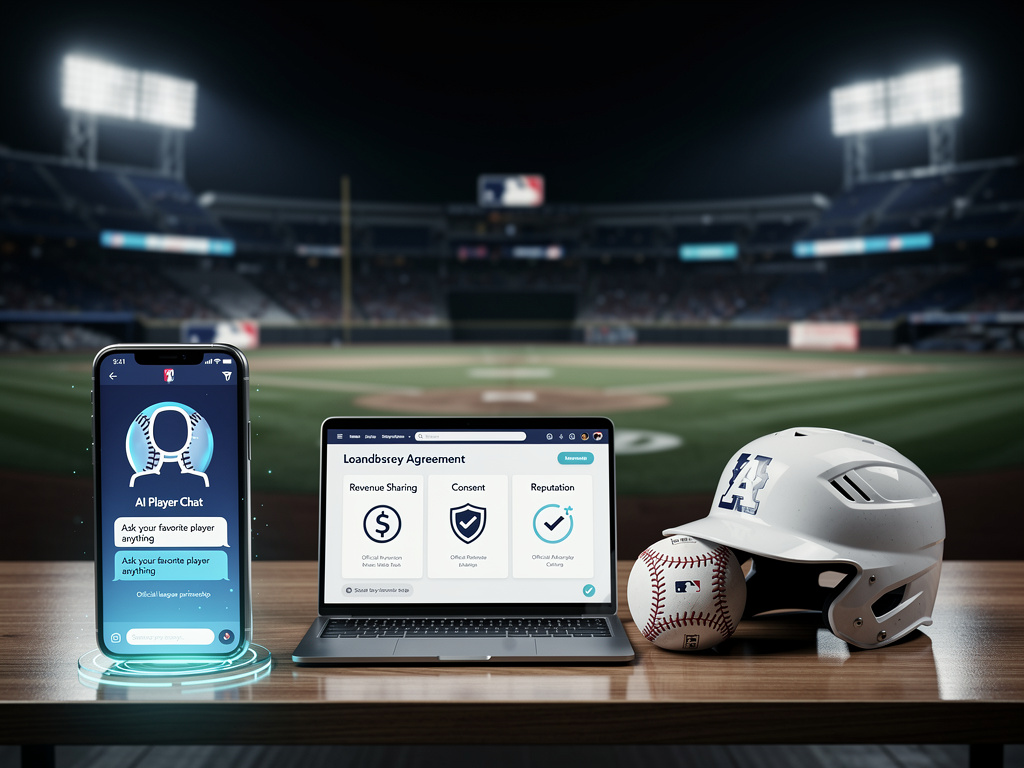
In a move that signals a new frontier for athlete compensation and digital rights, Major League Baseball players have struck a groundbreaking agreement that will allow their likenesses, voices, and personalities to be transformed into artificial intelligence characters for fan interaction. The deal, negotiated between the MLB Players Association and the league, represents one of the most significant collective bargaining developments in professional sports in years — and one that could set the template for how athletes across all leagues monetize their identities in an era of rapidly advancing AI technology.
The agreement, first reported by ABC News, will enable fans to engage in AI-powered conversations with digital versions of their favorite players through chatbot-style interfaces. These AI characters will be designed to reflect the personalities, speech patterns, and baseball knowledge of real MLB players, offering a new form of fan engagement that goes far beyond traditional autograph signings and social media interactions. The deal ensures that players will be compensated for the commercial use of their digital likenesses — a critical sticking point that has animated labor discussions across entertainment and sports industries.
How the Deal Was Structured and What Players Stand to Gain
At the heart of the agreement is a revenue-sharing framework that guarantees MLB players a cut of the income generated by their AI counterparts. According to reporting by ABC News, the MLB Players Association played a central role in negotiating terms that protect individual player rights while allowing the league to explore new technology-driven revenue streams. The structure is designed to ensure that no player’s likeness is used without consent, and that compensation flows directly to the athletes whose identities fuel the AI products.
The deal also includes guardrails on how AI characters can behave and what they can say. Players and their representatives were reportedly insistent that the digital versions of athletes not be used to make controversial statements, endorse products without explicit permission, or behave in ways that could damage a player’s reputation. These protections reflect lessons learned from the entertainment industry, where actors and musicians have fought bitterly over unauthorized AI reproductions of their voices and images. The Screen Actors Guild’s 2023 strike, which lasted 118 days, was driven in large part by concerns over AI replication — a precedent that MLB players and their union clearly took to heart.
A New Era of Fan Engagement — or a Pandora’s Box?
For Major League Baseball, the AI initiative is part of a broader strategy to attract younger fans and deepen engagement with a demographic that increasingly consumes content through interactive digital platforms rather than traditional broadcasts. The league has been investing heavily in technology partnerships in recent years, from its Statcast analytics system to augmented reality experiences in ballparks. AI-powered player chatbots represent a logical next step — one that could allow a teenager in Tokyo or a retiree in Tampa to have a simulated conversation with Shohei Ohtani or Aaron Judge at any hour of the day.
But the initiative also raises profound questions about authenticity, consent, and the boundaries of digital identity. Critics have pointed out that even the most sophisticated AI chatbot is, at best, an approximation of a real person — and at worst, a tool that could mislead fans into believing they are interacting with the actual athlete. Sports ethicists and digital rights advocates have urged the league to implement clear disclosures so that users understand they are chatting with an AI construct, not a human being. The potential for misuse, whether through deepfake-style manipulation or unauthorized third-party applications, remains a significant concern that the agreement will need to address on an ongoing basis.
The MLBPA’s Calculated Bet on Proactive Negotiation
The MLB Players Association’s decision to negotiate proactively on AI rights, rather than wait for disputes to arise, marks a strategic departure from the reactive posture that has characterized many labor organizations’ approach to emerging technology. Tony Clark, the MLBPA’s executive director, has been vocal in recent years about the need for players to assert control over their digital identities before corporations and technology companies establish precedents that are difficult to reverse. The union’s approach in this case was to get ahead of the curve — to set terms before AI fan engagement products were launched, rather than litigating after the fact.
This proactive stance is particularly notable given the history of labor relations in baseball, which has been marked by some of the most contentious strikes and lockouts in American sports history. The 1994-95 players’ strike, which canceled the World Series, and the 2021-22 lockout, which delayed the start of the regular season, are reminders that the relationship between players and owners is often adversarial. The AI agreement, by contrast, appears to represent a rare instance of genuine collaboration — a recognition by both sides that the commercial potential of AI-driven fan engagement is large enough to share, and that getting the framework right from the beginning serves everyone’s interests.
How Other Leagues and Sports Are Watching
The implications of the MLB deal extend well beyond baseball. Leaders at the NFL Players Association, the NBA Players Association, and the National Hockey League Players’ Association are all closely monitoring the terms of the agreement, according to industry sources. The question of how athletes’ digital likenesses should be compensated in the age of AI is one that every major professional sports league will eventually have to answer, and MLB’s framework could serve as a blueprint — or a cautionary tale.
In the NFL, for instance, the use of player likenesses in video games was the subject of years of litigation following the landmark O’Bannon v. NCAA case and the EA Sports controversy, in which former college and professional athletes sued over the unauthorized use of their images. The rise of generative AI adds entirely new dimensions to these disputes, because the technology can create interactive, conversational versions of athletes that are far more immersive — and potentially more commercially valuable — than a static image in a video game. The MLB deal’s emphasis on consent, compensation, and reputational safeguards is likely to influence how these conversations unfold in other leagues.
The Technology Behind the Digital Dugout
While the specific technology partners involved in building MLB’s AI player chatbots have not been fully disclosed, the project is expected to leverage large language models similar to those developed by companies like OpenAI, Google, and Anthropic. These models can be fine-tuned on player-specific data — including interviews, press conferences, social media posts, and biographical information — to create conversational agents that mimic a player’s tone, vocabulary, and areas of expertise. The challenge, as AI researchers have noted, is ensuring that these models do not “hallucinate” — that is, generate false or misleading statements that could be attributed to the real player.
To mitigate this risk, the agreement reportedly includes provisions for ongoing human oversight and content moderation. Players or their designated representatives will have the ability to review and flag AI-generated content that deviates from acceptable parameters. This hybrid approach — combining the scalability of AI with the accountability of human review — reflects a growing consensus in the technology industry that fully autonomous AI systems are not yet reliable enough to operate without guardrails, especially when real people’s reputations are at stake.
What This Means for the Business of Baseball
From a financial perspective, the AI deal opens up new revenue channels that could become increasingly significant as the technology matures. Subscription-based access to premium AI player interactions, sponsored conversations, and integration with fantasy baseball platforms are all possibilities that league executives have discussed internally. For a sport that has struggled in recent years to compete with the NFL and NBA for younger fans’ attention, AI-powered engagement tools could provide a differentiated offering that leverages baseball’s deep statistical tradition and its roster of charismatic stars.
The deal also has implications for player marketing and endorsement income. In an era when social media followings and personal brands drive a growing share of athlete earnings, an AI chatbot that faithfully represents a player’s personality could function as a 24/7 brand ambassador — engaging fans, promoting merchandise, and even providing personalized content at a scale that no human could match. For marquee players, this could mean a significant new income stream; for lesser-known players, it could provide a platform for building the kind of public profile that leads to endorsement deals and post-career opportunities.
The Broader Reckoning Over AI and Human Identity
Ultimately, the MLB players’ AI deal is about more than baseball. It is a microcosm of a much larger reckoning taking place across industries — from Hollywood to journalism to the legal profession — over who owns the rights to a person’s digital identity and how those rights should be valued. The agreement’s emphasis on consent, compensation, and control reflects a growing recognition that AI’s ability to replicate human likenesses and personalities is not merely a technological novelty but a fundamental challenge to existing frameworks of intellectual property and labor rights.
As generative AI continues to advance at a breakneck pace, the deals struck today will shape the norms and expectations of tomorrow. MLB and its players have taken a significant step by negotiating terms before the technology is fully deployed — a model that other industries would do well to emulate. Whether the agreement proves to be a fair and durable framework, or merely the opening salvo in a longer battle over digital identity rights, will depend on how faithfully both sides honor its spirit as the technology evolves. For now, the players have made clear that their likenesses belong to them — and that any AI version of a ballplayer had better come with a paycheck attached.


 WebProNews is an iEntry Publication