
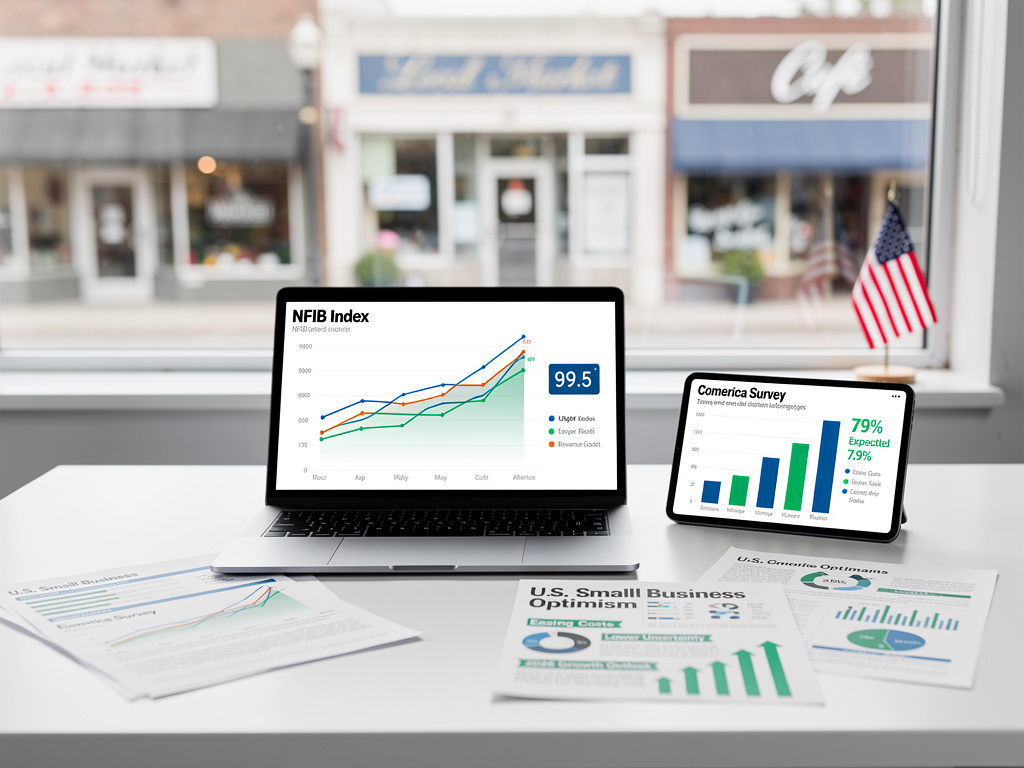
Small-business owners across the U.S. capped 2025 with rising confidence, defying persistent talk of economic headwinds. Multiple indexes point to improved sentiment as cost burdens lighten and uncertainty recedes, setting a steady course into the new year.
The National Federation of Independent Business Small Business Optimism Index climbed 0.5 points to 99.5 in December, marking its highest level since August and staying above the 52-year average of 98, according to the NFIB. This second straight monthly gain stemmed largely from owners expecting better conditions, with the net share jumping 9 points to 24%, the first rise since July.
The NFIB Uncertainty Index plunged 7 points to 84, its lowest since June 2024. “2025 ended with a further increase in small business optimism,” said NFIB Chief Economist Bill Dunkelberg. “While Main Street business owners remain concerned about taxes, they anticipate favorable economic conditions in 2026 due to waning cost pressures, easing labor challenges, and an increase in capital investments.”
Indexes Signal Broad Uptick
Business health ratings reflected a shift toward stability: 54% deemed conditions good, up 1 point, while 34% called them fair, up 4 points. Excellent ratings dipped to 9%, and poor fell to 3%. Taxes topped problems at 20%, the highest since May 2021, followed by labor quality at 19% and inflation at 12%.
Comerica Bank’s Small Business Pulse Index captured similar buoyancy. A survey of over 1,000 owners found 80% somewhat or very confident for the next 12 months, with 79% forecasting revenue growth averaging 7.9%, per the PR Newswire release. Technology firms led at 93% confidence, planning $187,000 in capital spending on average, while 57% overall eyed investments averaging $109,000.
“Small businesses have navigated a year filled with challenges, from tariffs and inflation to a prolonged government shutdown – yet their optimism remains unwavering,” said Larry Franco, Comerica Bank executive vice president and national director of retail and small business banking.
Sales and Employment Hold Firm
Fiserv’s Small Business Index, drawing from 2 million firms, showed December sales edging up from November amid holiday resilience. “December’s sales gains show the resilience of small businesses during a competitive holiday season,” said Prasanna Dhore, Fiserv chief data officer, as reported in The Guardian. Consumers prioritized essentials amid cost strains, yielding modest growth.
Intuit’s QuickBooks index, based on over 420,000 businesses, reported small-business employment rising 0.04% or 5,500 jobs in December, upticks in eight of 12 sectors and all eight regions. Revenue per business climbed 1.27% to $48,270 in real terms, advancing in 10 sectors and all regions, according to the Intuit report.
NFIB data underscored labor dynamics: 33% cited unfilled openings, steady but above the 24% historical norm, with 17% planning hires, down slightly. Compensation raises hit a net 31%, up 5 points.
Policy Shadows Linger
Capital outlays strengthened, with 56% reporting recent spending, up 4 points, including more on vehicles and facilities. Plans for future spending eased to 19%. Inventory reports improved to the year’s best, net -1% gains.
Yet challenges persist. Comerica noted inflation at 23% of top concerns, tariffs at 14%, with 42% reporting negative tariff effects, mostly manufacturing and retail. “Most expecting tariff impacts to persist or worsen in 2026,” per the survey. NFIB’s Holly Wade highlighted lingering tariff uncertainty but easing inflation, calling the 99.5 reading a “comfortable position” for moderate growth, as quoted in The National Desk.
“There were a few trips… related to specifically tariffs. But once they were able to get a grasp… they moved forward, supported largely by consumer spending,” Wade said. She anticipates “cruising altitude” in 2026.
Sector and Regional Variations
Sector splits emerged: Intuit saw professional services add 3,600 jobs, agriculture fastest at 0.64%. Comerica found healthcare at 90% confidence, real estate lowest at 67%. Regionally, Intuit employment grew quickest in Rocky Mountains, revenue in Plains; Comerica confidence peaked South at 83%.
NFIB owners reported net -8% higher nominal sales, below average, but expectations for real sales held. Price hikes plans dropped, though remained elevated versus history amid profit volatility.
Recent Federal Reserve rate cuts aided over half of Comerica respondents. Gene Marks noted in The Guardian that while agriculture, retailers, truckers and services face hurdles like tariffs and regulations, the 33 million small firms overall showed resilience.
Investment and Hiring Outlook
NFIB capital spending rose despite softer plans, signaling confidence in stability. “The drop in the uncertainty index showed more small businesses have a better feel for the environment they’re operating in, which is favorable to investments,” per The National Desk.
X posts echoed the trend. Infrastructure Capital Advisors highlighted the NFIB rise to 99.5 above average, while NRCC tied it to pro-growth policies. Apex Macro Research noted optimism tied to markets but flagged softening labor and capex plans.
With 64% still facing supply chain issues unchanged, and taxes surging as top worry, owners brace for policy tests. Yet data from NFIB, Comerica, Fiserv and Intuit paints a picture of adaptation, modest expansion and forward-looking poise among America’s small-business engine.


 WebProNews is an iEntry Publication