
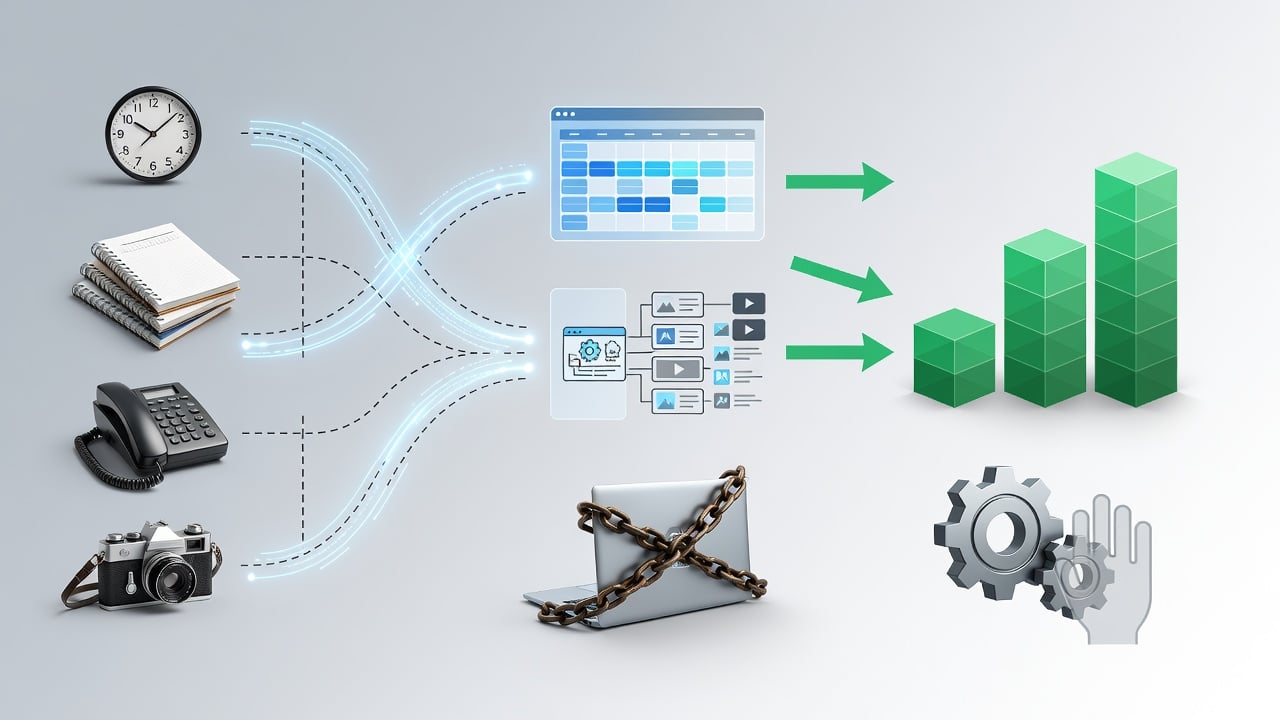
Small businesses keep adopting artificial intelligence tools at a steady clip. The payoff shows up in hours saved on emails, schedules, and reports rather than wholesale operational overhauls.
According to a whitepaper from the U.S. Chamber of Commerce Foundation and Hiring Our Heroes, owners focus on narrow problems first. They test scheduling aids, safety monitors, and basic content generators. Early results include fewer errors and faster turnaround on routine work. U.S. Chamber of Commerce
Half of workers at small businesses already use AI on the job. Most apply it to draft messages, gather research, or handle creative tasks. Just 6 percent describe their use as full workflow automation with little human oversight. The pattern points to augmentation, not replacement. U.S. Chamber of Commerce Foundation
One survey from Goldman Sachs found 76 percent of small businesses currently use AI. Of those, 93 percent report a positive impact, led by gains in efficiency and productivity. Yet only 14 percent have folded the tools into core operations. The gap reflects practical hurdles more than outright rejection. Goldman Sachs
Recent data from JPMorgan Chase Institute shows newer firms reach meaningful adoption faster than older ones. The 2025 cohort hit a 10 percent adoption threshold in roughly six months. Earlier cohorts took years. Lower entry costs and easier cloud access drive the shift. JPMorgan Chase Institute
Constant Contact reports that 54 percent of small businesses already deploy AI marketing tools. Another 27 percent plan to start this year. That trajectory points toward more than four in five users by year-end. Time savings on campaign creation reach up to 23 percent in platform measurements. Constant Contact
Census Bureau tracking places overall business AI use between 17 and 20 percent through early 2026. Larger firms lead, with 37 percent of those with 250 or more employees reporting use. Firms with fewer than 20 employees sit below 20 percent. The divide narrows slowly as tools simplify. U.S. Census Bureau
Barriers remain consistent across reports. Cost concerns, unclear returns, fragmented data, and limited training top the list. Workforce skills lag most noticeably in labor-intensive sectors such as construction and manufacturing. Owners cite privacy risks and tool-selection uncertainty as additional friction points.
Successful users follow a narrow playbook. They pick one pain point, measure the result, then expand. A home-services firm might start with AI-assisted scheduling before adding predictive maintenance alerts. A retailer could begin with email drafting and move to inventory forecasting. Each step builds internal confidence and data quality.
Employee-driven adoption appears frequently. About one in five workers in the Chamber Foundation survey say usage began with individual exploration rather than top-down mandates. That bottom-up pattern matches earlier waves of consumer technology entering workplaces. Employers who later provide guidance see higher sustained use.
Training programs are expanding in response. The U.S. Chamber Foundation partners with local chambers to reach 10,000 small businesses with basic AI instruction. Google.org funding supports similar efforts aimed at 40,000 owners. Hands-on sessions focus on prompt writing, tool selection, and risk awareness rather than technical coding.
Time savings translate into varied outcomes. Fifty-nine percent of AI users in the Chamber Foundation poll reinvest gains into more or higher-quality work. Others reduce overtime or create space for planning. Productivity metrics improve, yet employment levels show little net change in most tracked surveys. NFIB data indicates 98 percent of AI-using small employers report no shift in headcount.
Revenue signals appear positive where measured. Goldman Sachs respondents anticipate gains, with 67 percent expecting higher revenue. Broader Chamber findings link technology adoption, including AI, to workforce growth in 82 percent of cases. The connection runs through capacity expansion rather than headcount reduction.
Blue-collar sectors present distinct opportunities. AI safety monitoring on job sites and equipment-predictive alerts reduce downtime without requiring massive infrastructure changes. Administrative tools free field crews for billable work. Data fragmentation still limits deeper integration in these environments.
Policy discussions increasingly center on support rather than restriction. Proposals include expanded training access, clearer data standards, and incentives for responsible pilots. Small-business advocates emphasize that uneven adoption risks widening competitive gaps between tech-ready firms and others.
Real-world examples surface regularly. Apparel companies use AI for product descriptions and customer queries on lean teams. Pet-product makers apply it to photography and inventory signals. The common thread is incremental application tied to existing workflows.
Looking ahead, adoption curves suggest continued acceleration among smaller firms. Newer businesses enter with lower technical debt and higher comfort with cloud services. The question shifts from whether to adopt toward which narrow applications deliver measurable returns first.
Owners who treat AI as another operational lever rather than a standalone project appear best positioned. They track hours saved, error rates, and customer response times. Those metrics guide the next targeted test. The pattern repeats across industries and firm sizes where results hold steady.


 WebProNews is an iEntry Publication