
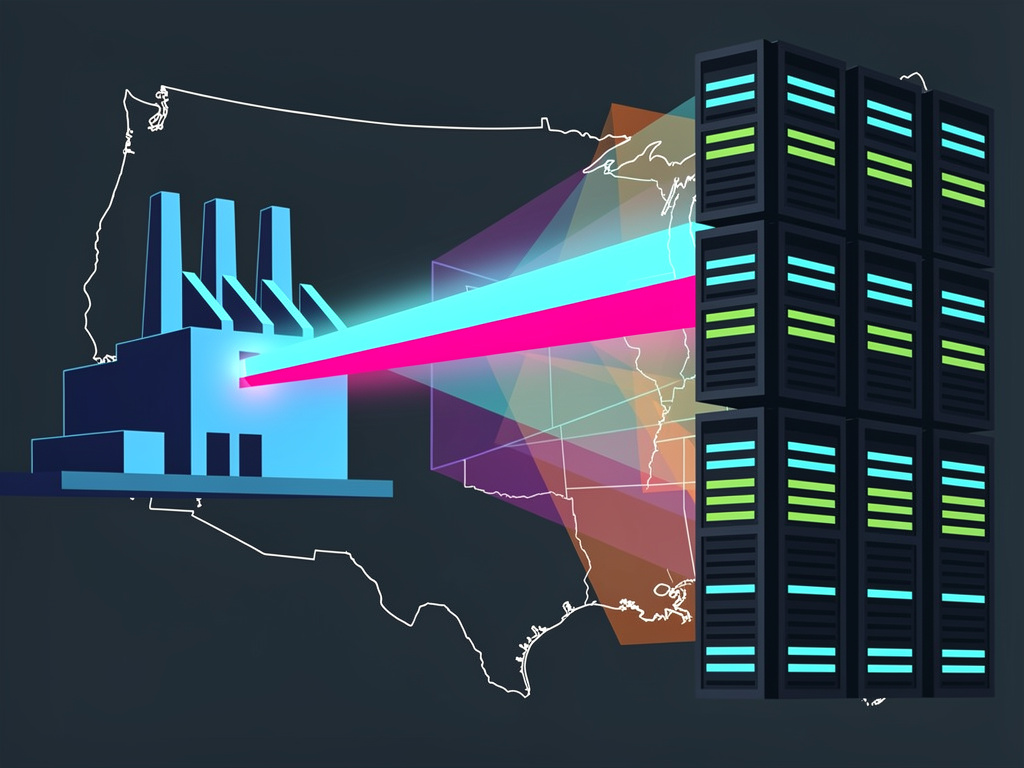
Lumentum Holdings is about to pour more than $1 billion into a new U.S. manufacturing facility dedicated to producing lasers and optical components for artificial intelligence data centers — a move that signals just how dramatically the demand for high-speed optical interconnects has reshaped the fortunes of a company that, not long ago, was best known for supplying sensors to smartphone makers.
The announcement, first reported by Reuters via MSN, confirms that Nvidia will be among the facility’s customers. That detail alone tells you everything about where the optical networking industry is headed. When the world’s most valuable chipmaker needs your product to complete its AI infrastructure vision, you build the factory.
Lumentum CEO Alan Lowe didn’t mince words. “The demand signals we’re seeing from hyperscalers and AI infrastructure builders are unlike anything in the history of our industry,” he said, according to Reuters. The new plant will manufacture vertical-cavity surface-emitting lasers (VCSELs), indium phosphide lasers, and advanced photonic components — the kinds of parts that move data at the speed of light inside and between the massive GPU clusters powering AI training and inference workloads.
The facility’s location hasn’t been publicly finalized, though the company has indicated it will be situated in the United States, aligning with broader industry and government efforts to reshore critical technology manufacturing. Lumentum is expected to benefit from incentives under the CHIPS and Science Act, which has already funneled billions toward domestic semiconductor and advanced component production. The timing isn’t accidental.
To understand why a laser company is suddenly at the center of the AI infrastructure buildout, you need to understand the bottleneck. GPUs from Nvidia, AMD, and others have grown enormously powerful. But connecting thousands of them inside a single data center — and linking data centers to each other — requires optical transceivers and the laser components inside them to operate at speeds of 800 gigabits per second and beyond. Copper cables can’t do it. Not at these distances, not at these speeds. Photonics can.
And the numbers are staggering. Industry analysts estimate that the global market for optical transceivers used in data centers will exceed $20 billion by 2028, up from roughly $7 billion in 2023. Every new AI cluster deployed by Microsoft, Google, Amazon, or Meta requires thousands of optical modules. Each module contains lasers. Lumentum makes those lasers.
Nvidia’s role as a confirmed customer adds a new dimension. The GPU giant has been steadily expanding its networking ambitions since acquiring Mellanox Technologies in 2020 for $7 billion. Its InfiniBand and Spectrum-X networking platforms already dominate AI data center connectivity. But Nvidia doesn’t make its own optical components — it relies on suppliers like Lumentum, Coherent, and II-VI (now part of Coherent) to provide the photonic building blocks. Securing a domestic supply of these components, particularly as geopolitical tensions with China complicate global supply chains, is a strategic priority for Nvidia and its hyperscaler customers alike.
Lumentum’s stock has been on a tear. Shares climbed more than 15% in the trading sessions surrounding the announcement, reflecting investor enthusiasm for a company that appears to be transitioning from a diversified optical products maker into a focused AI infrastructure supplier. The stock had already roughly doubled over the past year as Wall Street warmed to the AI-driven demand story in optical networking.
But this isn’t just a Lumentum story. It’s an industry-wide phenomenon.
Coherent Corp., Lumentum’s chief rival, has seen its own shares surge on similar AI tailwinds. Broadcom, which designs optical transceiver chips, reported record demand from hyperscalers in its most recent earnings call. Ciena, which makes optical networking systems, has flagged accelerating orders tied to AI workloads. The entire optical supply chain is being pulled forward by the insatiable appetite for faster, denser data center interconnects.
The $1 billion-plus investment also reflects something less discussed but equally important: the sheer difficulty of manufacturing these components. Indium phosphide lasers, for example, are fabricated on specialized semiconductor wafers using processes that bear little resemblance to conventional silicon chip manufacturing. The yields are lower. The equipment is more specialized. The workforce is smaller and harder to train. Building a new facility from scratch isn’t like standing up another DRAM fab — it requires deep expertise in III-V compound semiconductors, epitaxial growth, and precision photonic packaging.
Lumentum has that expertise. The company traces its lineage to JDS Uniphase, the optical networking giant of the late 1990s telecom boom. It was spun off from Viavi Solutions in 2015 and has since built a formidable portfolio of photonic products spanning telecommunications, 3D sensing, and industrial lasers. The 3D sensing business — which supplied components for Apple’s Face ID — was once the company’s growth engine. That business has since plateaued. AI has taken its place.
The strategic pivot is evident in Lumentum’s recent financial results. In its most recent quarterly earnings, the company reported that its cloud and networking segment grew more than 40% year over year, driven almost entirely by demand for data center optical components. Meanwhile, its industrial and consumer segments were flat or declining. Management has made clear that capital allocation will increasingly favor the data center business.
So what does the new factory actually produce, and why does it matter?
VCSELs — vertical-cavity surface-emitting lasers — are tiny semiconductor lasers that emit light perpendicular to the chip surface. They’re used in short-reach optical connections inside data centers, typically spanning distances of a few hundred meters or less. They’re cheap to manufacture in volume, test easily on-wafer, and consume relatively little power. For the thousands of intra-rack and inter-rack connections inside an AI cluster, VCSELs are the workhorse.
Indium phosphide lasers, by contrast, operate at longer wavelengths and are used for connections spanning longer distances — between buildings, between data centers, or across metro and long-haul networks. They’re more expensive and harder to make, but they’re essential for the high-capacity links that tie distributed AI infrastructure together. As AI workloads increasingly span multiple data centers — a trend driven by the sheer scale of frontier model training — demand for these longer-reach lasers is accelerating.
Lumentum also manufactures coherent optical components, which use advanced modulation techniques to pack more data onto a single optical fiber. These are critical for the 400G, 800G, and emerging 1.6T transceiver modules that hyperscalers are deploying at scale. The new facility is expected to produce components across all of these categories, giving Lumentum a vertically integrated domestic supply chain for AI optical infrastructure.
The geopolitical angle can’t be ignored. China has been aggressively building its own optical component manufacturing capacity, with companies like Hisense Broadband, Eoptolink, and Source Photonics expanding production. U.S. export controls on advanced AI chips have heightened awareness in Washington about the vulnerability of optical supply chains. If you can’t ship the GPUs without the optical links to connect them, then optical components are just as strategically important as the chips themselves.
The Biden administration’s CHIPS Act recognized this, and the incoming policy environment appears likely to continue supporting domestic photonics manufacturing. Lumentum’s investment fits neatly into this framework, and the company is expected to apply for federal subsidies to offset construction and equipment costs. Whether those subsidies materialize — and at what scale — will significantly affect the project’s economics.
There are risks. A billion-dollar factory takes years to build and ramp. If AI spending cycles prove more volatile than current projections suggest, Lumentum could find itself with expensive excess capacity. The optical networking industry has been through this before — the telecom bust of 2001 left a trail of shuttered fabs and bankrupt companies. Lumentum’s own corporate ancestor, JDS Uniphase, became the poster child for that era’s excess, recording a $50 billion goodwill write-down that remains one of the largest in corporate history.
Management insists this cycle is different. The demand drivers are broader, they argue — not just telecom carriers building out fiber networks, but the world’s largest and most well-capitalized technology companies building AI infrastructure they view as existential to their businesses. Microsoft alone has signaled plans to spend more than $80 billion on data center infrastructure in fiscal 2025. Google, Amazon, and Meta have each announced capital expenditure plans in the $50 billion range. A meaningful share of that spending flows to optical components.
And the technology roadmap supports sustained demand growth. The industry is currently transitioning from 400G to 800G optical modules, with 1.6T modules expected to enter volume production by 2026. Each generational jump requires new laser designs, higher-bandwidth components, and greater manufacturing precision. Lumentum’s new facility is being designed to support multiple product generations, giving it a runway that extends well into the next decade.
Nvidia’s involvement as a customer adds credibility but also concentration risk. If Nvidia’s networking business stumbles — or if a competitor like Broadcom or Marvell captures a larger share of AI networking silicon — Lumentum’s revenue projections could shift. The company has said it’s diversifying its customer base across multiple hyperscalers and system integrators, but Nvidia’s prominence in the announcement suggests it will be a cornerstone account.
For the optical components industry, Lumentum’s factory announcement marks a turning point. For decades, the center of gravity in photonic component manufacturing has been shifting toward Asia — first Japan, then China. This investment represents a deliberate effort to pull some of that capacity back to the United States, backed by both commercial demand and government policy. Whether it succeeds will depend on execution, market timing, and the durability of the AI infrastructure supercycle that’s currently reshaping the technology industry from the ground up.
One thing is clear. The lasers that move data at the speed of light inside AI data centers have become as strategically important as the chips that process it. And Lumentum is betting a billion dollars that the world is going to need a lot more of them.


 WebProNews is an iEntry Publication