
Abingdon, England — Electric motors devour nearly half the planet’s electricity. Most run inefficiently. Factories accept it. Engineers tweak parameters once during commissioning. Then conditions change. Loads vary. Wear sets in. Energy slips away unnoticed.
Luffy AI thinks this acceptance ends now. The Oxfordshire startup just closed a £8.1 million Series A. The Next Web reported the round Tuesday. BGF led. MIG Capital, Bow Capital, Chrysalix, Momenta and UKI2S joined. The cash moves pilots into real commercial deployments. No valuation disclosed. Revenue still under wraps.
Founders Matthew Carr and Alex Meakins once worked as nuclear physicists at the UK Atomic Energy Authority. They spun the company out of the Culham Campus. Fusion research happens there. Not motor controllers. Yet the location fits. Both men understand complex physical systems. They saw AI’s blind spot.
The Gap Conventional AI Cannot Fill
Chatbots and image generators feast on mountains of data. They demand cloud racks and constant connections. Factory floors reject that model. Pumps sit in remote plants. Conveyors cannot phone home every cycle. A single variable-frequency drive might control a fan whose load shifts with temperature, dust buildup or process tweaks. Traditional controllers stay rigid.
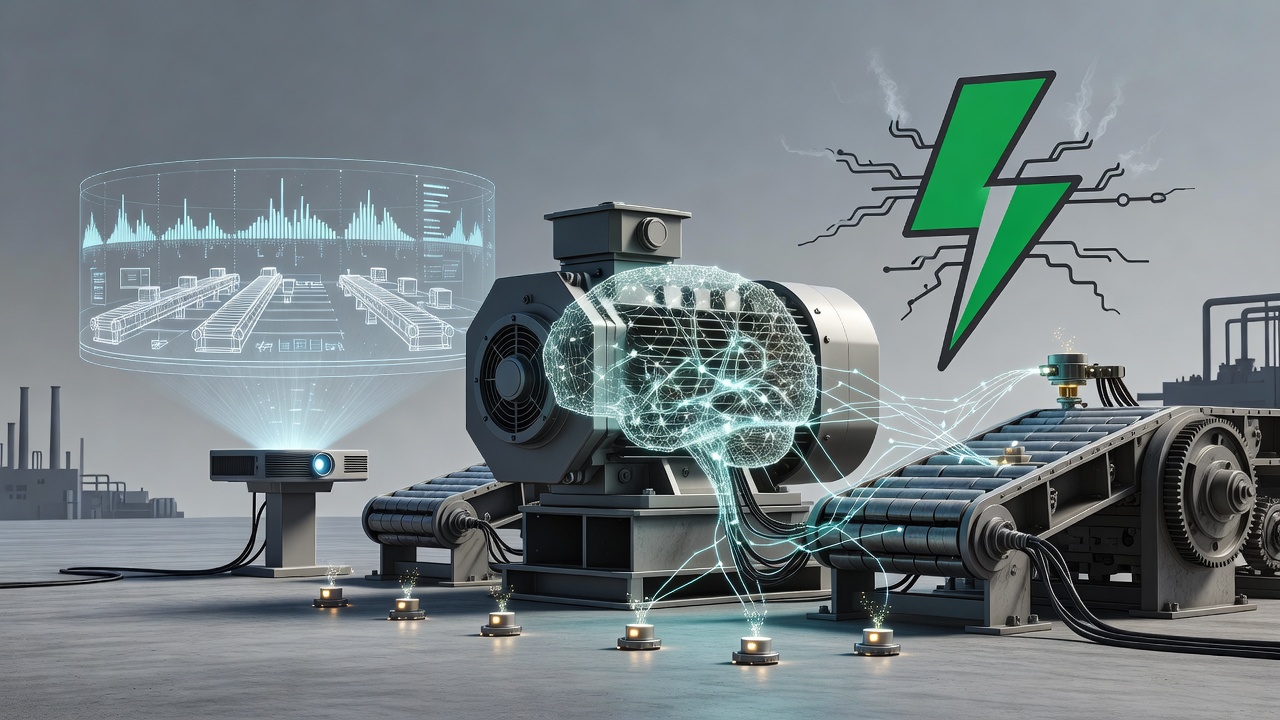
Luffy attacks the mismatch head-on. Its sparse neural networks train first inside simulation. No need for gigantic real-world datasets. Then the model lands on the hardware itself. Live feedback refines it continuously. The company claims up to 400 times greater efficiency than standard deep learning. Small enough for edge deployment. No cloud retraining required.
“AI has been transformative for language and image generation, but has yet to make a substantial impact in industry beyond predictive maintenance and dashboards,” said Carr, Luffy’s co-founder and chief executive. Factories and motors need AI that is “small, fast and adaptive in real time,” rather than cloud-dependent and hungry for data and compute.
Short. Direct. The quote lands like a challenge to the entire industrial automation sector. And the numbers back the bravado. Half the world’s electricity flows through motors. Most waste some portion of it. Even modest gains multiply fast across thousands of installations.
Investors heard the math. Kate Ronayne, early-stage investor at BGF, called the approach one that “disrupting an industry norm that has stood for 100 years” by embedding specialised AI directly into physical systems. She highlighted reduced dependence on specialist engineers for commissioning.
Dr Nicolas Rose-André at MIG Capital echoed the efficiency angle. “Luffy does more with far less data and compute, which is precisely what makes AI workable inside physical machines.” He pointed straight at electricity consumption by motors as the prize.
Earlier coverage filled in history. EU-Startups noted the same round, framing it as fuel for the commercialisation pipeline. FinSMEs detailed the neuroplastic focus on real-time adaptive control. The Times ran a founder-led piece titled “We’ve raised £8m to make industrial motors more energy efficient.” Momentum built quickly this week.
But Luffy’s story stretches back further. UK Innovation Science Seed Fund backed the pair as early as 2019 with small cheques and grants. Total UKI2S investment reached £965,000 across rounds. The firm introduced corporate partners and helped secure Innovate UK funding. That patience now pays off.
The technology draws on biology. Neuroplasticity. The brain rewires itself with experience. Luffy bakes similar self-tuning into its networks. Real-time feedback from sensors lets the controller adjust gains, compensate for drift, even handle unexpected disturbances. Traditional proportional-integral-derivative loops cannot match that adaptability without manual recalibration.
Tests already target motor drives, pumps, fans and conveyors. Plug-and-play installation. The motor learns its own load profile on site. Commissioning shrinks. Energy use drops. Performance climbs. No PhD engineer required on every job.
Yet the ambition stretches beyond motors. Carr and team see the same stack moving into robotics, drones, thermal processes and other embodied control tasks. A YouTube video on an AI flight controller for UAVs shows early work on fault tolerance and robustness against wind or system failures. The controller adapts without massive retraining.
LinkedIn updates from the company mention conversations at SPS 2025 about adaptive control across motors, furnaces, robotics and UAVs. Lightweight neural controllers running at the edge. The message repeats: data and compute constraints disappear when the network learns on the job.
Competitors exist in the broad industrial AI space. Siemens, ABB and Rockwell offer sophisticated drives with some learning features. But most still rely on cloud analytics or fixed models. Predictive maintenance dashboards proliferate. Real-time adaptive control inside the drive itself remains rare. Luffy bets its sparse, self-refining architecture creates a defensible edge.
Challenges remain. A self-tuning motor must prove itself on noisy factory floors, not just in simulation. Hardware constraints bite. Certification for safety-critical applications takes time. Partnerships with large industrial brands will decide success. The fresh capital targets exactly those steps.
Carr’s physics background shows. Nuclear reactors demand precision under uncertainty. So do aging conveyor systems in food plants or variable-speed pumps in water treatment. The same mindset applies. Model the physics. Add intelligence that updates itself. Accept the world changes constantly.
Industry stands at a pivot. Decarbonization pressures mount. Energy prices swing. Labor shortages hit commissioning teams. A controller that installs itself, tunes itself and keeps tuning as conditions evolve suddenly looks valuable. Very valuable.
Luffy still calls its offering neuroplastic AI. The term captures the core idea without hype. Networks that change structure and weights in response to experience. Not static. Not brittle. Adaptive in the harshest sense.
Whether the approach scales depends on execution. Pilots must convert. Hardware partners must integrate. Customers must trust black-box adaptation with their biggest energy consumers. But the problem is real. The opportunity is massive. And the funding gives the team runway to test its claims where it matters most. On the factory floor.
So the motors keep spinning. For now, many do so wastefully. Luffy AI wants to change the equation. One self-tuning drive at a time.


 WebProNews is an iEntry Publication