
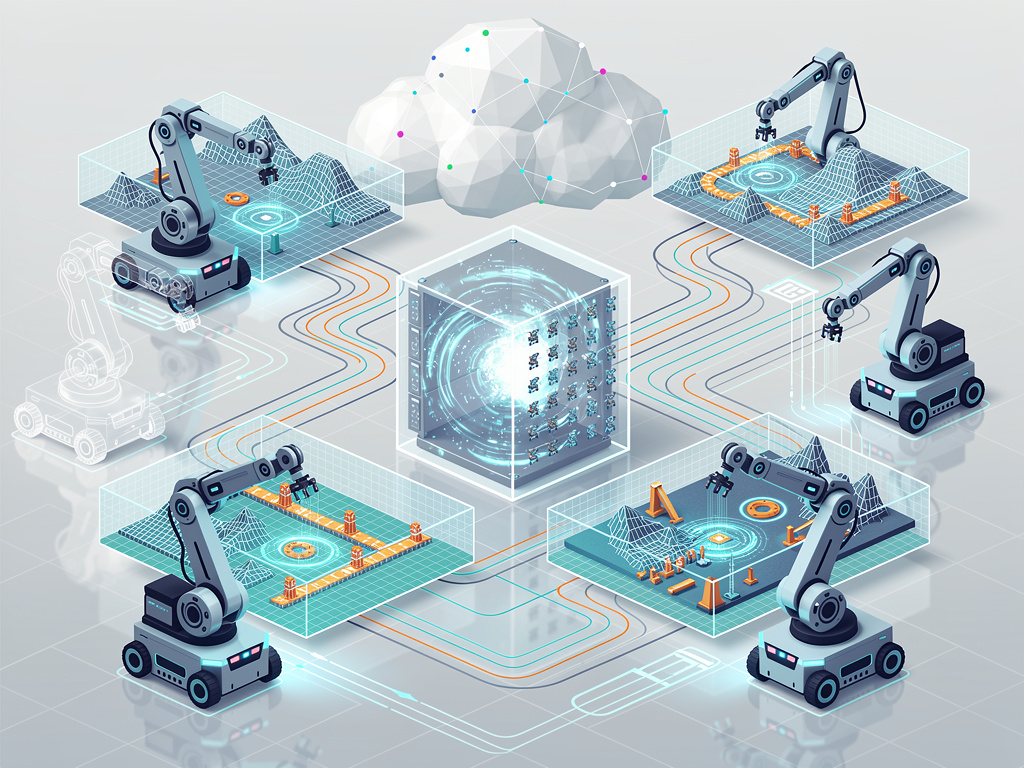
A million trials. Zero broken robots. That simple promise sits at the heart of Lucky Robots, a small Austin-based team turning simulation into the primary training ground for the next wave of physical AI.
The company has released Lucky Engine, a simulation platform built from scratch specifically for robotics. Unlike general-purpose tools such as Unity or Unreal, this one runs on MuJoCo physics with Vulkan rendering and outputs data in LeRobot 3.0 format. Developers script scenes in C# or drive experiments through a Python SDK and gRPC API. The result? Thousands of randomized episodes generated overnight on a desktop or scaled in the cloud through LuckyHub.
The Simulation Bottleneck in Robotics Development
Real robots remain expensive, fragile and slow to train. Teleoperation doesn’t scale. Physical labs book up quickly. Data collection for vision models or manipulation policies takes months and risks hardware damage. Lucky Robots attacks this problem directly.
Its engine creates virtual worlds where a Unitree G1 humanoid can grasp cups, open fridges or fly drones millions of times before ever touching hardware. The physics stay accurate enough for sim-to-real transfer. The renderer produces camera feeds close to real sensors. Every run logs labeled episodes — camera frames, joint states, actions — ready for imitation learning or reinforcement algorithms.
And. The team didn’t stop at local software. LuckyHub extends the concept into a collaborative workspace modeled after Hugging Face but aimed at robotics teams. Projects, datasets, models and replayable episodes live together. Organizations can spin up cloud runs, review every frame of a failed grasp, then push the best policy to production. Billing starts free and scales through credits for simulation minutes and generated episodes.
Founders Devrim, Yan and Artia assembled a group heavy on game engine talent and machine learning researchers. Yan Chernikov, known online as The Cherno for his game development tutorials, serves as CTO. Advisors include Yanjie Ze, Chris Paxton and others with deep experience in robot learning. The company raised a modest pre-seed round of $200,000 from investors including Draper Associates, according to PitchBook.
Recent updates show momentum. In the past week the team announced the first public release of Lucky Engine on LinkedIn, noting it delivers exactly what they wished existed when they started. LuckyHub went live with cloud recording capabilities promised soon after. A presentation at the Humanoids Summit 2025 highlighted how the platform lets developers train without physical robots, teleoperation or complex VR setups. The YouTube recording of that talk remains available for those tracking embodied AI progress.
But the approach raises questions industry insiders have debated for years. How accurate must simulation become before policies transfer reliably to the mess of real factories, homes and streets? Lucky Robots bets that high-frequency data at 10,000 Hz, domain randomization and MuJoCo-grade contact dynamics close the gap. Early code examples show a Walker robot controlled with simple velocity commands. More complex scenes feature articulated objects — doors, drawers, grills — that actually hinge and respond to contact.
Support for existing hardware helps adoption. The engine works with Unitree G1, Hello Robot Stretch, Franka arms, drones and any robot described in MuJoCo XML. Researchers can download the engine for free for personal and academic use. Enterprise customers get custom scene building and a dedicated engineer to accelerate deployment.
This matters now. The global industrial robotics market hit record installations last year, according to the International Federation of Robotics. AI-driven autonomy stands as the top trend for 2026, with both analytical and generative systems pushing robots toward greater independence. Humanoids from Tesla, Figure, Unitree and Chinese manufacturers continue to draw investment and pilot deployments in auto plants and warehouses. Yet data scarcity remains the binding constraint.
Lucky Robots offers one answer. Generate the data first in simulation. Refine the policy there. Deploy with far less real-world fine-tuning. The platform’s compatibility with LeRobot — Hugging Face’s robot learning library — positions it inside the open-source ecosystem many teams already use.
Critics point out that no simulator has fully solved sim-to-real for complex, contact-rich tasks at scale. Isaac Sim from NVIDIA still dominates many research labs despite setup complaints the Lucky Robots team openly acknowledges. Others rely on custom engines or massive real-world fleets. The bet here is that a purpose-built game engine, tuned for physics accuracy and data output rather than visual fidelity alone, can outperform general tools while staying lightweight enough to run locally.
So far the company keeps its claims measured. No wild promises of human-level robots next quarter. Instead it focuses on practical gains — fewer broken arms, faster iteration, datasets that grow overnight instead of over months. One early metric the site highlights: zero robots dropped, bricked or broken during training.
The broader industry watches closely. Funding for humanoid and embodied AI companies surged in 2025 and continues into 2026, per reports from F-Prime Capital and others. Simulation providers that deliver usable data at scale could capture meaningful share of the infrastructure layer. Lucky Robots, still early, has positioned itself at that intersection of game technology and robot learning.
Its open roles list reflects ambition. The team seeks C++ engineers for the core engine, rendering specialists and machine learning researchers focused on perception and manipulation. Many positions allow remote work. The message is clear — they’re hiring builders who understand both rendering pipelines and policy training loops.
Whether this engine becomes the standard tool for the field or joins a crowded simulator market will depend on transfer results published by users in coming months. For now the download page stays busy and the LinkedIn updates draw engagement from robotics engineers tired of wrestling with existing options.
The robots are coming. The question is how fast they learn. Tools like Lucky Engine aim to compress years of real-world experience into weeks of simulated failure — all without a single dented chassis or emergency service call.


 WebProNews is an iEntry Publication