
Lucid Group has spent the better part of its existence proving it can build one of the most efficient electric vehicles on the planet. Now it has to prove it can make money doing it.
The Newark, California-based automaker announced a new midsize vehicle platform at its Technology and Manufacturing Day event, a strategic pivot that Chief Executive Peter Rawlinson described as the company’s clearest path to profitability. The platform will underpin a lineup of smaller, more affordable SUVs and crossovers — vehicles that compete in the fattest part of the global auto market. It’s a direct acknowledgment that the luxury sedan that made Lucid famous won’t be enough to keep it alive.
“The midsize SUV segment is the world’s largest vehicle segment,” Rawlinson told attendees at the company’s Arizona manufacturing facility, according to Ars Technica. “And it’s the segment where profitability lies for Lucid.”
That’s a remarkably frank statement from the CEO of a company that has burned through billions of dollars since going public via SPAC in 2021. Lucid delivered just over 10,000 vehicles in 2024. Tesla, by comparison, delivered roughly 1.79 million. The gap isn’t just wide — it’s existential. And Lucid knows it.
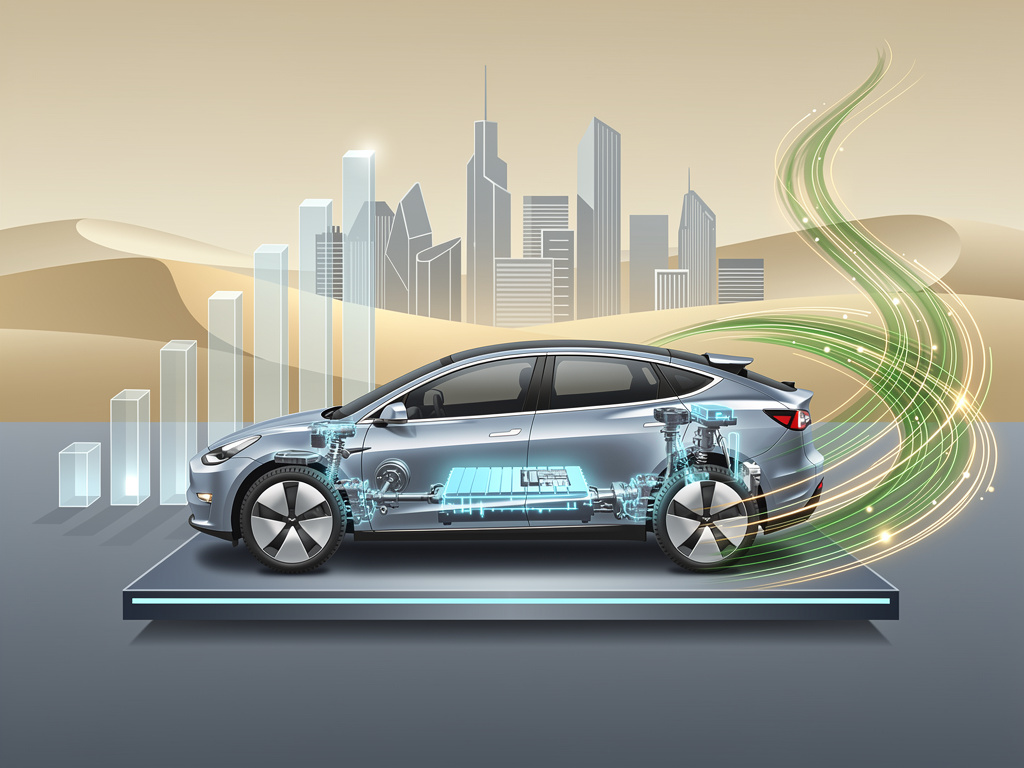
The new midsize platform represents Lucid’s second architecture. The first, which underpins the Lucid Air sedan and the larger Gravity SUV, was designed from the ground up around Lucid’s proprietary drivetrain technology. The midsize platform will do the same, but at a smaller scale and, critically, at a lower price point. Rawlinson indicated the vehicles built on this platform will start below $50,000, though specific pricing hasn’t been confirmed. The target is clear: reach the mass-affluent buyer who today drives a BMW X3, a Tesla Model Y, or a Genesis GV70.
Lucid’s entire thesis rests on drivetrain efficiency. The company’s motors, inverters, and battery packs are among the most energy-dense in the industry. The Lucid Air holds the EPA range record for production EVs at over 500 miles on a single charge. That efficiency advantage, Rawlinson argues, translates directly into cost savings — smaller battery packs can deliver competitive range, which means lower material costs per vehicle. “We can achieve the same range as competitors with a significantly smaller, lighter, and less expensive battery,” he said, per Ars Technica.
The math matters. Battery packs remain the single most expensive component in any electric vehicle, often accounting for 30 to 40 percent of total vehicle cost. If Lucid can genuinely deliver 400-plus miles of range from a pack that’s 20 or 30 percent smaller than what rivals use, the margin implications are significant. But translating engineering superiority into manufacturing efficiency at scale is a different discipline entirely — one that has humbled far larger companies.
And this is where Lucid’s relationship with the Saudi Arabian Public Investment Fund becomes both its lifeline and its strategic wildcard. PIF remains Lucid’s largest shareholder, holding approximately 60 percent of the company. Saudi Arabia has poured more than $8 billion into Lucid since 2018, and the Kingdom’s interest isn’t purely financial. It’s industrial. Saudi Arabia wants to build a domestic automotive manufacturing capability as part of its Vision 2030 diversification strategy, and Lucid is central to that ambition. The company is constructing a manufacturing plant in King Abdullah Economic City, with initial production expected to begin with the Gravity SUV.
The Saudi backing gives Lucid something most EV startups never get: time. Rivian nearly ran out of cash before securing its Volkswagen partnership. Fisker went bankrupt. Lordstown Motors collapsed. Lucid, shielded by sovereign wealth, has the runway to develop a second platform and build out manufacturing capacity without the immediate threat of insolvency. But patience, even sovereign patience, has limits.
The Gravity SUV, which began deliveries in late 2024, is Lucid’s first real volume play. Early reviews have been strong. The vehicle offers three rows of seating, over 440 miles of estimated range in its Grand Touring trim, and the kind of interior refinement that justifies its roughly $80,000 starting price. But it’s still a luxury product. The midsize platform is where Lucid must prove it can compete not just on technology, but on price, availability, and manufacturing throughput.
Rawlinson provided few specifics about timelines. He indicated that engineering work on the midsize platform is already underway, but production is likely several years away. That puts Lucid in a race against both established automakers and the Chinese EV manufacturers that are rapidly expanding into global markets with competitively priced electric SUVs and crossovers. BYD, in particular, has been aggressive — its Atto 3 and the newer Sea Lion 07 target precisely the midsize crossover segment Lucid is eyeing, and at price points that would be difficult for any Western manufacturer to match.
The competitive pressure from China is reshaping the entire industry’s calculus. European and American automakers have responded with tariffs, but tariffs are policy instruments, not permanent moats. Lucid’s argument is that its technology advantage — specifically its drivetrain efficiency — provides a structural cost advantage that doesn’t depend on trade policy. Whether that argument holds up at scale remains an open question.
There’s also the matter of the broader EV market’s trajectory. Growth in the United States slowed in 2024 compared to prior years, though absolute sales continued to climb. Hybrids surged. Consumer anxiety about charging infrastructure, resale values, and total cost of ownership persisted. The political environment has shifted, too — the current administration’s posture toward EV mandates and subsidies is markedly different from its predecessor’s. Lucid’s midsize vehicles will arrive into a market that may look quite different from today’s.
Still, the fundamentals of the SUV and crossover market are hard to argue with. These vehicles account for more than half of all new car sales in the United States. They command higher transaction prices and fatter margins than sedans. Every major automaker — from Ford to Hyundai to Volkswagen — has oriented its EV strategy around this segment. Lucid is late to articulate a midsize strategy, but the company argues that being late with superior technology beats being early with compromised products.
That’s a bet, not a certainty.
Rawlinson also discussed manufacturing improvements at the Arizona plant during the event. Lucid has been working to reduce production costs and increase line speed for the Gravity SUV. The company reported that it has improved manufacturing efficiency by roughly 30 percent year over year, though it did not provide absolute unit cost figures. Expanding the Arizona facility to accommodate midsize vehicle production — or building additional capacity, possibly in Saudi Arabia — will require substantial additional capital investment.
Lucid’s stock has been volatile, trading well below its 2021 highs. The company’s market capitalization hovers around $7 billion, a fraction of what it was at its post-SPAC peak. Investors have grown skeptical of EV startups broadly, and Lucid’s persistent losses and modest delivery numbers haven’t helped. The midsize platform announcement is designed, in part, to give the market a reason to believe in Lucid’s long-term story. Whether it succeeds will depend on execution — a word that has become the dividing line between EV companies that survive and those that don’t.
So here’s the tension at the heart of Lucid’s strategy. The company has built genuinely impressive technology. Its motors are smaller, lighter, and more efficient than almost anything else on the market. Its battery architecture delivers more range per kilowatt-hour than competitors. Its Air sedan is, by many accounts, one of the finest electric cars ever made. But none of that matters if Lucid can’t manufacture vehicles at scale, at a cost that allows positive gross margins, and sell them in sufficient volume to cover its enormous fixed costs.
The midsize platform is Lucid’s answer to that challenge. It won’t arrive tomorrow. It may not arrive for three or four years. But it represents the company’s clearest acknowledgment yet that the path to survival runs through the middle of the market — not the top.
For an industry watching dozens of EV startups flame out, Lucid’s combination of world-class technology and deep-pocketed sovereign backing makes it one of the most interesting cases still standing. Interesting, though, isn’t the same as inevitable. The midsize SUV market is enormous. So is the risk of trying to crack it.


 WebProNews is an iEntry Publication