
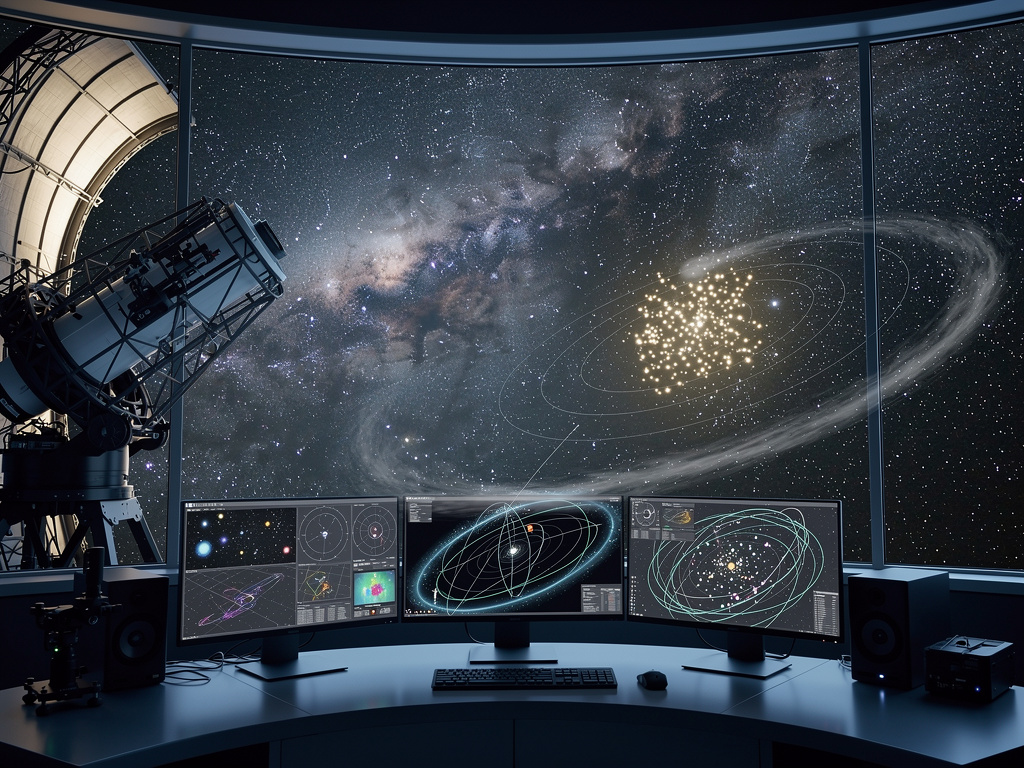
Astronomers have spotted traces of a long-lost dwarf galaxy inside our own Milky Way. They call it Loki. Twenty metal-poor stars, hiding in the galactic plane, tell the story. These ancient survivors share chemical fingerprints that scream foreign origin.
Metal-poor stars. Born from pristine gas. Mostly hydrogen and helium, with scant heavier elements. They formed soon after the Big Bang, when the universe was young. Normally, you’d find them in the galaxy’s outer halo, far from the bustling disk. But these 20? They’re right here, near the plane, orbiting our galactic center.
The discovery hinges on stellar chemistry. Researchers pored over abundances of elements like magnesium, aluminum, and manganese. They found signatures of supernovas and neutron star mergers. No signs of white dwarf explosions, though. White dwarfs take billions of years to evolve and detonate. Loki’s stars predate that drama. Their makeup points to a brief, violent life in a small dwarf galaxy.
Orbits seal the deal. Eleven stars circle prograde, matching the Milky Way’s spin. Nine go retrograde, bucking the flow. Chaos like that fits an early merger, when the proto-Milky Way was a turbulent mess of gas and stars. Loki got gobbled up more than 10 billion years ago, its remnants scattered but intact.
Chemical Clues Unearth a Cannibal’s Past
Federico Sestito led the team. Researchers from the UK, Canada, Chile, and beyond crunched the data. Their paper, published in Monthly Notices of the Royal Astronomical Society (MNRAS, stag563), lays it out. They named the system Loki after the Norse trickster god—mischievous, chaotic, neither good nor evil.
These stars sit within 2,000 parsecs of the Sun. Less than 6,500 light-years away. Their paths hug the plane, rarely straying beyond 4,000 parsecs. Prograde in red squares on charts. Retrograde in orange circles. The match in chemistry defies coincidence. One origin. One devoured world.
Digital Trends broke the story first (Digital Trends). Phys.org followed, highlighting the 20-star sample’s unique traits (Phys.org). Futurism noted the lack of white dwarf iron peaks, pinning Loki as short-lived (Futurism).
And it’s not alone. Back in 2020, another team spotted Kraken, a massive merger 11 billion years ago (MNRAS 2020). Nautilus.us recapped that history, calling Loki another building block in our galaxy’s turbulent youth (Nautilus). The Debrief emphasized the prograde-retrograde mix, evidence of early accretion (The Debrief).
Dwarf galaxies like Loki pack a few billion stars at most. Tiny next to the Milky Way’s hundreds of billions. Irregular shapes. Metal-poor hearts. They orbit giants, waiting to be consumed. Did gravity smash them together? Or did dark matter pull the strings? Loki’s case leans toward the former—pure chaos in the young universe.
Remapping the Milky Way’s Hungry History
Our galaxy didn’t form in isolation. It grew by eating neighbors. Early mergers like Loki shaped the disk. Later ones, like Gaia-Enceladus or the Sagittarius dwarf, peppered the halo. Simulations match this now. But confirmation needs more stars. Bigger samples.
Lead author Sestito’s group calls Loki provisional. Twenty stars make a strong case. But hundreds would clinch it. Upcoming surveys from the Vera C. Rubin Observatory promise that. They’ll scan the plane, hunting more fossils.
Labrujula Verde detailed the international effort, noting orbits confined to the plane (La Brújula Verde). Daily Galaxy warned it’s tentative, urging larger datasets (Daily Galaxy). X buzzed too—posts from @konstructivizm and @CurioSphereX echoed the chaos theme.
What does this mean? The Milky Way’s core holds secrets. Not just black holes and gas clouds. Whole galaxies, digested. Loki’s stars orbit on, ghosts in the machine. Their light, faint now, whispers of cosmic violence.
Billions of years later. Still turning. Hidden no more.


 WebProNews is an iEntry Publication