
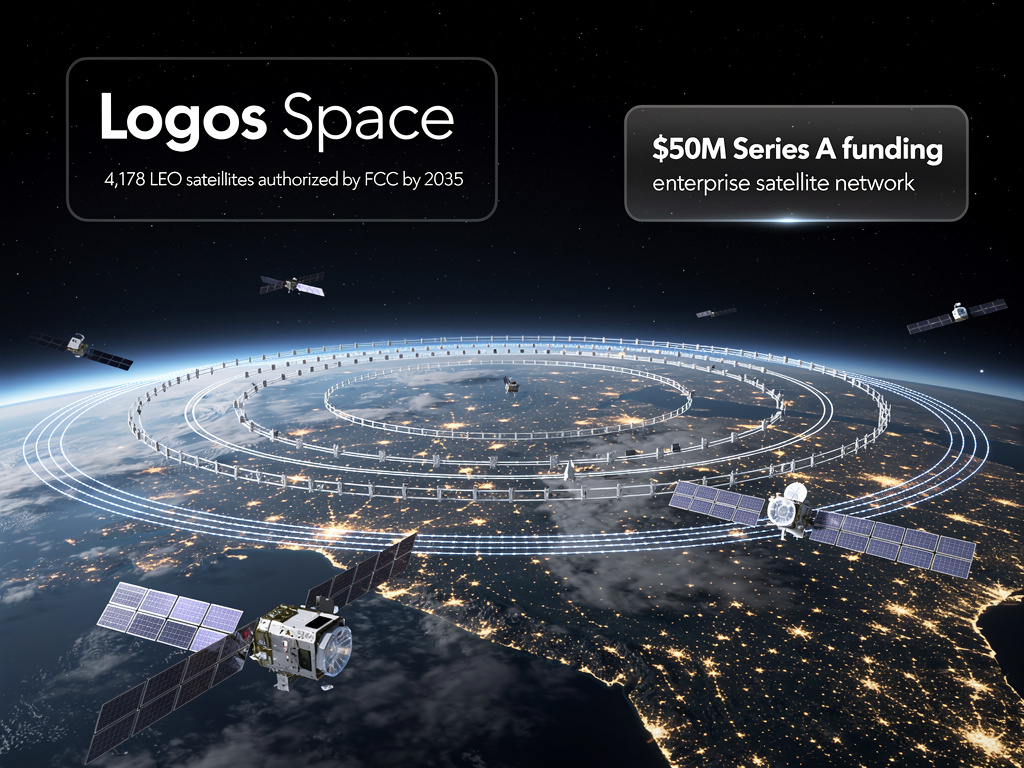
The Federal Communications Commission has granted Logos Space authorization to deploy a constellation of up to 4,178 low Earth orbit satellites, marking a significant milestone for the startup as it positions itself to compete directly with SpaceX’s Starlink in the rapidly expanding commercial satellite broadband market. The approval, issued in early February 2025, comes as Logos simultaneously announced the successful closure of a $50 million Series A funding round, providing the financial runway necessary to begin transforming regulatory permission into orbital reality.
According to Space News, the FCC’s authorization permits Logos to launch and operate satellites across multiple orbital shells, with deployment required by 2035 to maintain the license. The approval represents one of the largest satellite constellation authorizations granted to a company outside the established space industry giants, signaling regulatory openness to new entrants in an increasingly competitive sector. The commission’s decision follows a comprehensive review of Logos’s technical capabilities, orbital debris mitigation plans, and interference coordination protocols.
The timing of the FCC approval and Series A funding announcement reveals a carefully orchestrated strategy by Logos management to demonstrate both regulatory credibility and financial viability to potential customers and additional investors. The $50 million capital infusion, while substantial for an early-stage space venture, represents merely a fraction of the estimated multi-billion-dollar investment required to fully deploy and operate a constellation of this magnitude. Industry analysts note that Logos will need to secure significantly larger funding rounds or strategic partnerships to achieve its ambitious deployment timeline.
Enterprise Focus Distinguishes Market Approach
Unlike Starlink’s consumer-oriented business model, Logos Space has explicitly positioned its network to serve enterprise and government customers requiring secure, dedicated bandwidth and specialized service level agreements. SatNews reported that the company’s application emphasized enterprise connectivity as its primary market focus, distinguishing it from competitors pursuing mass-market consumer adoption. This strategic differentiation could prove crucial in a market where SpaceX has already captured significant consumer market share and established brand recognition.
The enterprise satellite communications market has demonstrated robust growth trajectories, driven by increasing demand from maritime operators, aviation companies, remote industrial operations, and government agencies seeking alternatives to terrestrial networks. Logos’s emphasis on this segment reflects recognition that competing head-to-head with Starlink for residential customers would require prohibitive capital expenditure and marketing investments. By targeting customers willing to pay premium prices for guaranteed performance and dedicated capacity, Logos can potentially achieve profitability with fewer deployed satellites than mass-market competitors require.
Industry veterans have noted that the enterprise approach also provides Logos with potential pathways to government contracts and classified communications services, revenue streams that typically offer higher margins and longer contract durations than consumer broadband. The company’s ability to secure Department of Defense or intelligence community contracts could significantly accelerate its financial sustainability and provide strategic advantages in future funding negotiations.
Technical Architecture and Orbital Strategy
The FCC authorization permits Logos to deploy satellites across multiple orbital altitudes, a configuration designed to optimize coverage, capacity, and latency characteristics for different customer requirements. According to Engadget, the approval encompasses operations at various orbital shells, allowing the company to tailor its network architecture to specific service requirements. This multi-shell approach mirrors strategies employed by other constellation operators who have discovered that different orbital altitudes offer distinct advantages for particular applications.
Lower orbital altitudes generally provide reduced latency, a critical performance metric for applications requiring real-time responsiveness, while higher orbits can offer broader coverage footprints and longer satellite visibility windows. Logos’s ability to leverage multiple orbital planes suggests a sophisticated understanding of satellite network optimization and indicates the company has assembled technical expertise capable of managing complex constellation operations. The specific orbital parameters approved by the FCC will influence everything from launch vehicle selection to ground station architecture and customer terminal design.
The company faces significant technical challenges in developing satellite hardware that can deliver competitive performance while maintaining cost structures that support business case viability. Modern LEO satellite constellations require rapid manufacturing processes capable of producing dozens or hundreds of satellites annually, along with rigorous quality control systems to ensure orbital reliability. Any significant satellite failures or performance shortfalls could jeopardize customer confidence and complicate future capital raising efforts.
Competitive Dynamics and Market Positioning
Logos enters a market increasingly crowded with both established operators and well-funded newcomers, each pursuing variations on the LEO broadband constellation model. SpaceX’s Starlink has already deployed more than 5,000 satellites and serves hundreds of thousands of customers globally, establishing significant first-mover advantages in manufacturing scale, launch cadence, and operational experience. Amazon’s Project Kuiper has secured substantial capital commitments and begun initial satellite deployments, while OneWeb has emerged from bankruptcy to deploy its polar-orbit constellation focused on enterprise and mobility markets.
The competitive environment presents both obstacles and opportunities for Logos. Established operators have demonstrated technical feasibility and market demand, reducing investor uncertainty about the fundamental business model. However, these same competitors have also secured advantageous spectrum allocations, established supply chain relationships, and built customer bases that create significant barriers to entry. Logos must articulate compelling differentiation beyond simply being “another LEO constellation” to attract customers, partners, and the billions in additional capital required for full deployment.
Strategic partnerships could prove essential to Logos’s success, potentially including satellite manufacturing agreements with established aerospace contractors, launch service contracts with emerging commercial space transportation providers, or distribution partnerships with telecommunications companies seeking to augment terrestrial networks. The company’s relatively modest initial funding round suggests management may be pursuing a phased deployment strategy, demonstrating technical and commercial viability with initial satellite launches before seeking the larger capital commitments required for full constellation deployment.
Regulatory and Orbital Sustainability Considerations
The FCC’s approval of another mega-constellation comes amid growing concerns about orbital congestion, space debris, and the long-term sustainability of the low Earth orbit environment. Regulatory authorities worldwide are grappling with how to balance commercial space development with responsible orbital stewardship, particularly as the number of active satellites increases exponentially. Logos’s authorization included specific requirements for debris mitigation, end-of-life disposal, and coordination with other orbital operators to minimize collision risks.
The company will be required to demonstrate compliance with FCC rules mandating satellite deorbit within five years of mission completion, along with detailed tracking and maneuverability capabilities to avoid potential conjunctions with other space objects. These requirements add operational complexity and cost but reflect increasing regulatory emphasis on sustainable space operations. Industry observers note that companies demonstrating superior orbital responsibility may gain competitive advantages as regulatory scrutiny intensifies and insurance costs potentially increase for operators with questionable safety records.
International regulatory coordination presents additional challenges, as satellite constellations inherently operate globally while regulatory authority remains nationally fragmented. Logos will need to secure operating authorities from communications regulators in countries where it intends to provide service, a process that can involve complex negotiations around spectrum rights, national security considerations, and local partnership requirements. The company’s ability to navigate this regulatory complexity while maintaining deployment timelines will significantly influence its competitive position.
Financial Realities and Path to Profitability
The $50 million Series A funding, while substantial for an early-stage venture, represents a small fraction of the capital required to deploy thousands of satellites. Industry estimates suggest that LEO constellation deployment costs typically range from $500,000 to $2 million per satellite when accounting for manufacturing, launch, insurance, and ground infrastructure. Even at the lower end of this range, Logos’s full 4,178-satellite constellation could require more than $2 billion in capital expenditure before generating significant revenue.
This financial reality suggests Logos will pursue a phased deployment approach, launching initial satellite batches to demonstrate technical capabilities and begin revenue generation while seeking subsequent funding rounds. The company’s ability to secure additional capital will depend heavily on demonstrating tangible progress in satellite development, successful initial launches, and customer contract acquisition. Early revenue generation, even at modest levels, could significantly enhance the company’s valuation and attractiveness to later-stage investors.
The competitive dynamics of the satellite broadband market may also drive industry consolidation, with smaller constellation operators potentially becoming acquisition targets for larger telecommunications companies or technology firms seeking space-based connectivity capabilities. Logos’s FCC authorization and enterprise market positioning could make it an attractive acquisition candidate for established companies seeking rapid entry into the LEO communications sector without undertaking independent constellation development.
As Logos Space embarks on the challenging journey from regulatory approval to operational constellation, the company joins a select group of ventures attempting to reshape global communications infrastructure through space-based networks. Success will require not only technical excellence and operational execution but also sophisticated capital management, strategic partnership development, and differentiated market positioning in an increasingly competitive sector. The next several years will reveal whether Logos can transform regulatory permission and initial funding into a sustainable challenge to established orbital operators, or whether the immense capital and operational requirements of mega-constellation deployment will prove insurmountable for all but the largest and best-funded competitors.


 WebProNews is an iEntry Publication