
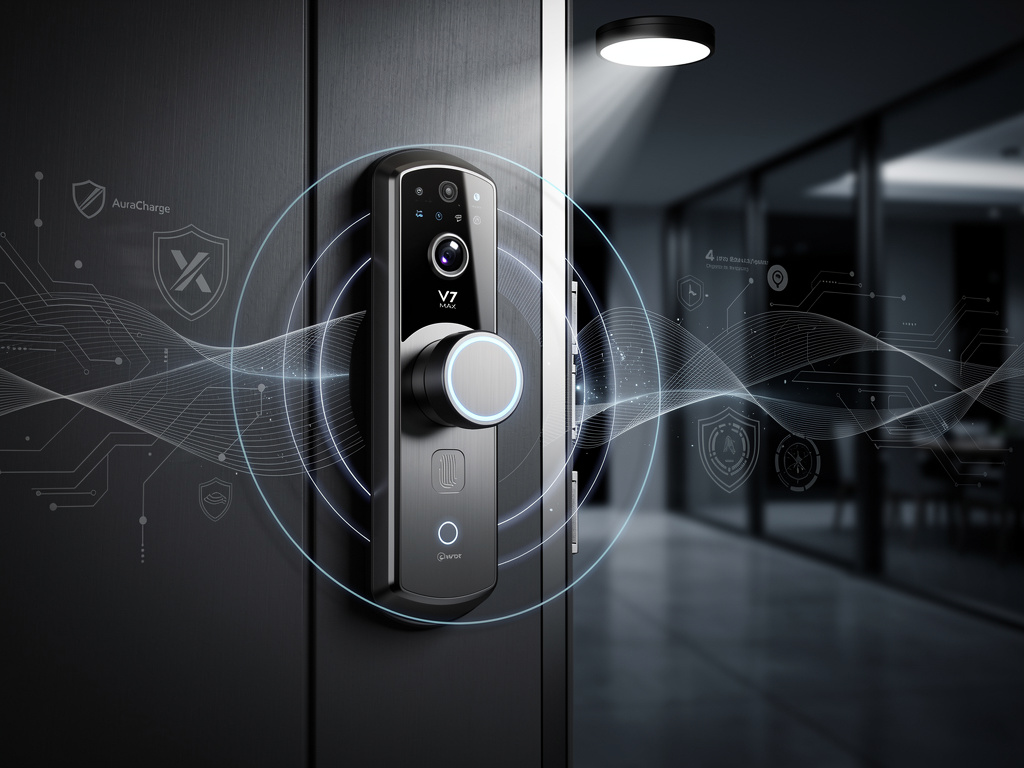
In the rapidly evolving world of smart home security, a groundbreaking development is poised to eliminate one of the most persistent annoyances for users: the need to recharge or replace batteries in smart locks. At CES 2026, Lockin unveiled its V7 Max smart lock, a device that harnesses wireless optical charging to provide what the company calls “eternal, zero-maintenance power.” This innovation, detailed in a Digital Trends report, promises to redefine reliability in home access systems by doing away with traditional power sources altogether.
The V7 Max employs AuraCharge technology, which uses eye-safe optical output to deliver power wirelessly within a four-meter range. Unlike conventional smart locks that rely on disposable batteries, lithium-ion rechargeables, or solar panels—each plagued by issues like limited endurance, frequent maintenance, and dependence on light conditions—Lockin’s system ensures consistent operation regardless of weather or installation site. According to a press release from PR Newswire, the lock earned the CES 2026 Innovation Awards Best of Innovation honor, highlighting its potential to advance the industry into a new era of power management.
This isn’t just a minor tweak; it’s a fundamental shift. Traditional smart locks, such as those from August or Yale, often require battery changes every few months, leading to downtime and user frustration. Lockin’s approach, certified safe by TÜV Rheinland and SGS, utilizes a uniform beam profile to charge the device efficiently, making it ideal for renters or apartment dwellers who can’t modify wiring. As noted in coverage from CNET, this could be a game-changer for those in multi-unit buildings where hardwired solutions are impractical.
Breaking Free from Battery Constraints
Industry experts see this as part of a broader push toward sustainable, low-maintenance IoT devices. Posts on X (formerly Twitter) from tech enthusiasts echo this sentiment, with users praising innovations that extend battery life or eliminate it entirely, such as one highlighting a Korean smart lock’s multi-year endurance before needing a change. Lockin’s V7 Max goes further by integrating triple biometric security—vein recognition, fingerprint, and facial scanning—alongside the charging tech, ensuring not just power reliability but enhanced protection against unauthorized access.
The optical charging system draws from ambient or dedicated infrared light sources, allowing the lock to recharge passively without user intervention. A The Verge article describes how the V7 Max even incorporates a built-in video doorbell, adding layers of functionality like remote monitoring and AI-driven alerts. This multifunctionality addresses common pain points in smart home ecosystems, where devices often operate in silos, draining resources and complicating user experiences.
Comparisons to past innovations reveal the V7 Max’s edge. Earlier attempts at battery-free locks, like those harvesting energy from NFC signals or kinetic motion, have been limited in scope and efficiency. Lockin’s solution, as explained in a ZDNET piece, stands out for its scalability and safety features, making it suitable for family homes where eye safety is paramount.
Market Implications and Adoption Challenges
The smart lock sector has seen explosive growth, with statistics from Market.us indicating that keyless entry systems are becoming ubiquitous, driven by smartphone integration and remote control capabilities. By 2026, projections suggest the global market could exceed $5 billion, fueled by demands for convenience and security. Lockin’s entry, timed perfectly with CES announcements, positions it as a leader in vein recognition technology, a biometric method that’s harder to spoof than fingerprints.
However, adoption isn’t without hurdles. Cost remains a factor; while exact pricing for the V7 Max hasn’t been disclosed, similar high-end locks retail for $200 to $400, potentially pricing out budget-conscious consumers. Integration with existing smart home platforms like Apple HomeKit, Google Home, or Amazon Alexa will be crucial, as seamless connectivity drives user satisfaction. Industry insiders note that while the technology is revolutionary, widespread rollout depends on manufacturing scalability and regulatory approvals in various regions.
Moreover, environmental benefits can’t be overlooked. By eliminating batteries, the V7 Max reduces electronic waste—a growing concern as IoT devices proliferate. This aligns with global sustainability goals, where innovations in energy harvesting are gaining traction. A post on X from a tech news account celebrated similar infrared-powered locks for their potential to improve long-term reliability, reflecting a positive public reception amid broader discussions on eco-friendly tech.
Technological Underpinnings and Future Directions
Diving deeper into the tech, AuraCharge leverages advanced photonics to convert light into electrical energy with high efficiency. Unlike solar-dependent systems that falter in low-light environments, this optical method provides stable power even indoors. As detailed in a GlobeNewswire release, the V7 Max’s AI component, LockinAI, optimizes power usage and enhances security through real-time anomaly detection, such as alerting users to tampering attempts.
Competitors are taking note. Brands like Schlage and Kwikset may accelerate their own R&D in wireless charging to keep pace. Historical parallels, such as August’s 2017 lock redesign for better battery life mentioned in older X posts, show how incremental improvements have paved the way for leaps like this. Lockin’s breakthrough could inspire similar advancements in other devices, from wireless earbuds to security cameras, creating a ripple effect across consumer electronics.
For industry players, the V7 Max raises questions about supply chain dependencies. Sourcing components for optical charging systems might involve specialized manufacturers, potentially leading to bottlenecks. Yet, the promise of “eternal power” could justify the investment, especially as consumer expectations shift toward hassle-free tech.
Security Enhancements and User Experience
Beyond power, the V7 Max’s vein recognition stands out for its accuracy and hygiene—scanning palm veins without physical contact reduces germ transmission, a post-pandemic priority. Combined with the video doorbell, it offers a comprehensive security suite. Users can grant temporary access remotely, ideal for service workers or guests, as highlighted in enthusiastic X discussions about multi-modal locks from Korea.
Real-world testing will be key. Early reviews from CES, as covered in Reuters, praise its reliability in diverse conditions, but long-term durability in extreme climates remains to be proven. For insiders, this means monitoring post-launch data on failure rates and user feedback.
The integration of AI also opens doors to predictive maintenance, where the lock could self-diagnose issues before they arise. This proactive approach could minimize service calls, a boon for property managers overseeing large installations.
Broader Industry Shifts and Innovations
Looking ahead, this innovation signals a maturation in smart home tech, where convenience meets robustness. X posts on battery advancements, like zinc-ion efficiencies or solid-state EV batteries, underscore a cross-industry trend toward longer-lasting power sources. Lockin’s V7 Max fits into this narrative, potentially influencing standards for wireless charging in IoT.
Challenges persist, including privacy concerns with biometrics and video features. Regulators may scrutinize data handling, especially in regions with strict GDPR-like laws. Still, the benefits—uninterrupted access, reduced maintenance—outweigh drawbacks for many.
As smart locks evolve, partnerships could accelerate progress. Imagine collaborations with energy firms for optimized light-based charging or with insurers offering discounts for enhanced security. The V7 Max isn’t just a product; it’s a harbinger of a future where recharging becomes obsolete.
Economic and Competitive Dynamics
Economically, Lockin’s move could disrupt established players. With the company already leading in vein recognition, as per market analyses, this launch strengthens its position. Investors might flock to similar startups, fueling innovation cycles.
Consumer sentiment, gauged from X buzz around CES reveals, is overwhelmingly positive, with users excited about never dealing with dead batteries mid-vacation. This could drive rapid adoption in urban areas where smart tech is standard.
Ultimately, the V7 Max exemplifies how targeted innovations solve real user problems, setting a benchmark for the sector. As more details emerge post-CES, its impact will likely extend far beyond locks, reshaping how we power our connected lives.


 WebProNews is an iEntry Publication