
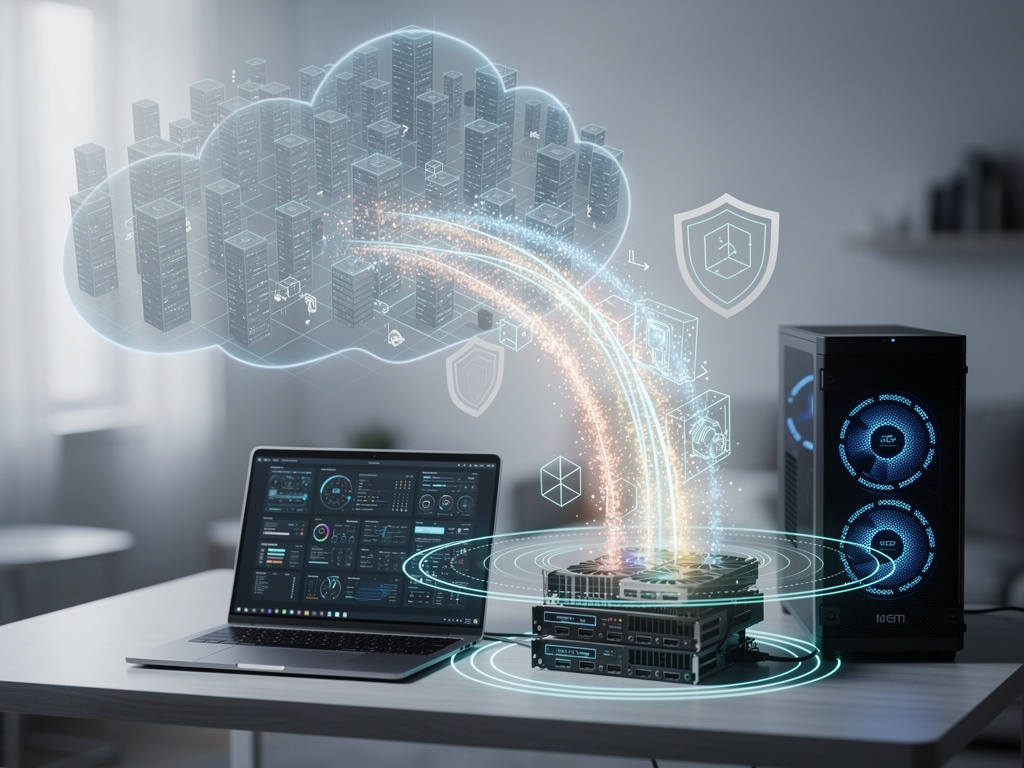
Cloud AI providers face mounting headaches. Capacity limits bite. Prices climb. Usage-based billing replaces flat rates. Yet a quiet alternative gains traction among developers and enterprises alike. Local large language models now handle real coding work on consumer hardware. They cut costs to near zero after the initial outlay. They keep data off the wire. And they offload routine tasks from strained data centers.
The Register tested this shift firsthand. Systems editor Tobias Mann and senior reporter Tom Claburn ran experiments with smaller models on high-end laptops and GPUs. What once felt like toys now delivers competent code. “The quality of those models have jumped from being kind of like toys, tech demonstrators, to being really rather competent,” they reported. Six months made the difference. (The Register)
Alibaba’s Qwen team supplied fresh ammunition. Its 27-billion-parameter model, or the 35B mixture-of-experts variant with roughly 3 billion parameters active after quantization, packs serious coding punch. The company positioned it as frontier-quality in a compact form. Developers run it on a 32GB M-series Mac or a 24GB GPU. Context windows stretch to 262,144 tokens, though hardware often caps practical use at 65,536.
Performance surprised the testers. Qwen3.6-27B one-shot an interactive solar system web app. It spotted and patched bugs in existing codebases. A Python script for image resizing earned praise as “Overall: Strong, production-quality script” from a separate Claude Code evaluation, though suggestions followed for edge cases like WebP handling. Not every task succeeds on the first try. Rephrasing prompts helps. Yet for focused scripts and discrete changes, results hold up.
Cloud services hit their limits faster. Anthropic capped Claude Code sessions and tested removal from lower-tier plans. GitHub shifted Copilot to metered pricing after flat rates proved unsustainable. A modest project could run hundreds of thousands of dollars under heavy use. “There’s nothing that beats the price of being able to run this for next to nothing excluding your very expensive hardware,” The Register noted. Local setups flip the economics. One-time hardware buys replace recurring token fees.
Energy questions loom large over cloud expansion. Data centers could claim 12 percent of U.S. electricity by 2028, according to Lawrence Berkeley National Laboratory projections cited in recent analyses. Some campuses eye gigawatt scale by 2030. Local inference changes the equation. A server with an AMD RX 7900 XTX idles around 70 watts while hosting other services. During generation it draws 150 to 250 watts briefly. The entire system runs off a standard outlet. Electricity bills barely budge, even in high-cost markets. (XDA Developers)
But local does not mean isolated. Hybrid approaches emerge. Intel outlined an on-device-first strategy for AI PCs. Simple queries stay local. Only minimal identifiers reach the cloud when context falls short. This fusion limits data exposure while scaling capability. Enterprises test shared GPU servers that serve teams. One $70,000 Nvidia DGX Station handles workloads once routed to hyperscaler clusters. (Intel)
Tools and setups now lower the barrier for daily use.
Ollama, LM Studio, and llama.cpp dominate developer conversations. Reddit’s r/LocalLLaMA community, swollen past 600,000 members, swaps configurations for Qwen3.5, Gemma 4, GLM-5.1, and Llama 4 Scout. Models quantized to 4-bit or 5-bit run at 10 to 80 tokens per second on midrange GPUs. A 12GB RTX 3060 hosts Gemma 3 12B for solid reasoning. Entry points sit around 16GB to 24GB VRAM for usable experiences, though 8GB cards still manage lighter variants. (Prompt Quorum)
Agent frameworks add intelligence. Cline integrates with VS Code and offers planning modes with human approvals. Claude Code orchestrates generation, testing, and sandboxed execution via Docker. Pi Coding Agent runs lighter with fewer guardrails. Each connects to local backends through simple API calls. Safety varies. Some default to deny-by-default for shell commands. Others require custom sandboxes to prevent escapes. Careful configuration matters. Mozilla’s Davi Ottenheimer highlighted risks in related security discussions.
Hardware choices matter too. Newer Apple M5 chips accelerate matrix multiplications and slash prompt processing from minutes to seconds. Older M1 systems lag noticeably on larger contexts. Nvidia retains the edge for CUDA compatibility, yet AMD and Intel options expand. Quantization, KV cache compression to 8 bits, and prefix caching squeeze more from limited memory. Unsloth and MLX optimizations push speeds higher on specific platforms.
Privacy stands as a core draw. Prompts never leave the device. No provider logs or retains data. This appeals to regulated industries and cautious teams. Vitalik Buterin outlined a self-sovereign setup in April that runs everything local first, sandboxes aggressively, and avoids external dependencies where possible. (Vitalik Buterin)
Limitations persist. Frontier models still outperform on the hardest problems. Local agents sometimes need multiple corrections on complex projects. Token generation runs slower than cloud APIs. Yet the gap narrows with test-time compute, better architectures, and mixture-of-experts designs. For prototyping, bug fixes, small scripts, and routine coding, local models suffice. They free expensive cloud capacity for tasks that truly demand it.
Recent benchmarks from the community reinforce the trend. Qwen variants lead coding categories on local leaderboards. DeepSeek models shine in math and logic. Llama 4 Scout balances general performance on 10GB to 12GB setups. Developers mix sizes: a small model for quick queries, a medium one for analysis, a larger one for deep reasoning when hardware allows. Parallel tool calls and custom templates enhance agentic flows.
Enterprises eye the shift. One high-end workstation can replace multiple developer subscriptions. A mini PC or single-board computer now runs distilled models for edge tasks. Power draw stays modest compared with always-on cloud queries. Latency drops to tens of milliseconds between tokens once loaded. No network hops. No rate limits at 3 a.m.
So the math changes. Hardware costs front-load. Ongoing expenses vanish. Data stays private. Cloud strain eases. Local LLMs won’t replace every frontier call tomorrow. They already handle enough today to matter. Developers who master the stack gain speed, control, and savings. Cloud providers gain breathing room. Both sides win when the right workload runs in the right place.
Watch the next wave of releases. Qwen updates, Gemma improvements, and open MoE architectures keep raising the floor. Tools grow more polished. Setup times shrink to minutes. The question shifts from whether local models work to how far they stretch before cloud assistance becomes necessary. For many coding flows, that line sits farther out than expected in 2026.


 WebProNews is an iEntry Publication