
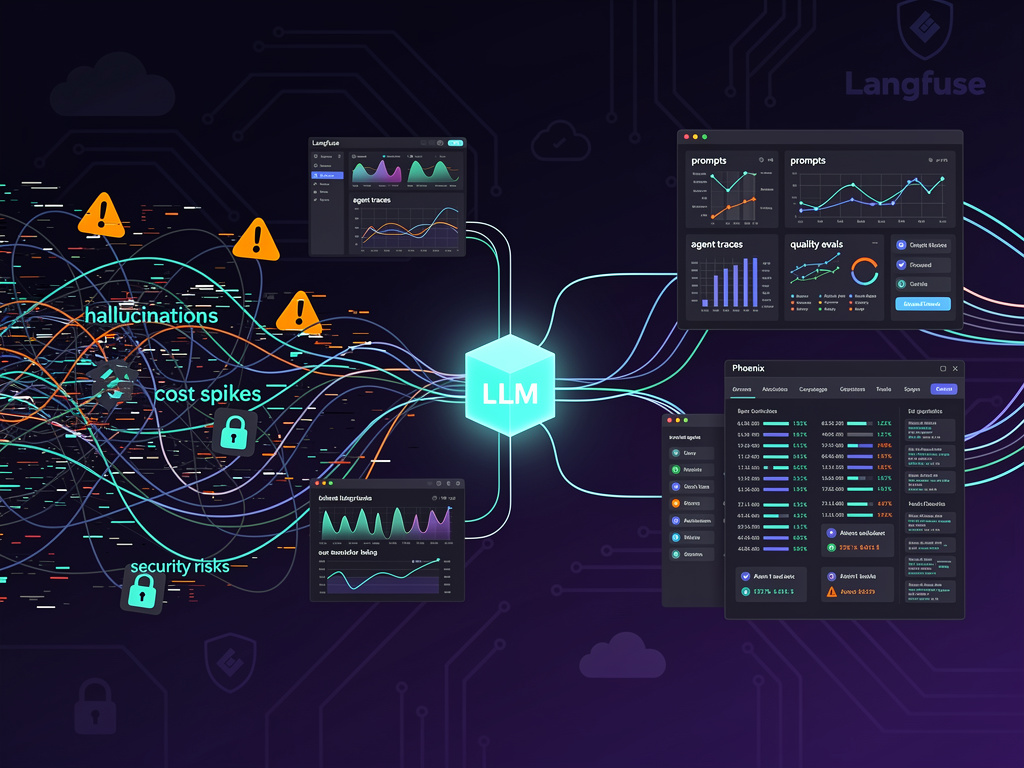
Software-as-a-Service operators have long mastered the art of troubleshooting through metrics, logs and traces. But the integration of large language models into production workflows is exposing profound gaps in these traditional tools, leaving teams scrambling to diagnose hallucinations, erratic agent behaviors and skyrocketing token costs.
Shahar Azulay, CEO of groundcover, warns in The New Stack that ‘Logs, metrics, and traces aren’t enough. AI apps require visibility into prompts and completions to track everything from security risks to hallucinations.’ Published January 24, 2026, the piece highlights how LLMs’ probabilistic outputs, multistep agent pipelines and constant evolution defy conventional monitoring paradigms.
LLM workloads are ‘probabilistic,’ Azulay explains. ‘The same inputs don’t always produce the same output. Transient and multistep. A single user request might trigger retrieval, multiple model calls, tool execution, parsing and retries. Constantly evolving. Prompt templates change weekly, model versions get swapped out and quality fluctuates without warning.’
Why Legacy Tools Fall Short
Traditional observability stacks excel at microservices but falter with AI’s improv-like unpredictability. ‘It’s not that the legacy tools are bad; they just weren’t built for systems that reason, adapt and change this quickly,’ Azulay notes. SaaS teams now track token usage for cost control, latency in critical paths, error rates from model failures and response quality to flag hallucinations.
Emerging requirements demand tracing full agent chains—from retrieval-augmented generation (RAG) context pulls to tool calls and retries. In Maxim AI, experts stress that ‘distributed tracing, token accounting, automated evals, and human feedback loops are now baseline requirements in 2025,’ pinpointing gaps in prompt-completion linkage and multi-agent workflows.
Cost and reliability entwine tightly. ‘The biggest reliability issues are often cost issues in disguise,’ per Azulay, citing verbose prompts, suboptimal models or stale RAG contexts that trigger hallucinations while inflating bills.
Tracing the Unseen: New Signals Emerge
LLM observability pivots to prompts as versioned artifacts, workflow traces capturing retrieval relevance and model trade-offs. Non-invasive instrumentation via eBPF offers kernel-level hooks, bypassing code changes in fast-evolving stacks. Groundcover’s approach promises ‘day-one observability’ without redeploys.
Security adds urgency: Prompts and completions brim with sensitive data, demanding self-hosted or bring-your-own-cloud (BYOC) models to contain telemetry. ‘Security isn’t optional,’ Azulay asserts, as third-party tools risk leaks.
Over 65% of organizations deploying AI cite monitoring as their top challenge, according to a O-mega analysis. Without visibility, production agents devolve into guesswork, as one X post laments: ‘Built an AI agent last month. Works great in testing. Production: It’s making decisions I can’t explain.’
Tool Wars: Open Source Leads Charge
The market exploded in 2025 with specialized platforms. Langfuse, now acquired by ClickHouse as detailed in their January 23, 2026 announcement, dominates open source with 19,000 GitHub stars. It excels in tracing multi-turn conversations, prompt versioning and LLM-as-judge evals. ‘Having proper observability into our LLM interactions has been invaluable,’ ClickHouse reports from internal use on their DWAINE agent.
Braintrust integrates debugging and evals for production loops, serving Notion and Stripe per Braintrust. Phoenix (Arize AX) leverages OpenTelemetry for unified ML/LLM traces, detecting drift and hallucinations. Helicone offers proxy-based logging with caching for 100+ LLMs.
Firecrawl ranks Langfuse tops for its full stack, while Logz.io lists nine tools ensuring GenAI accuracy, speed and cost efficiency through end-to-end traces.
OpenTelemetry Enters the Fray
Standards like OpenTelemetry gain traction for interoperability. OpenTelemetry’s 2025 post defines agents as ‘LLM capabilities, tools… and high-level reasoning,’ urging standardized telemetry to avoid lock-in. By 2026, major vendors default to OTel, per Dash0.
Gartner deems LLM observability ‘the strategic enabler for deploying and scaling solutions responsibly,’ as cited in Dynatrace’s 2025 report. Yet challenges persist: Nondeterminism demands constant monitoring, as Gergely Orosz noted on X: ‘o11y becomes SO important! You need to monitor, monitor, monitor; alert, alert alert!!’
In Medium’s Elementor Engineers, Idan Felz recounts: ‘As our LLM features grew, so did our blind spots.’ Langfuse resolved this with structured traces for AI workflows.
Production Realities: Cost, Quality, Security
Optimization loops replace dashboards: Correlate latency, tokens and quality to slash expenses. RAG flaws like irrelevant contexts amplify issues, as Azulay quips: ‘Garbage in, garbage out… But now the garbage comes from a vector store.’
Enterprise adoption surges, but self-hosting rises for data control. Galileo warns: ‘Model calls vanish into observability blind spots’ without tailored tools, transforming debugging from guesswork to precision.
X discussions echo urgency. Kubernetes expert Naveen S16 shared Azulay’s piece, underscoring prompt visibility needs. As AI agents scale, ‘AI isn’t replacing observability, but it’s forcing it to grow up,’ Azulay concludes.
Charting AI’s Next Monitoring Frontier
From eBPF hooks to agent-specific evals, the shift empowers production-ready AI. Platforms like Maxim AI and Braintrust close gaps in black-box reasoning, while OTel standardization promises vendor-agnostic futures. SaaS leaders ignoring this risk cost overruns, breaches and unreliable features in an era where AI defines competitiveness.


 WebProNews is an iEntry Publication