
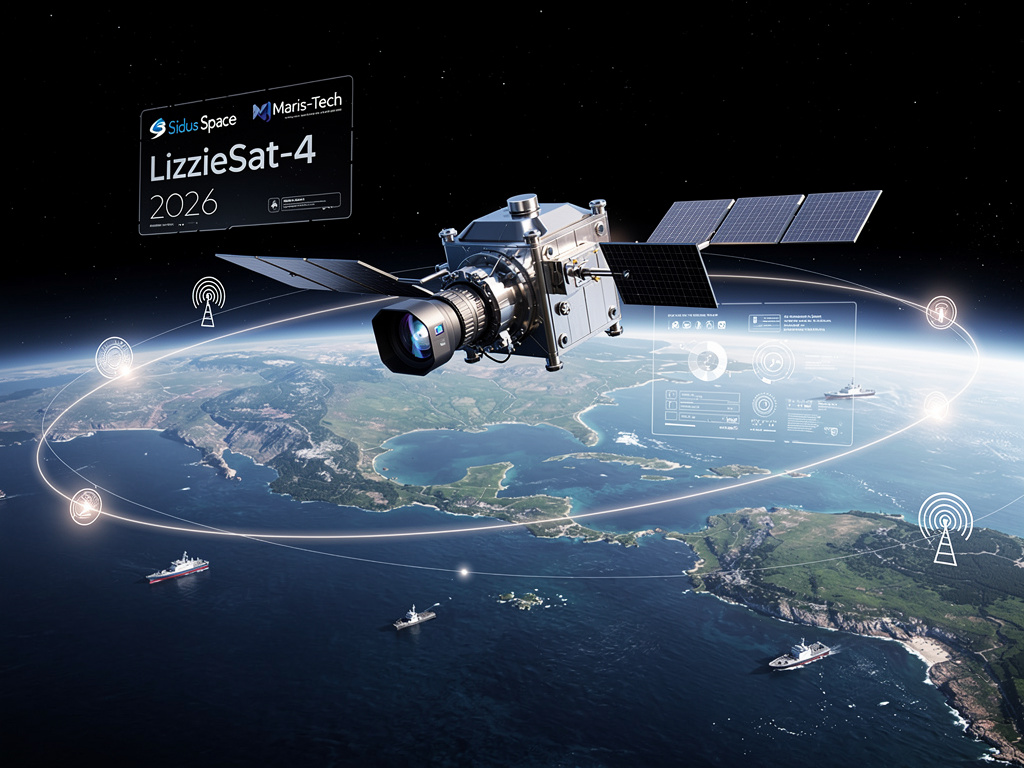
Sidus Space Inc. and Maris-Tech Ltd. have crossed a pivotal integration milestone for the LizzieSat-4 mission, shifting from planning to hardware testing as the satellite readies for a launch later this year. Announced on January 26, 2026, the development marks Maris-Tech’s advanced payload entering active validation on Sidus’s modular platform, targeting demonstrations of high-performance video processing and AI-driven edge computing in orbit.
The payload, designed for real-time data handling and analytics in constrained space environments, leverages Sidus’s flight-proven subsystems including a VPX-based command and data handling architecture capable of up to 248 tera-operations per second. LizzieSat-4, part of a multi-mission constellation in the 100- to 800-kilogram class with mission lifetimes of three to seven years, supports rapid payload integration for Earth observation, space situational awareness, and defense applications. Hardware testing begins next week at Sidus’s Cape Canaveral facility, followed by full satellite integration.
From Ground Tests to Orbit: The Integration Push
“This integration milestone represents a critical step as we prepare LizzieSat-4 for launch later this year,” said Patrick Butler, EVP of Engineering & Programs at Sidus Space, in a statement reported by StockTitan. “Beginning payload testing and progressing into full hardware and software integration underscores the maturity of the LizzieSat platform and our ability to support advanced customer technologies from ground testing through on-orbit operations.”
Maris-Tech, based in Rehovot, Israel, specializes in miniature, low-power video and AI systems for edge environments. Its payload aims to process data onboard, slashing bandwidth needs and latency compared to traditional downlinking of raw feeds—a game-changer for defense and commercial users demanding instant insights, as detailed in the joint press release via GlobeNewswire.
Sidus, headquartered on Florida’s Space Coast, operates a 35,000-square-foot manufacturing and testing facility, enabling swift transitions to flight. The LizzieSat series features hybrid composite structures, software-defined radios, S- and X-band communications, autonomous navigation, and redundant systems for deep-space viability.
LizzieSat’s Proven Pedigree Builds Momentum
Prior LizzieSat missions have validated the platform’s versatility. LizzieSat-3, launched in March 2025, achieved bus-level commissioning by December 2025, incorporating high-resolution imaging, AIS for maritime tracking, and Sidus’s Orlaith AI for onboard processing, according to Yahoo Finance. It fused multi-sensor data for near-real-time asset detection, expanding to partnerships like Little Place Labs for maritime intelligence via OrbitfyEdge software, as covered by Via Satellite.
The collaboration with Maris-Tech dates back to at least 2023, when they announced AI-driven ultra-HD video systems for LizzieSat, enabling onboard AI for situation awareness without cloud dependency, per Maris-Tech’s site. “With the launch of LizzieSat set for the fourth quarter of this year, we are thrilled to work with Maris-Tech to develop an innovative, AI driven, situation-awareness-solution that answers a critical need in the New Space market,” said Carol Craig, Sidus founder and CEO, in a 2023 statement echoed in Edge Industry Review.
LizzieSat-1 and -2, launched in 2024, confirmed modular design, FeatherEdge AI, and multi-sensor ops for agriculture, oil & gas, and maritime sectors, with payloads like multispectral cameras and AIS, as noted on Sidus Space’s site. These successes position LS-4 as a low-risk escalator for Maris-Tech’s space entry.
Edge Computing’s Orbital Edge in Defense and Beyond
Orbital edge computing addresses core bottlenecks: limited downlink bandwidth costs millions, and delays hinder time-sensitive ops like threat detection or disaster response. Maris-Tech’s solution processes video and runs AI analytics in situ, delivering refined insights rapidly. Military Aerospace Electronics highlighted this as enabling “real-time data processing and…” for defense, in their January coverage at MilitaryAerospace.com.
Sidus’s Orlaith ecosystem, including FeatherEdge hardware, already powers LS-3’s vessel classification and dark ship flagging by cross-referencing AIS. “By processing data directly onboard LizzieSat satellites, OrbitfyEdge is expected to eliminate the delays traditionally associated with downlinking and ground-based analysis,” Sidus stated, per Via Satellite. Integrating Maris-Tech amplifies this for video-heavy missions.
Industry observers on X note the shift’s import. “Maris-Tech’s payload has entered real hardware testing and active integration… technological risk drops meaningfully,” posted @ShabtaiYossi, framing it as an inflection for space AI valuation.
Strategic Plays Amid Constellation Expansion
Sidus eyes constellation growth, with LizzieSat supporting hyperspectral imaging, lidar, SAR, RF relay, and lunar probes. Maris-Tech gains a turnkey path to U.S. defense via Sidus’s heritage, bolstering its Nasdaq-listed pivot from terrestrial edge to orbital, as analysts at TipRanks observed: “The collaboration deepens Maris-Tech’s presence in the space sector.”
Risks remain—launch delays, integration snags—but prior missions’ track record and 2026 slot mitigate them. PR Newswire’s release via PRNewswire underscores flight readiness trajectory. X chatter from @MicrocapTrader and @acosult echoes stock buzz around $SIDU and $MTEK.
For insiders, LS-4 signals maturing New Space: agile platforms hosting specialized AI payloads, slashing costs versus bespoke sats. Sidus’s Space Access Reimagined motto rings true as edge tech redefines orbital utility.
Path Forward: Testing to Telemetry
Next: payload quals in February, vibro-acoustic tests, environmental sims, then LS-4 stack-up. Launch via rideshare like prior Transporter missions. On-orbit, expect demos of AI video analytics, potentially fusing with LizzieSat sensors for enhanced ISR. Success could spawn follow-ons, per GlobeNewswire forward looks.


 WebProNews is an iEntry Publication