
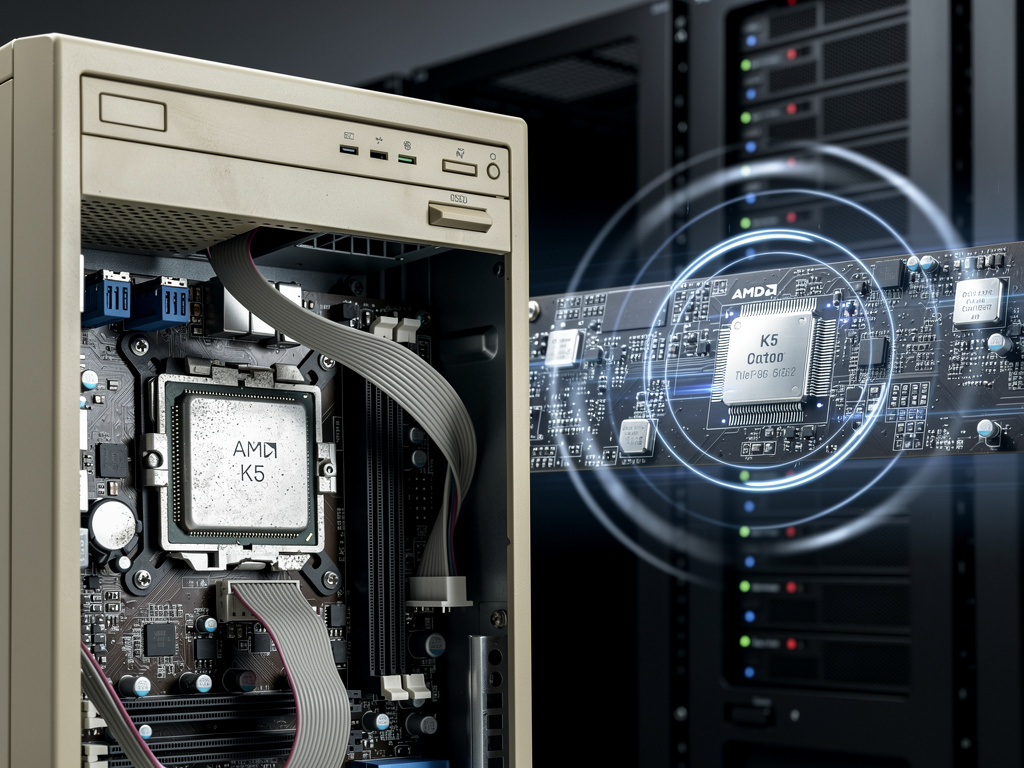
Three decades after AMD launched its first homegrown x86 processor, the Linux kernel has begun the process of dropping official support for the K5 family. The move, tucked into patches queued for the upcoming Linux 7.2 cycle, reflects a broader effort by kernel developers to shed code paths tied to processors that lack a Time Stamp Counter.
But this isn’t just housekeeping. It’s the latest sign that even the open-source community’s remarkable tolerance for ancient hardware has practical limits. The change follows last year’s removal of i486 support in Linux 7.1. And it targets a narrow but technically annoying set of early Pentium-era chips.
The patch in question removes support for TSC-less CONFIG_M586 configurations. Phoronix first highlighted the development, noting that the AMD K5 along with certain Cyrix models fall under the affected group. Intel Pentium processors that include TSC remain fully supported. The net result? Developers can make CONFIG_X86_TSC unconditional. Non-TSC code paths scattered across the x86 subsystem can disappear.
That simplification carries real weight. Maintaining separate timing logic, alternative delay loops, and conditional boot checks for a handful of processors from the mid-1990s consumes maintainer time. It adds complexity to an already intricate kernel. With virtually no one running production workloads on these systems, the cost-benefit calculation tipped decisively.
The K5 arrived in 1996 as AMD’s bid to challenge Intel’s Pentium dominance. Unlike earlier AMD chips that cloned Intel designs, this one was built from the ground up. Its 4.3-million-transistor die hid a RISC-like core that translated x86 instructions into micro-operations. Clock speeds ranged from 75 MHz to 133 MHz. AMD marketed the parts using performance ratings. A 116 MHz chip carried the PR166 badge, promising Pentium 166-level performance.
In practice, the K5 delivered mixed results. It often beat rival Cyrix parts in integer tasks yet lagged Intel in floating-point and overall consistency. The processor reached market late. Its architectural quirks and driver issues in the Windows era limited its success. Still, for enthusiasts and early Linux adopters, the K5 represented something special. An independent challenger in a market dominated by one company.
Fast forward thirty years. Those same chips now create friction in modern kernel development. The absence of TSC forces workarounds for high-resolution timing, scheduling, and profiling. Such accommodations once made sense. Today they represent technical debt. Tom’s Hardware detailed how the lack of TSC turns these variants into a burden for developers. The patch itself, authored as part of the tip tree’s x86/cpu branch, carries commit ID dbafa16ec2b6be40055db181c99f2529b20dd951 and carries the terse title focused on removing TSC-less Pentium variant support.
This pattern isn’t new. Linux 7.1 already began excising i486 options and related drivers for AMD’s Elan system-on-chips. Those parts, also TSC-less and dating to the mid-1990s, followed the same logic. Even AMD’s later Geode embedded line has seen its support marked as orphaned in recent patches, with questions about long-term viability.
Kernel maintainers have grown more willing to retire old architectures. The reasons stack up. Security updates become harder to validate on ancient silicon. Modern code relies on instructions and features introduced after the K5 era. Testing resources are finite. And the community has shifted focus toward contemporary hardware, cloud infrastructure, and embedded systems that actually ship in volume.
Yet nostalgia runs deep. On Slashdot and X, users recalled their first encounters with K5 systems. One Hungarian site remembered a PR100 model that outperformed an Intel Pentium 150 in integer workloads. Hobbyists still restore vintage machines. They run early Linux distributions on them for fun or historical preservation. Those users won’t lose access immediately. The kernel change targets official support and compilation options. Older long-term support kernels will continue to boot these systems for years. Linux 6.12, for instance, enjoys extended support until 2035.
The practical impact remains small. No enterprise data center relies on K5 processors in 2026. No cloud provider offers virtual machines backed by 1996 silicon. The affected hardware mostly lives in museums, basements, or retro computing circles. Still, the decision carries symbolic weight. Linux once prided itself on running on everything from wristwatches to supercomputers. That breadth helped it displace commercial Unix variants. It won mindshare among developers who valued portability.
Now the kernel’s x86 code increasingly assumes features that arrived with the Pentium and later generations. TSC itself became standard. Later additions like constant_tsc, nonstop_tsc, and advanced power management further widened the gap. Removing the oldest edge cases lets maintainers delete thousands of lines of conditional compilation and runtime checks. The resulting code runs cleaner. It proves easier to audit and extend.
Some observers question where the line should be drawn. The Pentium with TSC stays. What about other quirky i586 and early i686 parts? The current patch focuses tightly on TSC absence. Future changes could target additional requirements. SSE, for example, or more modern timing interfaces. Each step reduces the kernel’s support surface. Each step also sparks debate among those who remember when Linux ran on 386 machines with little more than a floppy drive.
AMD itself has moved far beyond the K5. The company now competes at the highest end of server and client computing. Its Epyc and Ryzen lines dominate discussions of performance and efficiency. The K5 saga feels like ancient history to current engineers at the firm. Yet that first independent design laid groundwork for later successes. The K6, Athlon, and beyond all trace lineage back to that risky 1996 project.
For the Linux community, the retirement marks another milestone in maturation. The project no longer needs to prove it can boot on every conceivable x86 variant. Instead it focuses on performance, security, and scalability for the hardware that matters today. That shift doesn’t erase the project’s roots. It simply acknowledges reality.
Developers who want to keep K5 systems alive can maintain out-of-tree patches. Enthusiasts can stick with older kernels. The broader ecosystem, though, will move forward without the overhead of supporting processors that predate many of today’s contributors. The K5 earned its place in computing lore. Now it earns its retirement from the mainline kernel.
And that’s how progress looks sometimes. Not with fanfare but with a quiet patch that deletes a few configuration options and a handful of code branches. The machines themselves won’t notice. Their caretakers might feel a twinge of sentiment. The kernel will simply run a little leaner on everything that remains.


 WebProNews is an iEntry Publication