
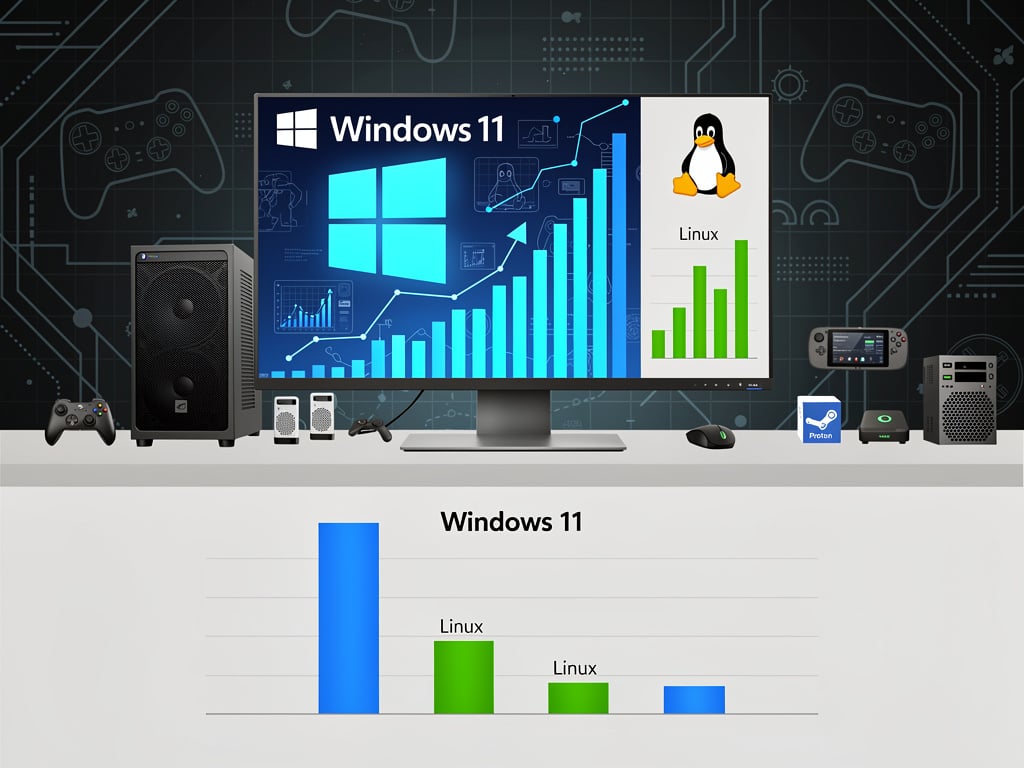
For years, the narrative around Linux gaming has been one of steady, if modest, growth — buoyed by Valve’s Steam Deck handheld console and a maturing compatibility layer called Proton. But the latest Steam Hardware & Software Survey for February 2026 suggests that the Linux desktop’s share among gamers may have plateaued, raising hard questions about whether the open-source operating system can break through its persistent ceiling in the consumer gaming market.
According to data reported by Phoronix, the February 2026 Steam Survey shows Linux holding roughly steady in its share of active Steam users, failing to make meaningful gains despite continued investment from Valve and a growing catalog of Linux-compatible titles. The survey, which Valve conducts monthly by polling a random sample of Steam’s massive user base, remains one of the most closely watched barometers of desktop operating system adoption among PC gamers worldwide.
The Numbers Tell a Story of Stagnation
The February 2026 figures place Linux’s share of Steam users in the low single digits, a range it has occupied with only minor fluctuations for the better part of two years. While the platform saw a notable uptick following the Steam Deck’s launch in early 2022, that momentum has largely stalled. Windows continues to dominate with well over 90% of the Steam user base, and macOS holds a small but relatively stable slice of the remaining share.
What makes the stagnation particularly notable is the context in which it is occurring. Valve has poured significant engineering resources into Proton, its Wine-based compatibility tool that allows Windows games to run on Linux without developer intervention. The Steam Deck itself runs SteamOS, a Linux-based operating system, and has sold millions of units. Yet those hardware sales have not translated into a durable, growing share of the broader Steam platform for Linux. As Phoronix noted, the survey results suggest that many Steam Deck owners may be using the device as a secondary gaming platform rather than replacing their primary Windows desktop.
Windows 11 Tightens Its Grip
On the Windows side, the February 2026 survey reflects the continued migration from Windows 10 to Windows 11. With Microsoft having ended mainstream support for Windows 10 in October 2025, the transition has accelerated, and Windows 11 now commands a dominant majority among Steam’s Windows users. The shift has been smoother than many analysts predicted, in part because most modern gaming hardware already meets Windows 11’s TPM 2.0 and Secure Boot requirements.
This migration matters for the Linux conversation because one of the long-standing arguments for Linux adoption has been that forced Windows upgrades — particularly those with new hardware requirements — would push disgruntled users toward alternatives. That thesis has not played out in any measurable way in the Steam data. Gamers, it appears, are far more likely to upgrade their hardware to meet Windows requirements than to switch operating systems entirely. The friction of leaving behind a familiar platform, along with concerns about game compatibility and anti-cheat software, continues to act as a powerful deterrent.
The Anti-Cheat Problem Persists
One of the most stubborn obstacles for Linux gaming remains anti-cheat software. Titles that use kernel-level anti-cheat systems like Easy Anti-Cheat (EAC) and BattlEye have been a mixed bag on Linux. While both middleware providers have technically offered Linux and Proton support for several years, the decision to enable that support rests with individual game developers and publishers. Many of the most popular competitive multiplayer titles — the games that drive the highest concurrent player counts on Steam — still do not function on Linux because their publishers have not flipped the switch.
This creates a vicious cycle. Without access to marquee competitive titles, Linux struggles to attract the mainstream gaming audience. Without a larger audience, publishers see little financial incentive to invest in testing and enabling Linux compatibility. Valve has made efforts to break this cycle through direct outreach to developers and by making Proton compatibility as frictionless as possible, but the February 2026 numbers suggest those efforts have not yet reached a tipping point.
Hardware Trends: AMD Gains, Intel Arc Finds a Foothold
Beyond operating system share, the February 2026 Steam Survey offers a snapshot of the hardware landscape among PC gamers. AMD continues to gain ground in the CPU market, a trend that has been building for several years as the company’s Ryzen processors have earned a strong reputation for price-to-performance ratios. Intel, meanwhile, has seen its CPU share erode gradually, though it remains the majority vendor among Steam users.
On the GPU front, NVIDIA continues to hold a commanding lead, with its GeForce RTX 40-series and newer RTX 50-series cards appearing with increasing frequency in the survey data. AMD’s Radeon division has maintained a steady but distant second place. Intel’s Arc graphics cards, which launched to a rocky reception in 2022, have begun to register a small but growing presence in the survey — a sign that Intel’s persistence in the discrete GPU market is yielding at least modest results. For Linux users specifically, the GPU picture is complicated by driver quality. NVIDIA’s proprietary Linux drivers have historically been a source of frustration, though the company’s gradual shift toward open-source kernel modules has improved the situation. AMD’s open-source driver stack, by contrast, is widely regarded as superior on Linux, which creates an interesting dynamic where the GPU vendor with the smaller market share offers the better Linux experience.
The Steam Deck Factor: Blessing and Ceiling
The Steam Deck deserves special examination in any discussion of Linux’s Steam share. Valve’s handheld has been, by most accounts, a commercial success. It introduced millions of users to a Linux-based gaming device, and its successor — widely expected to be announced later in 2026 — is generating significant anticipation. Yet the Steam Deck’s impact on Linux’s overall Steam share has been more complicated than simple addition.
Many Steam Deck owners also own a Windows desktop or laptop, and the Steam Survey counts each user only once, typically capturing whichever machine they happen to be using when the survey prompt appears. Because gaming sessions on a primary desktop tend to be longer and more frequent than handheld sessions, there is a statistical bias toward the desktop machine being the one that gets surveyed. This means the Steam Deck’s contribution to Linux’s share may be systematically undercounted — but it also means that the device has not driven users to abandon Windows on their primary machines in significant numbers.
What Would It Take for Linux to Break Through?
Industry observers have long debated what conditions would need to align for Linux to achieve a meaningful breakthrough in desktop gaming. The most commonly cited catalysts include: universal anti-cheat support, a major misstep by Microsoft that drives users away from Windows, continued improvements in Proton compatibility, and a killer hardware product that makes Linux the default rather than the alternative.
Valve has been working on several of these fronts simultaneously. SteamOS, which has been exclusive to the Steam Deck, is expected to receive a general desktop release that would allow users to install it on any PC. If that release delivers a polished, console-like experience on standard desktop hardware, it could lower the barrier to entry significantly. But even optimistic projections suggest that Linux gaming share would need to at least double from its current level before it would command serious attention from the majority of game publishers and anti-cheat providers.
A Platform With Passionate Advocates but Limited Mass Appeal
The February 2026 Steam Survey paints a picture of a platform that has a dedicated and technically sophisticated user base but has not yet found the formula for mass-market adoption among gamers. Linux’s strengths — its customizability, its open-source philosophy, its superior performance in certain workloads — are real, but they are not the factors that drive purchasing decisions for the average person who wants to play the latest AAA title with minimal hassle.
For Valve, the calculus may be different. The company’s investment in Linux is as much about strategic independence from Microsoft as it is about market share. A viable Linux gaming platform gives Valve an insurance policy against any future scenario in which Microsoft attempts to lock down the Windows platform or extract rents from third-party storefronts. In that light, even a low-single-digit share represents a meaningful foothold — not a failure, but a foundation. Whether that foundation can support something larger remains one of the most interesting open questions in PC gaming, and the monthly Steam Survey will continue to be the scoreboard by which progress is measured.


 WebProNews is an iEntry Publication