
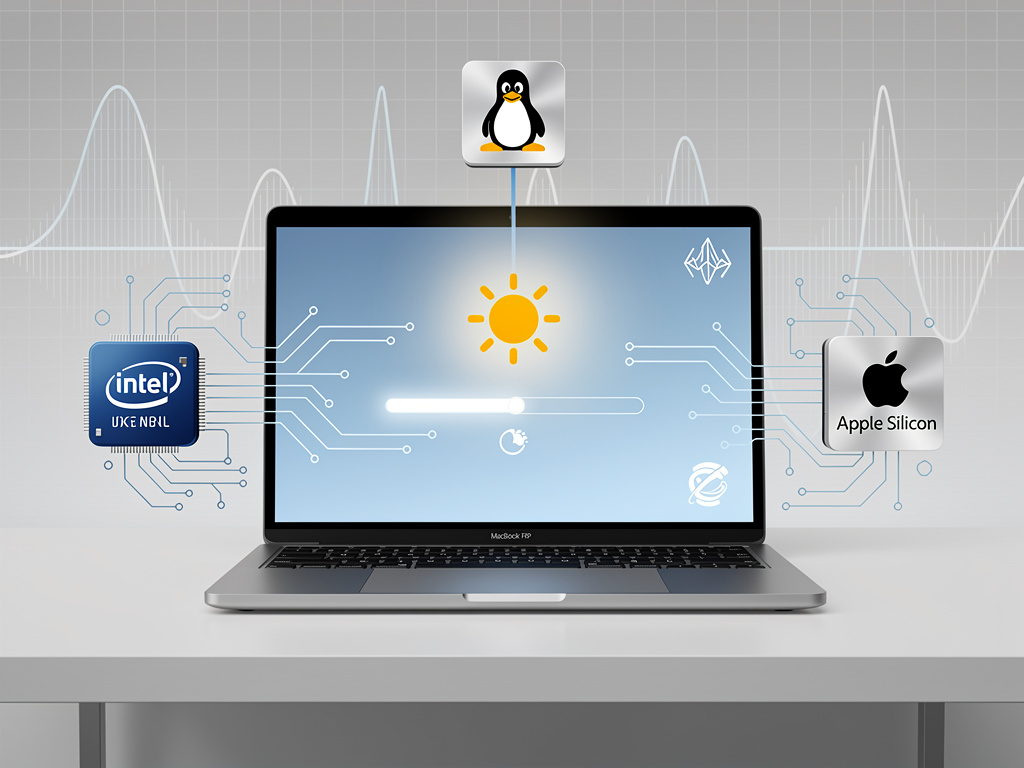
For years, Linux users who dared to install their favorite open-source operating system on Apple hardware have endured a peculiar and frustrating limitation: the inability to properly control display backlight brightness. That era is now drawing to a close, as a new kernel patch set promises to deliver native backlight brightness control for Apple Mac devices running Linux—a development that may seem minor to casual observers but represents a significant milestone for the growing community of developers and enthusiasts running Linux on Apple Silicon machines.
The patch series, authored by Aditya Garg, introduces a dedicated Apple backlight driver for the Linux kernel that targets both Intel-based and Apple Silicon Macs. As reported by Phoronix, the new driver interfaces with Apple’s firmware to expose standard backlight controls through the Linux kernel’s existing backlight subsystem. This means that once merged, Linux desktop environments and system utilities will be able to adjust screen brightness on Macs just as seamlessly as they do on conventional PC laptops—a capability that has long been taken for granted on non-Apple hardware.
The Technical Architecture Behind the Fix
The challenge of backlight control on Apple hardware is rooted in Apple’s proprietary firmware interfaces. Unlike most PC manufacturers, which adhere to ACPI (Advanced Configuration and Power Interface) standards for controlling display brightness, Apple has historically relied on its own mechanisms. On Intel Macs, brightness adjustments are managed through Apple’s System Management Controller (SMC), while on Apple Silicon machines, the process involves communication with the proprietary firmware layer that sits between the hardware and the operating system. Neither approach maps cleanly onto the standard Linux backlight subsystem without dedicated driver support.
Aditya Garg’s patch set addresses this gap by creating a unified Apple backlight driver that abstracts away the differences between Intel and Apple Silicon firmware interfaces. According to the patch notes discussed by Phoronix, the driver registers itself with the Linux kernel’s backlight class, enabling user-space tools—from GNOME’s settings panel to simple command-line utilities like brightnessctl—to adjust brightness through the standard /sys/class/backlight interface. The result is a clean, upstream-friendly solution that avoids the hacky workarounds that Linux-on-Mac users have relied upon for years.
A Community’s Years-Long Struggle for Basic Functionality
To understand why this patch matters, one must appreciate the broader effort to bring Linux to Apple Silicon. When Apple introduced its M1 chip in late 2020, it represented a dramatic departure from the x86 architecture that had underpinned Macs since 2006. The Asahi Linux project, led by Hector Martin, took on the monumental task of reverse-engineering Apple’s hardware and firmware to make Linux run on these new machines. Over the past four years, the project has achieved remarkable progress—GPU acceleration, audio, Wi-Fi, and Thunderbolt support have all been brought online through painstaking reverse-engineering work. Yet basic backlight control remained an open issue that affected every user’s daily experience.
Without proper backlight control, Linux users on Macs were often stuck at a single brightness level, or forced to rely on fragile workarounds that could break with kernel updates. Some users resorted to writing raw values to hardware registers, a dangerous practice that risked damaging displays or destabilizing the system. Others used custom scripts that interfaced with the SMC or Apple’s Device Tree properties, but these solutions were never upstreamed into the mainline Linux kernel, meaning they required manual maintenance and offered no guarantee of long-term stability. The new driver aims to put all of that behind the community by providing an officially supported, maintainable solution.
How the Driver Handles Intel and Apple Silicon Differently
One of the more technically interesting aspects of Garg’s implementation is how it handles the divergent hardware paths. On Intel Macs, the driver communicates with the SMC to set backlight levels. The SMC is a microcontroller embedded in every Mac that manages a wide range of hardware functions, including fan speed, power management, and—critically—display brightness. Linux has had partial SMC support for some time through the applesmc driver, but backlight control was never fully integrated into that framework.
On Apple Silicon Macs, the situation is more complex. The backlight is controlled through Apple’s proprietary firmware interface, which the Asahi Linux project has been steadily documenting and reverse-engineering. Garg’s driver leverages the Device Tree bindings that describe the hardware to the kernel, allowing it to discover and communicate with the backlight controller on Apple Silicon machines. This approach is consistent with how ARM-based Linux systems typically handle hardware discovery, making the driver a natural fit for the kernel’s existing infrastructure. The patch set includes the necessary Device Tree bindings alongside the driver code, ensuring that the kernel has all the information it needs to properly initialize and control the backlight hardware.
Implications for the Linux-on-Mac Ecosystem
The arrival of proper backlight support is more than a quality-of-life improvement—it signals the maturing of Linux as a viable daily-driver operating system on Apple hardware. For enterprise users and developers who prefer Linux but are drawn to the exceptional build quality and battery life of Apple laptops, the absence of basic display controls has been a dealbreaker. With this patch, one of the last major pain points in the Linux-on-Mac experience is being addressed through the proper upstream channels, which means it will eventually be available in every major Linux distribution without requiring users to apply custom patches or install third-party packages.
The move to upstream the driver also reflects a broader trend in the Linux kernel community toward better support for non-traditional hardware platforms. In recent years, kernel developers have become increasingly receptive to patches that enable Linux on consumer devices originally designed for proprietary operating systems. This shift has been driven in part by the success of projects like Asahi Linux, which have demonstrated that there is genuine demand for running Linux on Apple hardware, and that the technical challenges, while significant, are surmountable. The backlight driver is one piece of a much larger puzzle, but it is a piece that touches every user’s experience every time they sit down at their machine.
What Comes Next for Linux on Apple Hardware
Looking ahead, the Linux-on-Mac community still faces significant challenges. While GPU acceleration has made enormous strides—Asahi Linux now ships with a conformant OpenGL 4.6 and Vulkan 1.3 driver for Apple Silicon GPUs—there are still gaps in areas like hardware video decoding, camera support, and Touch Bar functionality on older MacBook Pro models. Each of these features requires its own dedicated reverse-engineering effort and driver development, and progress depends heavily on the availability and dedication of volunteer developers.
The backlight driver’s journey through the kernel review process will also be worth watching. Linux kernel patches must pass rigorous code review before being accepted into the mainline tree, and drivers for niche hardware platforms sometimes face additional scrutiny. Reviewers will evaluate the driver’s adherence to kernel coding standards, its handling of edge cases, and its potential impact on other subsystems. If the patch set passes review cleanly, it could be merged as early as the Linux 6.14 or 6.15 kernel cycle, though timelines in kernel development are always subject to change.
A Small Patch With Outsized Significance
For the uninitiated, a backlight brightness driver might seem like a trivial piece of software. But in the context of Linux on Apple hardware, it represents something much larger: the steady, methodical dismantling of the barriers that have kept Linux from being a first-class citizen on some of the world’s most popular laptops. Every driver that gets upstreamed into the mainline kernel reduces the maintenance burden on downstream projects, improves the out-of-box experience for new users, and sends a signal to the broader industry that Linux is a serious platform on any hardware.
Aditya Garg’s contribution, built on the foundation laid by the Asahi Linux project and the broader Apple reverse-engineering community, is a testament to the power of open-source collaboration. It is the kind of work that rarely makes headlines but quietly transforms the usability of an operating system for thousands of users. As Linux continues its march onto every computing platform imaginable—from servers and desktops to phones and now Apple laptops—patches like this one are the building blocks that make it all possible.


 WebProNews is an iEntry Publication