
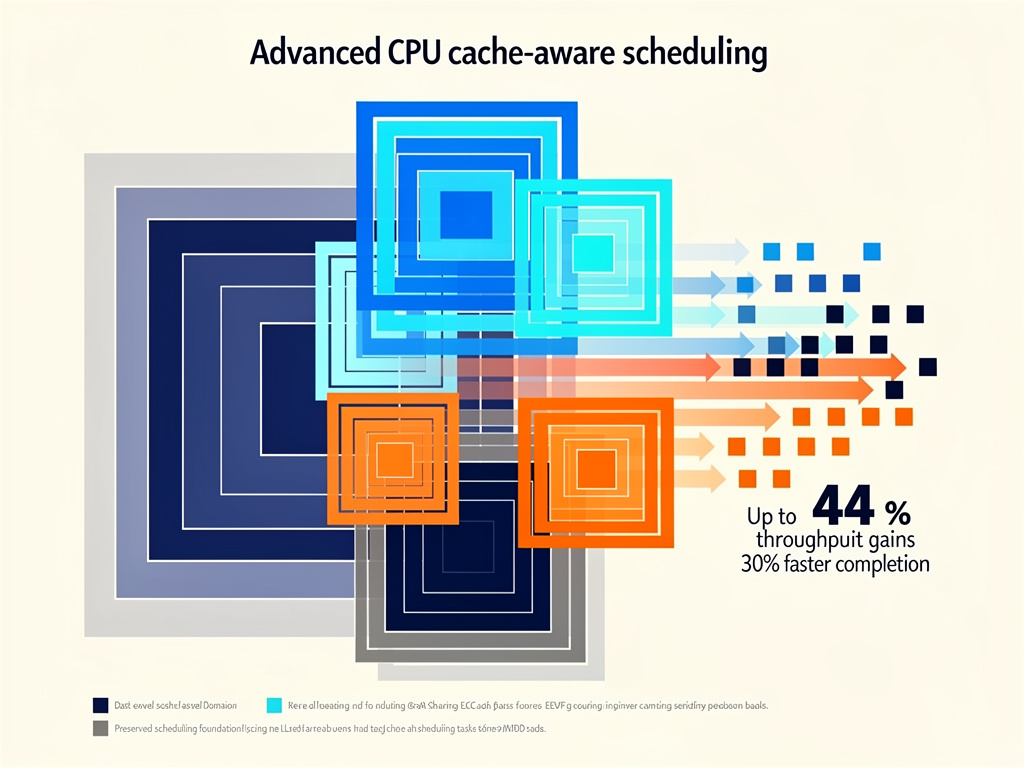
Cache aware scheduling just landed in the tip scheduling tree. The change targets a stubborn inefficiency in how the Linux kernel places tasks across chips that pack multiple last-level caches. For years server workloads paid a quiet tax in cache misses and data bouncing between sockets. Linux 7.2 looks set to shrink that tax.
The feature, developed primarily by Intel engineers over more than a year, reached the sched/core branch through a merge by Peter Zijlstra. Once the merge window opens it should reach mainline without drama. Phoronix first reported the merge on May 20, 2026. The code adds a new CONFIG_SCHED_CACHE option and a DebugFS interface at llc_balancing/enabled that lets administrators toggle the logic at runtime for testing.
But why now? Modern server CPUs from Intel and AMD routinely ship with several discrete last-level cache domains per socket. A single 64-core EPYC or Xeon can expose four, eight or more LLCs. The default scheduler, tuned for fairness and overall throughput, often scatters related tasks without regard for those boundaries. Data that should stay hot in one cache slice ends up pulled across interconnects. Latency climbs. Throughput suffers.
Cache Aware Scheduling changes the decision logic. When the kernel detects tasks that share data — through futexes, pipes, shared memory or simply frequent communication — it prefers to keep them inside the same LLC domain. The balancing code tracks load per LLC, respects affinity hints, and applies new heuristics around overload percentages and epoch periods. Administrators gain several tunables under /sys/kernel/debug/sched including llc_aggr_tolerance, llc_overload_pct, llc_imb_pct, llc_epoch_period and llc_epoch_affinity_timeout. The knobs allow fine-tuning for specific workloads once the feature ships.
Early testing already shows tangible gains. On AMD EPYC Genoa systems one ChaCha20 crypto benchmark delivered 44 percent higher throughput. Hackbench and schbench runs on Intel Sapphire Rapids finished up to 30 percent faster. Michael Larabel, who tested earlier patch versions, noted strong results on AMD EPYC Turin and respectable lifts on Intel Xeon 6 platforms. “I have benchmarked earlier versions of the patches and found great performance on AMD EPYC CPUs and Xeon 6 benefiting nicely too,” he wrote in the Phoronix report.
Not every workload wins. Stream and netperf tests sometimes show little change or minor regressions, a reminder that cache-aware placement can increase contention inside a single LLC when aggregate load spikes. The runtime toggle therefore matters. Operators can disable the feature quickly if a production workload reacts poorly.
This update arrives against a broader backdrop of scheduler evolution. The kernel shifted to EEVDF years ago to replace the classic CFS red-black tree logic. That change improved latency for interactive tasks but exposed new regressions on some server hardware after the 6.11 cycle. Follow-on patches from Peter Zijlstra and others later recovered most of the lost ground. Cache awareness builds on that foundation. It does not replace EEVDF. It augments placement decisions inside it.
Server operators stand to benefit most. Cloud providers running dense virtual-machine fleets, databases with heavy inter-query communication, and high-performance computing jobs that rely on shared memory all spend cycles waiting on remote cache lines today. Reducing those stalls translates directly into higher density or lower latency. Desktop and laptop users with single LLC chips will see smaller effects, though the code adds negligible overhead when disabled.
Academic and industry researchers have examined similar ideas before. A recent thesis from DiVA portal evaluated sched_ext-based alternatives such as LAVD for telco workloads that demand microsecond-class latency. That work, published in 2025, highlighted how the default EEVDF scheduler sometimes struggles with short, bursty tasks. Cache awareness does not solve every latency problem, yet it addresses one clear source of variability on contemporary multi-chip modules. The full thesis is available here.
Industry reaction on X has been measured but positive. Phoronix itself posted about related DRM scheduler tweaks for Linux 7.2 in late April, signaling that the kernel release cycle continues to accumulate performance-oriented changes across subsystems. No major distribution has yet announced backports, but once the code stabilizes in mainline, vendors will likely enable CONFIG_SCHED_CACHE by default on server kernels.
Implementation details matter for kernel developers. The patch set touches load balancing, task wakeup paths, and select sched domains. It introduces LLC-specific metrics without exploding the size of the runqueue data structures. Reviewers inside the tip tree appear satisfied; the merge commit a26d9208c1376ac3877d9f12e697f83368e2af1c signals confidence. Still, real-world deployment at scale will reveal edge cases. Expect follow-up patches during the 7.2 rc cycle.
Hardware trends guarantee the feature will grow more relevant. Both Intel and AMD continue to scale core counts while partitioning caches for power efficiency and die yield. Future generations may expose even more LLC domains per package. Without scheduler intelligence that matches the hardware topology, software simply cannot extract the full potential of these chips.
So the timing feels right. Linux 7.2 will not transform every benchmark overnight. Yet for the data-center workloads that pay the hardware bills, this quiet scheduler improvement could deliver measurable efficiency gains without requiring application changes. Administrators will still need to measure. They will still tune. But they will do so with one fewer source of hidden cache traffic.
Additional recent coverage from June 2026 reinforced expectations that the change will land cleanly. Phoronix listed Cache Aware Scheduling among the top anticipated features for the release, calling out performance improvements for modern AMD and Intel hardware. Independent blogs echoed the same benchmarks and tunable list, citing the original Phoronix reporting.
The Linux scheduler has always been a compromise between fairness, responsiveness and throughput. Cache awareness adds another variable to that equation. Done well, it narrows the gap between what the silicon promises and what the operating system delivers. Watch the 7.2 merge window. The numbers that follow will tell the real story.


 WebProNews is an iEntry Publication