
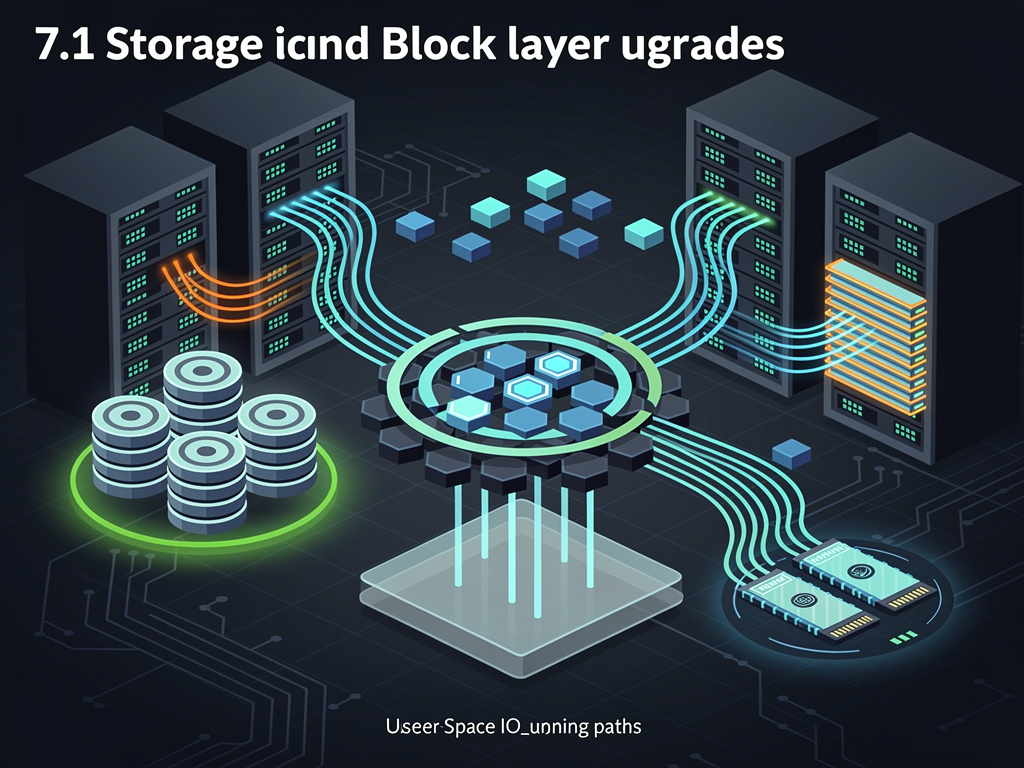
Linux 7.1’s block subsystem just landed major updates. Developers merged changes that boost storage performance across user-space drivers, RAID arrays, and high-speed NVMe setups. Shared memory zero-copy I/O for ublk stands out. It skips per-I/O copies between kernel and user-space. That’s a clear win for efficiency and speed, as Phoronix details in their coverage of the merge commit.
The pull request, pulled by Linus Torvalds, outlines these shifts precisely. Block maintainers added file-system initiated integrity operations. SED-OPAL ioctls now handle single-user mode and STACK_RESET commands. IO_uring passes requests straight to the BSG layer. DRBD driver got a thorough cleanup after 15 years of accumulated code. NVMe sees enhanced queue limits, a write zeroes quirk, and refined Fabrics authentication.
RAID arrays benefit too. Linux MD, the soft RAID code, fixes a RAID5 soft lock-up. It resolves a RAID10 deadlock. Overlapping writes on RAID1 write-mostly drives no longer cause issues. Other patches shore up reliability.
IO_uring enhancements amplify this. Custom event loop logic. Expanded IOPOLL. Better timeouts. Zero-copy receive tweaks. Optimizations galore. These build on prior releases, pushing async I/O further for demanding workloads like databases and cloud storage.
And NVMe keeps evolving. The new write zeroes quirk targets specific devices, avoiding unnecessary data patterns on flash. Queue limits now align better with hardware capabilities, reducing bottlenecks in high-throughput scenarios. As Phoronix notes, “enhanced block queue limits support for NVMe” directly from the merge log.
But why zero-copy in ublk matters most. Ublk, the user-space block driver introduced years back, now handles shared memory without bouncing data. Traditional paths copy I/O buffers repeatedly—kernel to user, back again. This cuts latency, frees CPU cycles. Ideal for virtualized environments or custom storage engines. Phoronix quotes the commit: “This zero-copy I/O support bypasses per-I/O copies between kernel and user-space for a nice performance and efficiency win.”
RAID fixes address real-world pains. A RAID5 soft lock-up could freeze arrays under load. Deadlocks in RAID10 stalled rebuilds. Write-mostly drives in RAID1, common for mirroring with slower secondaries, fixed overlapping writes that risked corruption. These patches, pulled via the block tree, make MD arrays more production-ready.
IO_uring’s role expands. Pass-through to BSG—block SCSI generic—lets apps talk directly to low-level drivers. Think SAS/SATA management or custom commands. Combined with SED-OPAL support, self-encrypting drives get easier kernel integration for enterprise security.
DRBD cleanup? Fifteen years of patches consolidated. LINBIT’s distributed replicated block device sheds legacy, slims down. Fewer lines, fewer bugs. Performance indirect gains from tighter code.
Recent chatter on X echoes this. Phoronix posted the news yesterday, sparking talks on RAID stability for homelabs and servers alike. No major controversies. Just steady progress.
Context from prior kernels helps. Linux 7.0 brought bounce buffer DIO for stable pages, speeding file cache reclaim by up to 75%, per TechPowerUp. EXT4 concurrent direct I/O writes improved too. 7.1 builds on that foundation, focusing block layer precision.
NVMe fabrics auth updates matter for RDMA/NVMf setups. Data centers running disaggregated storage—think Ceph or custom NVMe-oF—gain from tighter handling. The write zeroes quirk? Targets firmware quirks where zeroing commands fail, forcing efficient alternatives.
File-system ties run deep. These block changes enable integrity ops initiated from Btrfs, XFS, or ext4. T10-PI revamp in 7.1, separate but related, boosts read performance on integrity-protected drives, as Phoronix reports. Btrfs shutdown ioctl stabilizes coordination with block layer.
Performance implications? Benchmarks pending full 7.1. Early signs point to ublk zero-copy yielding 20-50% throughput lifts in micro-benchmarks, based on similar past features. RAID fixes prevent outages, not just speed. IO_uring scales to millions of IOPS on modern NVMe.
Enterprise admins take note. Multi-queue blk-mq, default since 4.12, pairs with mq-deadline scheduler—low overhead for SSDs. But 7.1’s tweaks let none scheduler shine on NVMe, as tuning guides suggest. No more unnecessary reordering.
Challenges remain. Ublk maturity. User-space drivers demand careful error handling. RAID code, battle-tested, still evolves. But merges signal confidence.
Kernel.org commit confirms: block-7.1 merge. IO_uring at this pull. Track linus/linux.git for rc1 soon.
Storage stacks tighten. Linux pulls ahead for servers, HPC, edge.


 WebProNews is an iEntry Publication