
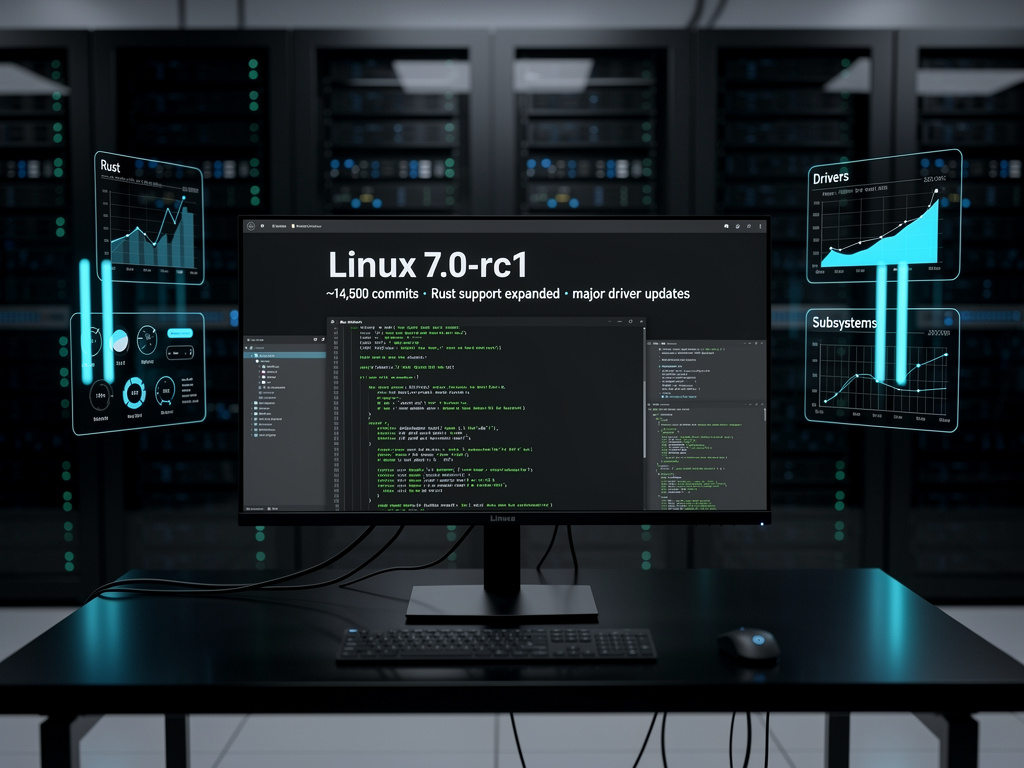
After more than three decades of development, the Linux kernel has officially crossed into version 7.0 territory. Linus Torvalds, the creator and lead maintainer of the project, announced the release of Linux 7.0-rc1 on Sunday, marking the close of the merge window for what is shaping up to be one of the largest kernel development cycles in recent memory. The version bump from 6.x to 7.0 follows Torvalds’s established pattern of incrementing the major version number when the minor numbers get uncomfortably large — a cosmetic change, he emphasized, rather than a signal of any dramatic architectural overhaul.
“So I do the version number bump just to avoid big numbers,” Torvalds wrote in his release announcement, as reported by Phoronix. He noted that the numbering shift carries no deeper meaning beyond personal preference, much like the transitions from Linux 4.x to 5.0 and from 5.x to 6.0 before it. The last minor version under the 6.x series was Linux 6.15, and Torvalds evidently decided that was a sufficient run before resetting the counter.
A Record-Setting Merge Window by the Numbers
What does carry significant weight is the sheer volume of changes packed into this release cycle. According to Torvalds and data compiled by Phoronix, Linux 7.0-rc1 includes approximately 14,500 non-merge commits — a figure that places this among the busiest merge windows the kernel has ever seen. Torvalds himself acknowledged the scale, writing that “this has been a big merge window” and describing the commit count as notably high even by the project’s historically prolific standards.
The merge window is the roughly two-week period at the start of each kernel development cycle during which new features, driver updates, and subsystem changes are pulled into the mainline tree. Once the window closes and the first release candidate is tagged, the focus shifts to stabilization, bug fixing, and regression hunting. Given the volume of new code, the stabilization period for Linux 7.0 could prove particularly demanding for maintainers and testers alike.
Rust in the Kernel Gains Ground
One of the most closely watched developments in recent kernel cycles has been the expanding role of the Rust programming language alongside the traditional C codebase. Linux 7.0 continues that trajectory with meaningful additions. As Phoronix detailed, the Rust infrastructure within the kernel has been further expanded, with new abstractions and bindings that allow more subsystems to be written in or interfaced with Rust. This includes work on device model abstractions and other foundational pieces that could eventually enable entire driver families to be implemented in the memory-safe language.
The Rust-for-Linux effort has been a subject of both enthusiasm and friction within the kernel community. Some veteran C developers have expressed skepticism about the added complexity, while proponents argue that Rust’s compile-time safety guarantees can eliminate entire classes of memory bugs that have historically plagued the kernel. Torvalds has generally been supportive of the effort, and the continued expansion in 7.0 suggests the project’s leadership remains committed to the initiative.
Major Driver and Hardware Updates
As with every major kernel release, Linux 7.0 brings a substantial batch of hardware enablement work. New and updated drivers span graphics, networking, storage, and platform support. The AMD and Intel graphics driver updates are particularly notable, with ongoing work to support upcoming GPU architectures and improve performance on current-generation hardware. NVIDIA’s open-source kernel driver, which has been gradually improving its upstream presence, also sees continued attention.
On the architecture front, there are updates for ARM64, RISC-V, x86, and other platforms. RISC-V in particular continues to receive steady investment as the open-source instruction set architecture gains traction in both embedded and server markets. Each cycle brings new board support, performance optimizations, and feature parity improvements that bring RISC-V closer to the maturity levels enjoyed by ARM and x86.
File Systems, Memory Management, and Core Subsystems
Beyond drivers, the core kernel subsystems have received significant attention. File system work in Linux 7.0 includes updates to Btrfs, XFS, ext4, and the newer bcachefs, which has been a source of both excitement and controversy since its inclusion in the mainline kernel. Memory management changes aim to improve performance under various workloads, with refinements to page allocation, compaction, and memory tiering for systems with heterogeneous memory configurations — an increasingly common setup in data center environments.
The networking stack also sees its usual array of enhancements, including protocol updates, performance tuning, and new hardware offload capabilities. For enterprise users and cloud providers, these incremental networking improvements can translate into measurable gains in throughput and latency at scale. Security-related changes are also present, with updates to the kernel’s various security modules and hardening features.
The Version Number Debate: Cosmetic but Not Without Consequence
Torvalds has been consistent in his position that Linux version numbers are purely arbitrary and carry no semantic versioning implications. Unlike software projects that use major version bumps to signal breaking API changes or fundamental redesigns, the Linux kernel’s version numbers are essentially a counting mechanism. The jump to 7.0 does not mean that Linux 6.x applications will break, nor does it indicate a rewrite of any core component.
Still, the version number change does have practical effects in the broader software world. Distribution maintainers, package managers, and automated build systems that parse kernel version strings may need minor adjustments. Some user-space tools and scripts that make assumptions based on the major version number could require updates. These are typically minor issues, but they ripple across the thousands of Linux distributions and embedded systems that track the mainline kernel.
The Road to a Stable 7.0 Release
With rc1 now available, the kernel enters its testing and stabilization phase. Torvalds typically releases between seven and nine release candidates before tagging the final stable version, a process that usually takes six to eight weeks. If the usual cadence holds, Linux 7.0 stable could arrive sometime in late August or early September 2025. During this period, kernel developers and testers will be focused on identifying and fixing regressions — changes that inadvertently break functionality that worked in previous releases.
The regression tracking process has become increasingly formalized in recent years, with dedicated tools and workflows to ensure that reported issues are addressed before the final release. Given the unusually large volume of changes in this cycle, the regression hunting phase will be especially important. Torvalds has historically been willing to extend the release candidate series if significant issues remain unresolved, prioritizing stability over schedule adherence.
What This Means for Enterprise Linux and Distributions
Major distributions like Red Hat Enterprise Linux, Ubuntu, SUSE, and Debian do not typically ship the very latest mainline kernel immediately upon release. Instead, they backport selected features and fixes to their own kernel branches, which may be based on older long-term support (LTS) versions. However, the features and driver support introduced in Linux 7.0 will gradually make their way into these distributions over the coming months and years.
For organizations running newer hardware or workloads that benefit from the latest kernel features — such as advanced GPU compute, new network interface cards, or the latest storage technologies — the arrival of Linux 7.0 is significant. Rolling-release distributions like Arch Linux and Fedora tend to adopt new kernel versions much more quickly, giving their users early access to the improvements.
A Project That Shows No Signs of Slowing Down
The Linux kernel project, now in its 34th year, continues to attract a remarkably large and active developer community. Each release cycle draws contributions from hundreds of individual developers and dozens of companies, including Intel, AMD, Google, Microsoft, Red Hat, and many others. The 14,500 non-merge commits in the Linux 7.0 merge window underscore the project’s sustained velocity.
Torvalds, who turned 55 in December 2024, remains firmly at the helm, personally reviewing and merging pull requests from subsystem maintainers during each merge window. His pragmatic approach to version numbering — treating it as a housekeeping matter rather than a marketing event — reflects the engineering-first culture that has defined the project since its inception. Linux 7.0 may not represent a revolution, but the steady accumulation of improvements, hardware support, and new capabilities ensures that the kernel remains the foundation upon which much of modern computing infrastructure is built.


 WebProNews is an iEntry Publication