
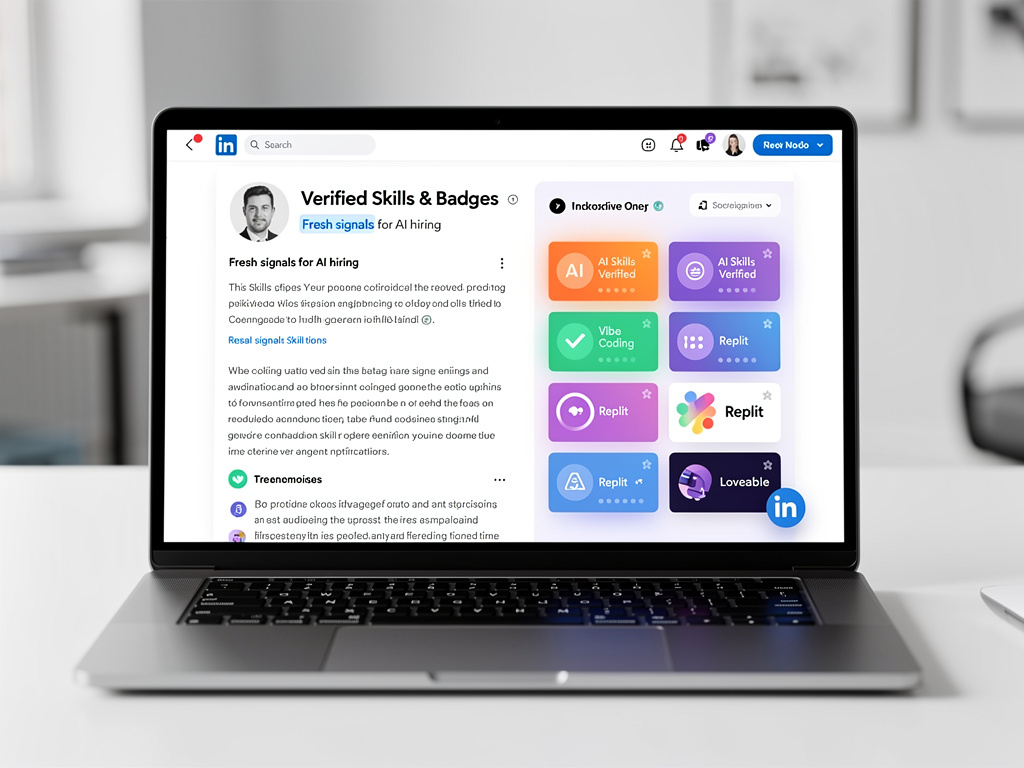
LinkedIn, the Microsoft-owned professional network, unveiled a feature on January 28, 2026, allowing users to showcase verified proficiency in ‘vibe coding’ and other AI tools directly on their profiles. These badges, drawn from usage data provided by third-party partners, mark a shift toward data-backed claims of expertise amid surging demand for AI fluency.
The rollout targets a core tension in today’s hiring market: self-reported skills often lack proof. Partners like Replit, Lovable, Descript, and Relay.app assess users through real-world interactions—no exams required. Proficiency levels, such as Lovable’s ‘bronze’ in vibe coding or Replit’s numerical scores, appear in the ‘Licenses and Certifications’ section and update dynamically as skills improve. Engadget detailed how these signals aim to help recruiters spot genuine talent.
Upcoming integrations with GitHub and Zapier signal broader ambitions. LinkedIn invites more software makers to join for free, positioning the platform as a hub for emerging tech credentials. This move builds on over 100 million identity verifications already on the site, extending trust to capabilities.
Vibe Coding’s AI-Driven Roots
Vibe coding, coined by OpenAI co-founder Andrej Karpathy in early 2025, describes an intuitive approach where developers ‘surrender to the vibes,’ letting AI handle code generation via natural language prompts. Users describe ideas, accept AI suggestions from tools like Cursor or GitHub Copilot, and iterate without deep code review. MIT Technology Review explained Karpathy’s method: ‘I’m building a project or webapp, but it’s not really coding—I just see stuff, say stuff, run stuff, and copy paste stuff, and it mostly works.’
Platforms like Replit and Lovable embody this trend. Replit, valued at $3 billion in 2023, launched vibe coding for mobile apps using English prompts, enabling non-coders to publish to app stores. Lovable, a Swedish unicorn at $6.6 billion, lets users build apps via chat-like interfaces. These tools have exploded in popularity, with courses like DeepLearning.AI’s ‘Vibe Coding 101 with Replit’ teaching agentic development.
Yet risks persist. Cybersecurity firm Tenzai flagged vulnerabilities in AI-generated code from Replit and others, including failures against brute-force attacks. Sergey Tselovalnikov of Canva warned in MIT Technology Review: ‘Vibe coding can make a lot of errors… if you don’t know if there are any security vulnerabilities and you didn’t test the code yourself, that’s very dangerous.’
How Proficiency Gets Verified
Users connect partner accounts to LinkedIn, where AI analyzes usage patterns, project outcomes, and sophistication. Relay.app might tag someone ‘intermediate’ in AI Agent Builder; levels rise with consistent engagement, even from side projects. Pat Whelan, LinkedIn’s head of career products, told Fast Company: ‘The level of certification can increase over time as people continue to use a tool and demonstrate their sophistication with it.’
This ‘live certification’ bypasses traditional tests, validating hands-on experience. Whelan added: ‘That signals to hirers that this person actually has that skill and actually put the time in—they’re using that product.’ Hari Srinivasan, LinkedIn VP of Product, emphasized trust in a TechCrunch statement: ‘Jobs require fluency in the technology your employer depends on and AI proficiency; the ability to use these tools to deliver today is now the most in-demand skill.’
The feature integrates with LinkedIn’s hiring tools, feeding verified data into recruiter searches and AI assistants. Social Media Today noted it reinforces generative AI skills, helping users stand out without unverified boasts.
Exploding Demand Fuels the Push
AI mentions in job postings have skyrocketed. An eDX report cited in TechCrunch showed they doubled in the prior year. Indeed’s Hiring Lab found U.S. postings with AI keywords hit 4.2% by late 2025, spreading from tech to banking and marketing.
LinkedIn’s timing reflects this shift. With 82% of businesses facing developer shortages per eWeek, vibe coding democratizes creation. Jacob Bank, CEO of Relay.app, posted on X: ‘Working with AI (prompting, vibe coding, building AI agents) is now the most important skill for every job seeker.’ Tools like Replit’s Autonomous AI Agent support Python, JavaScript, and more, fueling innovation.
Critics see irony: AI tools behind these badges have spurred layoffs. Whelan addressed this in Engadget: ‘This is less about replacing any of those other existing signals, and more about showing new ways that people are doing work.’
Industry Echoes and Early Reactions
News spread quickly on X, with TechCrunch and Engadget posts garnering thousands of views. Techmeme highlighted the launch, while users like @jebank praised automatic updates: ‘As your skills improve, your certification will automatically update.’ Sarcasm appeared too, with one calling them ‘official douchebag certifications.’
For partners, it’s validation. Replit’s mobile vibe coding drew praise for speed but flak for credit burn and bugs, per ZDNet hands-on tests. Lovable impressed with semantic analysis apps. LinkedIn’s free partner program could draw dozens more, per Fast Company.
As of late January 2026, no major updates emerged, but the feature aligns with LinkedIn Learning’s AI courses, amplifying its ecosystem.
Implications for Hiring and Careers
Hirers gain filters for AI-savvy candidates, potentially reshaping resumes. Whelan told Fast Company: ‘We think there’s a lot of opportunities to create new signals where members can show they genuinely have skills in these emerging areas.’
Job seekers, especially non-traditional learners, benefit. Tobin South noted in MIT Technology Review: ‘It takes the cost of producing software and dramatically reduces it to an exponential degree. The world will have to adapt.’
Challenges remain: over-reliance on partners risks echo chambers, and unverified tools could mislead. Still, this verifiable layer elevates LinkedIn amid AI’s hiring upheaval.


 WebProNews is an iEntry Publication