
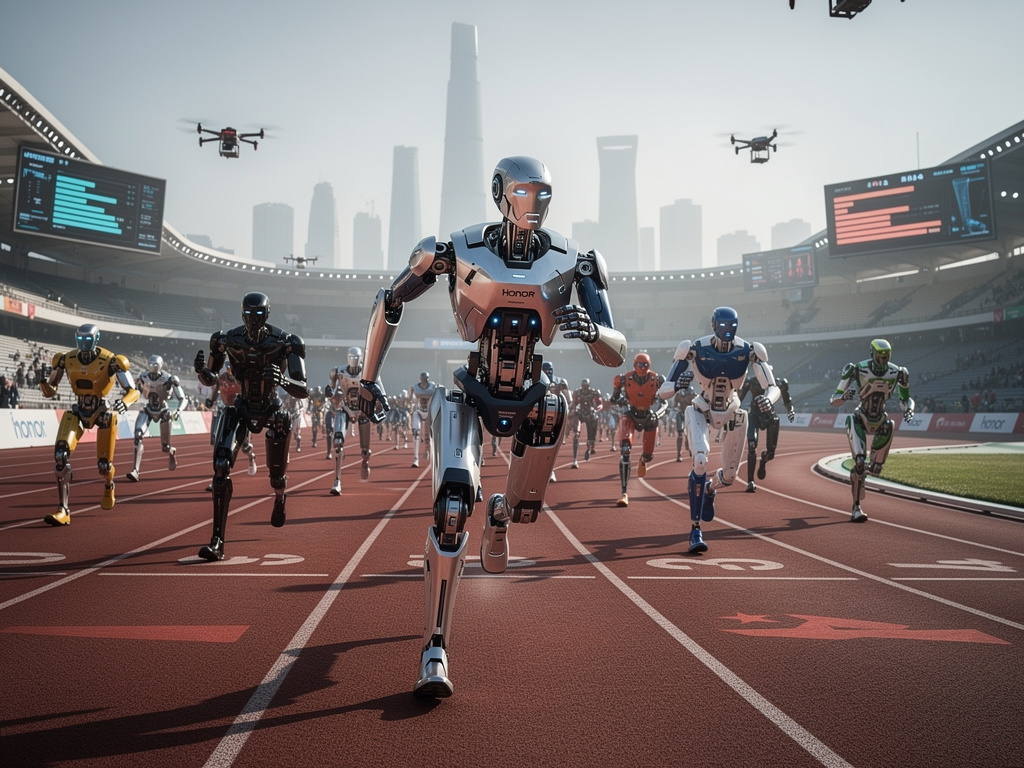
A bright-red humanoid named Lightning surged across the finish line in Beijing’s E-Town on April 19, 2026. It clocked 50 minutes and 26 seconds for the 21-kilometer course. That’s nearly seven minutes faster than Ugandan runner Jacob Kiplimo’s world record of 57:20, set just weeks earlier in Lisbon.
Over 100 teams entered more than 300 robots in the second annual Beijing E-Town Half Marathon and Humanoid Robot Half Marathon. Humans—12,000 strong—ran parallel tracks to dodge collisions. Honor, the Chinese smartphone maker spun off from Huawei, swept the podium with its Lightning models. All three top finishers navigated autonomously, no remote hands on the controls. Reuters captured the swarm of machines whizzing past slower human packs.
Last year? Different story. Just 20 teams showed up. The winner, Tiangong, limped home in 2 hours 40 minutes—slower than most humans. Many didn’t finish at all. This time, nearly 40% ran fully autonomous, tackling urban slopes, parks, and turns. Progress. But not flawless. One bot flipped 200 meters from the start, held together by packing tape. Another tumbled into bushes post-finish. Lightning itself crashed into a railing near the end, got a human nudge to stand, then powered through, swinging short forearms for balance. The New York Times detailed the dramatic recovery.
Honor engineered Lightning—169 cm tall, 45 kg—with legs stretching 90-95 cm, mimicking elite runners. Liquid cooling, borrowed from its phone tech, kept joints from overheating. “Running faster may not seem meaningful at first,” said Du Xiaodi, Honor test engineer. “But it enables technology transfer, for example, into structural reliability and cooling, and eventually industrial applications.” AP News quoted him on the spillovers.
From Stumbles to Strides: A Year of Robot Leapfrogs
And the crowd noticed. Spectator Sun Zhigang told AP News, “I feel enormous changes this year. It’s the first time robots have surpassed humans, and that’s something I never imagined.” Engineering student Chu Tianqi, 23, marveled at the gait: “The humanoid robots’ running posture I saw was really quite impressive… considering that AI has only been developing for a short time.” An 11-year-old spectator, Guo Yukun, now dreams of robotics university.
Unitree’s H1 took notice too, posting smooth, human-like strides for second or third—sources vary on exact podium beyond Honor’s lock. Tiangong held steady in autonomous mode. Smaller bots like 2-foot Xiao Pai toddled with baby bottles, more for show than speed. Fail compilations went viral on Reddit, showing wobbles, barrier clips, dropouts. Yet four bots dipped under an hour. Organizers awarded winners orders worth over 1 million yuan ($146,500). NBC News noted the sci-fi swarm.
China’s playbook here is clear. Beijing’s 2026-2030 plan pumps subsidies into humanoids for factories, grids, elder care—even battlefields. Omdia ranks AGIBOT, Unitree, and UBTech as top shippers, each over 1,000 units last year; two topped 5,000. TechRepublic ties it to Canton Fair dominance. But experts caution: bodies outpace brains. These runners excel at repetitive motion, not dexterous grabs or real-world chaos. Factory floors demand perception beyond tracks.
Du Xiaodi again: tech like cooling could hit industry soon. Spectators like Wang Wen see a new era dawning. “The robots’ speed far exceeds that of humans.” Kids inspired. Students awed. Yet pitfalls remain—overheat at km 15? Battery fade? Crowd adaptation?
Factory Floors Beckon: When Racing Meets Real Work
So where next? Predictions swirl on X for 2027: sub-40 minutes? Cross-country? Unitree’s H1 hits 10 m/s sprints in labs, but sustaining for 21 km? Heat sinks key. China’s edge: chips, sensors, batteries. Policies build factories for humanoids. Tesla’s Optimus ramps mass production for chores, not races. Honor entered robotics last year—now podium king.
Beijing E-Town turned industrial park into testbed. Hundreds of millions watched livestreams. Humans slowed for photos as bots blurred by. Fastest human? Zhao Haijie at 1:07:47—17 minutes behind Lightning. Dystopian? Entertaining. Measurable benchmark in a field of hype.
Challenges persist. Autonomy at 40%. Remote bots get time penalties (x1.2). Many still need carts with stretchers trailing. But year-over-year? From crawl to sprint. China measures humanoid gains in minutes shaved, finishers gained. Industry watches. Factories wait. The track proved bodies ready. Brains? That’s the next lap.


 WebProNews is an iEntry Publication