
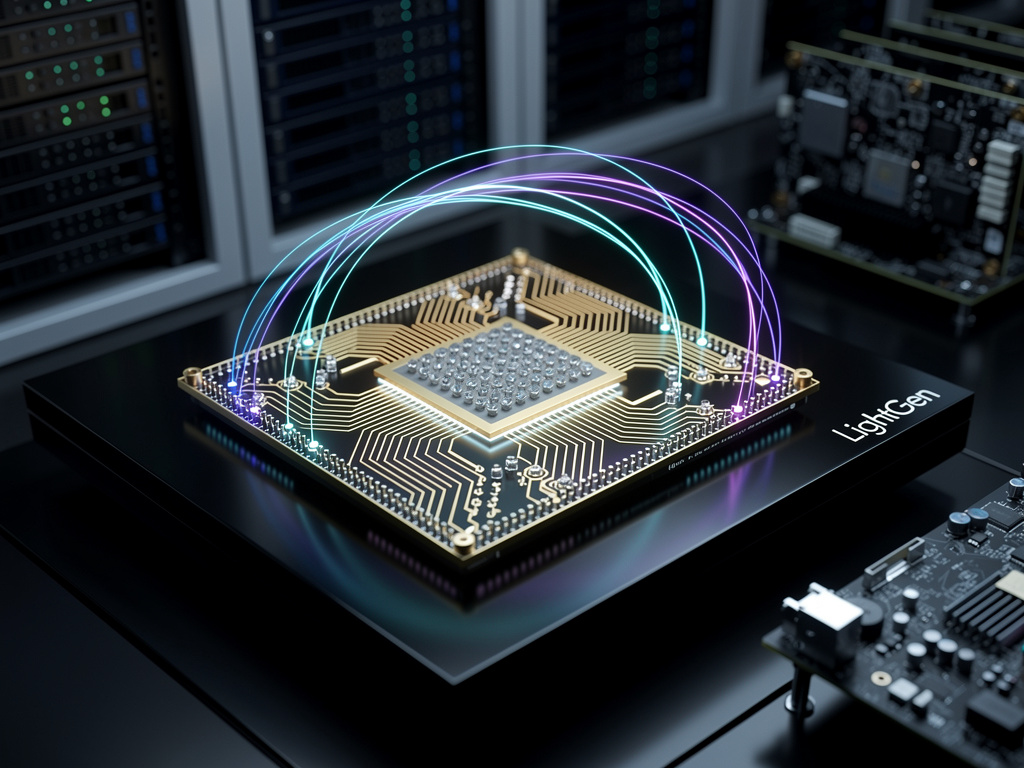
Illuminating the Future: How LightGen’s Optical Chip is Redefining AI Computation
In the relentless pursuit of more powerful artificial intelligence, a groundbreaking innovation has emerged from China’s academic corridors. Researchers at Shanghai Jiao Tong University and Tsinghua University have unveiled LightGen, an all-optical computing chip that promises to revolutionize generative AI by harnessing light instead of electricity. This development, detailed in a recent paper published in the journal Science, addresses the escalating demands for computational speed and energy efficiency in an era where AI models are growing exponentially larger and more complex.
LightGen represents a paradigm shift in computing architecture. Traditional electronic chips, like those from Nvidia, rely on electrical signals that generate heat and consume vast amounts of power. In contrast, LightGen uses photonic technology, processing data through pulses of laser light. This approach not only accelerates computations but also drastically reduces energy consumption, making it a potential game-changer for data centers and AI training facilities worldwide.
The chip’s capabilities were highlighted in demonstrations where it performed generative tasks, such as creating images from text descriptions, at speeds and efficiencies far surpassing current hardware. According to reports from the EurekAlert! news service, LightGen achieves performance levels orders of magnitude better than electronic counterparts, tackling the bottlenecks that have plagued large-scale AI models.
Breaking Through Computational Barriers
At the heart of LightGen is its architecture featuring over two million photonic neurons. These optical components enable the chip to handle complex generative AI tasks entirely within the optical domain, eliminating the need for cumbersome conversions between optical and electronic signals. This innovation, as described in coverage by the South China Morning Post, allows for a fully optical generative loop, which is crucial for tasks like semantic vision generation.
Benchmark tests reveal staggering improvements: LightGen delivers up to 35,700 trillion operations per second (TOPS) with an energy efficiency of 664 TOPS per watt. This is a hundredfold enhancement over Nvidia’s A100 GPU, a staple in AI computing. Posts on X from technology influencers, such as those emphasizing the chip’s light-speed processing, underscore the excitement around this leap, noting its potential to alleviate the power shortages crippling AI advancements.
The research team’s breakthrough lies in their proprietary Optical Latent Space Technology, which optimizes how data is represented and processed in the optical realm. This method ensures that generative models can run efficiently without the energy overhead of traditional systems, paving the way for more sustainable AI deployments.
Unveiling the Technical Marvels
Diving deeper into the chip’s design, LightGen integrates diffractive optics and microscopic lenses to manipulate light waves for computations. Inspired by earlier photonic experiments, such as those reported in a University of Florida news release, the chip performs convolutions—a core AI operation—using light beams, bypassing the power-hungry electrical transistors.
In practical terms, this means AI systems could train and infer at unprecedented speeds. For instance, generating high-fidelity images or videos, which currently demand massive server farms, could become feasible on much smaller, more efficient hardware. The China Daily reported that LightGen is the first optical chip to support large-scale semantic and visual generative models, marking a milestone in photonic computing.
Moreover, the chip’s efficiency could democratize AI access, reducing the environmental footprint of data centers that consume electricity equivalent to small cities. Industry insiders are buzzing about its implications for edge computing, where devices like smartphones or autonomous vehicles need real-time AI without draining batteries.
From Lab to Global Impact
The journey to LightGen builds on years of photonic research. Earlier innovations, like the optical feature extraction engines mentioned in X posts from users discussing Tsinghua University’s work, laid the groundwork. These precursors demonstrated light-based processing for decision tasks, but LightGen extends this to generative applications, a more demanding domain.
Collaborative efforts between Shanghai Jiao Tong and Tsinghua universities have accelerated this progress. As detailed in a KAD article, the chip’s unveiling on December 18, 2025, positions China at the forefront of optical AI technology, potentially shifting the balance in the global semiconductor race.
However, challenges remain. Scaling production of photonic chips involves overcoming manufacturing hurdles, such as precise alignment of optical components at nanoscale levels. Experts note that while LightGen excels in specific tasks, integrating it with existing electronic infrastructure will require hybrid systems, blending the best of both worlds.
Industry Reactions and Competitive Dynamics
The announcement has sparked widespread discussion on platforms like X, where posts highlight LightGen’s superiority in speed and efficiency. One influential thread described it as a “computing revolution,” echoing sentiments from Interesting Engineering, which reported the chip’s outperformance of GPUs in targeted AI workloads.
Competitors are taking note. Nvidia, long dominant in AI hardware, faces pressure to innovate amid U.S.-China tech tensions. Reports from Singularity Hub suggest that optical computing could erode the market share of traditional GPUs, prompting investments in photonic alternatives.
Beyond hardware giants, startups and research labs worldwide are exploring similar technologies. For example, advancements in co-packaged optics, as covered in a SiliconValley.com piece, indicate a broader trend toward light-based interconnects in AI clusters.
Economic and Ethical Considerations
Economically, LightGen could lower the barriers to AI adoption. By slashing energy costs, which account for a significant portion of AI operations, businesses might accelerate innovation in fields like healthcare and autonomous driving. A NewsBytes article emphasized how this efficiency could make advanced AI accessible to smaller enterprises, fostering a more inclusive tech ecosystem.
On the ethical front, the reduced energy demands align with global sustainability goals. AI’s carbon footprint is a growing concern, and photonic solutions like LightGen offer a path to greener computing. Yet, questions arise about equitable access, especially given geopolitical restrictions on technology transfers.
Furthermore, as AI becomes more powerful, ensuring responsible development is paramount. LightGen’s speed could enable real-time applications in surveillance or content generation, raising privacy and misinformation risks that policymakers must address.
Future Horizons in Optical AI
Looking ahead, the integration of LightGen-like chips could transform AI architectures. Hybrid systems combining optical and electronic elements might emerge, optimizing for different tasks. Research from X posts referencing diffractive neural networks suggests ongoing refinements that could enhance accuracy and versatility.
International collaboration or competition will shape the trajectory. While China’s lead is evident, U.S. and European initiatives, such as those in quantum optics, could yield competing breakthroughs. The RaillyNews article posits this as the dawn of a “computing revolution,” where light-powered chips become standard.
In essence, LightGen illuminates a future where AI computation is not bound by electrical limits. As the technology matures, it could redefine what’s possible, from ultra-efficient data centers to portable AI devices, ushering in an era of unprecedented innovation.
Pioneering Applications and Challenges Ahead
Envisioning applications, LightGen could power next-generation virtual reality, generating immersive environments on the fly with minimal latency. In scientific research, it might accelerate simulations for drug discovery or climate modeling, where computational demands are immense.
Yet, adoption hurdles include standardization and compatibility. Integrating optical chips into existing workflows requires new software tools and training, as noted in various X discussions on photonic AI.
Ultimately, LightGen stands as a beacon of progress, challenging the status quo and inspiring a wave of optical innovations that could sustain AI’s rapid evolution for decades to come. With continued research, this technology may well become the backbone of tomorrow’s intelligent systems.


 WebProNews is an iEntry Publication