
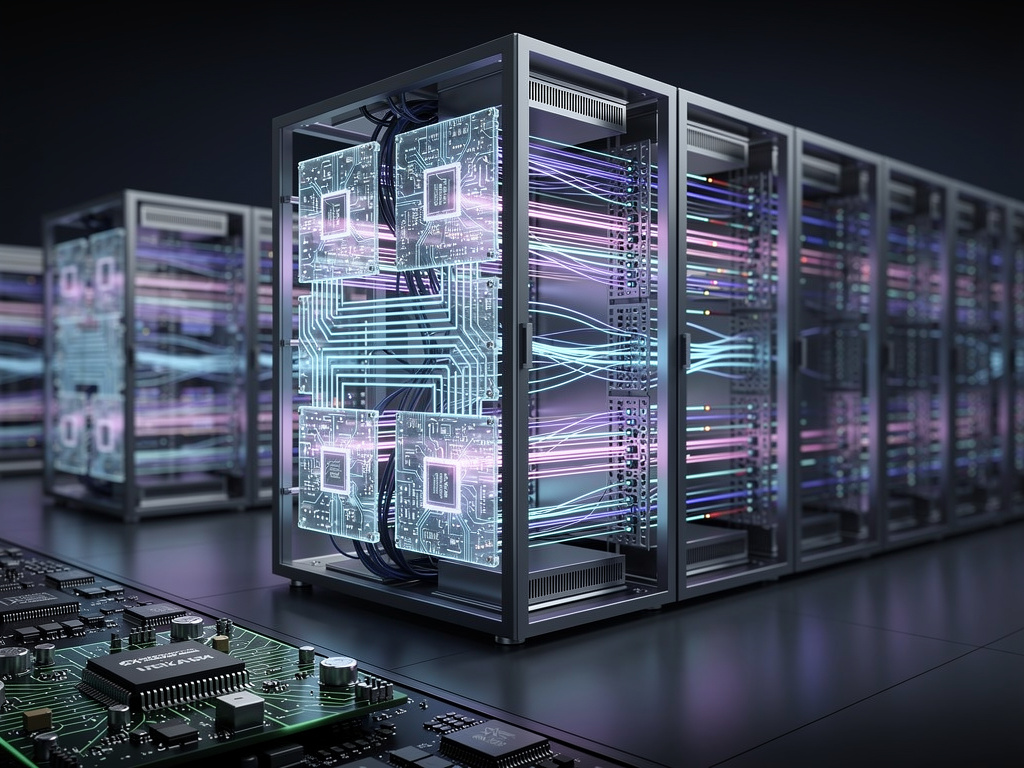
The semiconductor industry stands at a crossroads. For decades, Moore’s Law—the observation that the number of transistors on a microchip doubles approximately every two years—has driven technological progress with remarkable consistency. Yet as transistors shrink to atomic scales and heat dissipation challenges mount, the industry faces fundamental physical limitations that threaten to halt this relentless march forward. Enter Lightmatter, a Boston-based startup backed by Bill Gates, which is pioneering a radical departure from traditional electronic computing by harnessing photons instead of electrons.
According to TechRadar, Lightmatter’s optical computing technology promises to overcome the fundamental constraints of silicon-based processors. The company’s approach leverages photonic integrated circuits that use light waves to perform computations, potentially delivering exponential improvements in speed and energy efficiency. This technology could prove particularly transformative for artificial intelligence workloads, where massive parallel processing demands have pushed conventional GPU architectures to their thermal and power consumption limits.
The implications extend far beyond incremental performance gains. While traditional transistors face insurmountable barriers as they approach the 1-nanometer threshold, optical computing operates on entirely different principles. Photons, unlike electrons, don’t generate significant heat during transit and can pass through one another without interference, enabling unprecedented levels of parallelism. For data centers consuming ever-larger portions of global electricity—projected to reach 8% by 2030 according to industry estimates—this efficiency advantage could reshape the economics of computing infrastructure.
The Physics of Light-Based Processing
Lightmatter’s technology represents years of research translated from academic laboratories into commercial viability. The company’s photonic processors utilize silicon photonics, a manufacturing approach that leverages existing semiconductor fabrication techniques to create optical components. This strategic choice addresses one of the primary obstacles that has historically prevented optical computing from achieving mainstream adoption: the ability to manufacture photonic chips at scale using proven production methods.
The architecture centers on optical interconnects and computation units that manipulate light beams to perform mathematical operations. In neural network applications, matrix multiplication—the fundamental operation underlying modern AI—can be executed optically with dramatically reduced latency. Where electronic GPUs might require thousands of clock cycles and substantial power draw, photonic equivalents can complete similar operations nearly instantaneously, limited only by the speed of light itself rather than electrical resistance and capacitance.
Industry Validation and Strategic Backing
Bill Gates’ investment through Breakthrough Energy Ventures signals confidence from one of technology’s most prescient investors. Gates has consistently backed transformative technologies addressing fundamental challenges, and his support lends credibility to Lightmatter’s ambitious vision. The company has also attracted partnerships with major cloud providers and semiconductor manufacturers, suggesting that industry leaders view optical computing as a viable path forward rather than speculative research.
The competitive dynamics are shifting rapidly. While Lightmatter has emerged as a frontrunner, several well-funded competitors are pursuing similar approaches. Companies like Luminous Computing and Ayar Labs are developing their own photonic computing platforms, each with distinct architectural choices and target markets. This proliferation of optical computing ventures indicates growing consensus that electronic computing’s limitations are not merely theoretical concerns but immediate commercial challenges requiring new solutions.
Artificial Intelligence as the Killer Application
The explosive growth of artificial intelligence has created unprecedented demand for computational resources. Training large language models like GPT-4 requires thousands of high-end GPUs operating continuously for months, consuming megawatts of power and generating enormous operational costs. Inference—deploying these models to serve user requests—presents its own scaling challenges as AI applications proliferate across industries. Optical computing’s efficiency advantages directly address these pain points.
Lightmatter’s initial product focus targets AI inference workloads specifically. The company’s Envise photonic processor is designed to accelerate neural network operations with a fraction of the energy consumption of conventional accelerators. Early benchmark results suggest performance improvements of 10x or more on specific AI tasks, with power efficiency gains that could fundamentally alter the economics of deploying AI at scale. For hyperscale cloud providers operating millions of servers, such improvements translate directly to competitive advantage and profitability.
Manufacturing Challenges and Commercialization Timeline
Despite the technology’s promise, significant obstacles remain before optical computing can achieve widespread adoption. Integrating photonic and electronic components on the same chip requires sophisticated packaging and thermal management solutions. Light sources, modulators, and detectors must be precisely aligned and maintained within tight tolerances. Any manufacturing defects that would merely degrade performance in electronic circuits can render optical components completely non-functional.
Lightmatter has addressed these challenges through partnerships with established foundries and careful system design. The company’s approach emphasizes practical deployability rather than laboratory demonstrations, focusing on products that can be manufactured reliably and integrated into existing infrastructure. This pragmatic strategy distinguishes current efforts from previous optical computing initiatives that foundered on the gap between research prototypes and production-ready systems.
Economic and Environmental Implications
The environmental case for optical computing grows more compelling as data center energy consumption accelerates. Current trends suggest that without fundamental efficiency improvements, the computing industry’s carbon footprint will become increasingly untenable. Photonic processors could reduce energy consumption per operation by orders of magnitude, potentially enabling continued growth in computational capabilities while actually decreasing total power draw.
From an economic perspective, the transition to optical computing represents both disruption and opportunity. Established semiconductor manufacturers face potential obsolescence if they cannot adapt, while new entrants like Lightmatter could capture significant market share. The capital equipment industry will need to develop new fabrication and testing tools. Supply chains will shift as traditional silicon gives way to more complex photonic-electronic hybrid systems. These transitions will create winners and losers across the technology sector.
The Road Ahead for Photonic Computing
Industry analysts project that optical computing could capture a meaningful share of the AI accelerator market within five years, potentially reaching billions in annual revenue by the end of the decade. However, this timeline depends on continued technological refinement, successful commercial deployments, and customer validation. Early adopters will play a crucial role in proving the technology’s reliability and establishing best practices for integration and operation.
The broader implications extend beyond immediate commercial considerations. If optical computing delivers on its promise, it could enable entirely new categories of applications previously constrained by computational limitations. Real-time language translation, personalized medicine, climate modeling, and autonomous systems could all benefit from orders-of-magnitude improvements in processing capability. The technology might also revitalize Moore’s Law—not by shrinking transistors further, but by fundamentally changing how we compute.
Lightmatter and its competitors are not merely building faster chips; they are attempting to redefine the technological foundation of the digital age. Success would rank among the most significant technological transitions since the invention of the integrated circuit itself. While substantial challenges remain, the convergence of technical maturity, market demand, and strategic investment suggests that optical computing’s moment may finally have arrived. The next decade will reveal whether photons can indeed succeed where electrons are reaching their limits, ushering in a new era of computing performance and efficiency that reshapes industries and enables innovations we have yet to imagine.


 WebProNews is an iEntry Publication