
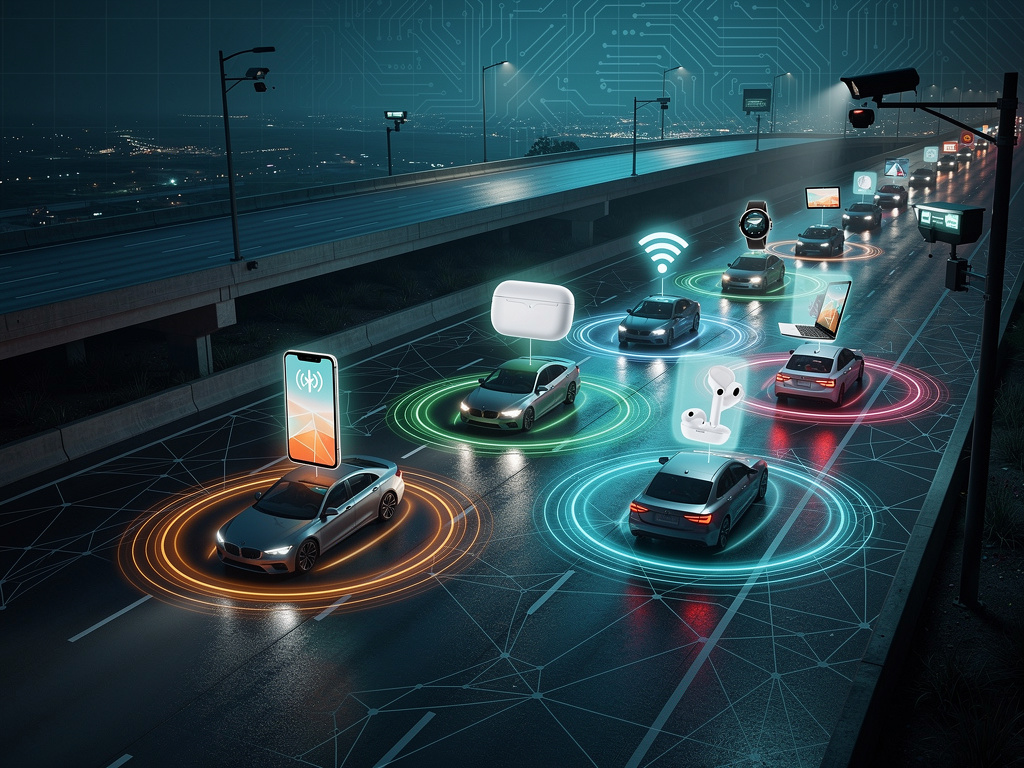
A surveillance firm has found a way to make automatic license plate readers far more personal. The company, Leonardo, added sensors that pick up signals from phones, wireless headphones, fitness trackers and car components. Call it SignalTrace. The system does not stop at noting a passing vehicle. It builds an electronic profile that ties the car to the devices riding inside.
Joseph Cox first detailed the product for 404 Media on June 8, 2026. His reporting drew from a Leonardo product sheet. That document describes how SignalTrace “links devices that regularly travel together, correlating them to license plate.” Short phrase. Large consequence.
The technology works because modern gadgets constantly announce themselves. Phones, AirPods, Apple Watches and even tire-pressure monitors send out Bluetooth, Wi-Fi or RFID signals. These contain unique identifiers, often MAC addresses, that stay consistent enough for tracking over time. Sensors mounted alongside existing license-plate cameras capture those broadcasts. Signal strength offers rough distance. Timestamps and plate images complete the picture.
Over repeated passes the system learns associations. Your phone and your smartwatch appear together most mornings. They ride in a gray SUV with a specific plate. The database notes the pattern. Later, investigators can search by device instead of plate. Or they can pull every gadget that kept company with a target vehicle. The result looks less like traffic enforcement and more like persistent location tracking of individuals.
Leonardo markets the capability directly to police. Its website calls SignalTrace “a groundbreaking software system for law enforcement, designed to identify suspect people or vehicles, even when a license plate number is not known.” The firm lists fitness trackers, smartwatches, RFID tags and “local signals from their mobile phones” as sources. A separate page promises data autonomy for agencies and compliance with local and federal guidelines. Yet the product sheet reveals a wider net: key cards, pet microchips, vehicle infotainment systems, tire-pressure sensors, laptops.
And. Recent coverage shows the rollout may already have momentum. Jalopnik reported on the same development June 11, 2026, noting that Leonardo’s cameras operate in all 50 states. The automotive site highlighted the absence of any opt-out. Drivers cannot disable the signals without powering down every device in the car. One example offered by the outlet: authorities could know that a particular Michigan plate on a 2016 Mercedes CLS 400 travels with an iPhone 16 and an Apple smartwatch.
This expansion arrives at a moment when courts have begun to draw boundaries around digital surveillance. Previous cases examined geofence warrants, prolonged device seizures and border searches. A federal appeals court ruled that the Fourth Amendment categorically prohibits certain geofence warrants. Another decision found lengthy police holds on phones violate constitutional protections. Those rulings, covered by WebProNews, suggest judges grow wary of bulk digital collection that reveals intimate patterns of life.
Yet license-plate readers occupy a gray zone. Plates sit in plain view. Courts have generally allowed their capture. Device identifiers travel in the open too, at least in a technical sense. Companies have long argued that broadcast signals carry no reasonable expectation of privacy. The Supreme Court has not settled the precise question for passive MAC-address collection from public roads. Until it does, agencies may treat SignalTrace data as fair game.
Privacy advocates see danger. The American Civil Liberties Union has called for strict limits on such tools. Mass retention of device-plate pairings could map social networks, medical visits, protest attendance and political meetings. One pass by a highway camera might link a journalist’s phone to a source’s car. Another could flag a patient’s watch near a clinic. Data stored for months or years only multiplies the risk of misuse or breach.
Leonardo insists its system respects individual rights. Promotional material claims the technology gathers only electronic signatures, not message content. It does not decrypt transmissions. Still, the distinction offers limited comfort. The identifiers alone suffice to follow someone across a city or state. Combine them with other feeds and the profile grows rich. Add facial recognition or public-camera video and the picture turns nearly complete.
Deployment looks straightforward. Many police departments already run Leonardo’s ALPR hardware. SignalTrace appears designed as an add-on. Upgrade the existing pole-mounted units rather than plant new ones. That lowers cost and speeds adoption. Discussions with agencies have begun, though specifics remain undisclosed. Incremental rollout could place the capability in dozens of jurisdictions before public debate catches up.
Similar concerns surfaced around earlier surveillance methods. Cell-site simulators, commercial Wi-Fi trackers and prolonged automatic license-plate retention all sparked litigation and legislation. Some states now restrict how long plate data may be kept. Others require warrants for certain queries. Those measures may need swift expansion to cover device correlation. Without them the infrastructure for continuous, suspicionless tracking of people—not just cars—settles into place.
Proponents counter that faster suspect identification solves crimes. A stolen car hits a camera. SignalTrace logs the phones that rode with it. Investigators locate the driver even after the plate is swapped. Convoy analysis could expose smuggling rings or organized theft operations. In targeted investigations the tool offers clear value. The trouble lies in mission creep. Systems built for serious cases tend to migrate toward routine patrol and database queries on minor matters.
Schneier on Security noted the development days after the initial report, warning that SignalTrace turns common ALPR deployments into far richer data collectors. Bruce Schneier’s brief post captured the shift: what once tracked vehicles now tracks the people inside them. The observation echoes long-standing cautions about function creep in law-enforcement technology.
Public reaction on X mixed alarm with resignation. Some users pointed out that phones already betray location to advertisers and carriers. Others argued the government collection differs in kind because it carries coercive power. A few posts highlighted that randomizing MAC addresses, available on recent phones, offers partial defense. Yet not every device supports the feature, and many users never enable it. Cars and watches often broadcast persistently.
The legal fights ahead seem certain. Defense lawyers will challenge SignalTrace-derived evidence under the Fourth Amendment. Civil suits may seek injunctions against unchecked retention. Legislatures in privacy-minded states could pass bills requiring warrants for device-linked queries or strict deletion schedules. How courts distinguish passive signal capture from more intrusive searches will shape the outcome.
For now the cameras keep rolling. They photograph the plate, note the time, and quietly log every emitting gadget within range. The database grows. Patterns emerge. A driver who once moved anonymously through traffic now carries an invisible electronic fingerprint. That change feels small at highway speed. Its cumulative weight on daily life may prove heavy.
Industry insiders tracking surveillance technology see this moment as pivotal. Automatic license-plate readers evolved from niche toll tools into widespread public-safety assets. SignalTrace marks the next logical step in that evolution, one that collapses the distinction between vehicle and occupant. Whether regulators, courts or voters rein it in will determine if the distinction survives.


 WebProNews is an iEntry Publication