
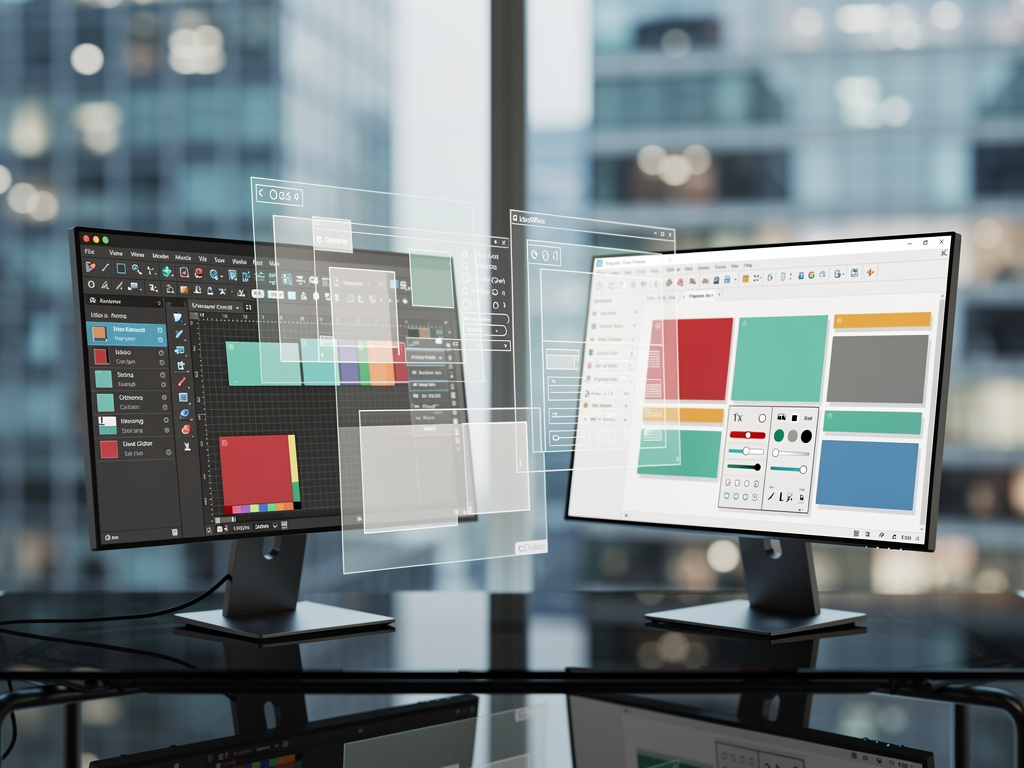
The Document Foundation, the nonprofit organization behind LibreOffice, has made a bold and provocative claim: its user interface has surpassed that of Microsoft Office. In a detailed blog post published in early March 2025, the organization laid out its case that the open-source productivity suite now offers a more intuitive, flexible, and user-friendly experience than the dominant commercial alternative — a declaration that has sparked heated debate across the technology world.
The assertion, first widely circulated via Slashdot, comes at a moment when Microsoft is increasingly steering its Office products toward cloud-based subscriptions, AI-powered features, and a design philosophy that prioritizes integration with its broader services portfolio. For LibreOffice, the timing is strategic: as users grow frustrated with subscription fatigue and interface bloat, the open-source alternative is positioning itself as the leaner, more customizable option.
The Document Foundation’s Case Against the Ribbon
At the heart of The Document Foundation’s argument is a critique of Microsoft’s Ribbon interface, the toolbar system that debuted with Office 2007 and has remained the primary navigation paradigm ever since. The Ribbon was originally introduced to help users discover features buried in cascading menus, but nearly two decades later, critics argue it has become cluttered and unintuitive in its own right. Microsoft has continued to iterate on the Ribbon — most recently with a simplified version in Microsoft 365 — but The Document Foundation contends that the fundamental approach remains flawed.
LibreOffice, by contrast, offers users multiple interface layouts. The traditional menu-and-toolbar arrangement remains available for those who prefer it, but the suite also includes a “Tabbed” mode that resembles the Ribbon, a “Groupedbar” layout that organizes tools into logical clusters, and a “Sidebar” mode that keeps tools accessible without consuming horizontal screen space. The Document Foundation argues that this flexibility — the ability to choose and switch between interface styles — is inherently superior to Microsoft’s one-size-fits-all approach. As the organization stated in its blog post, users should not be forced into a single interface paradigm simply because a software vendor has decided it is optimal.
Customization as a Core Philosophy
The customization argument extends beyond layout choices. LibreOffice allows users to modify toolbars, reassign keyboard shortcuts, and even alter menu structures with a granularity that Microsoft Office does not match in its consumer-facing products. For power users — particularly those in technical fields, academia, and government agencies — this level of control can translate into meaningful productivity gains. A researcher who uses a specific set of formatting tools daily can strip away everything else, creating a workspace tailored to their exact needs.
Microsoft Office, of course, offers its own customization options, including the Quick Access Toolbar and the ability to pin frequently used commands. But The Document Foundation’s position is that these options are limited compared to what LibreOffice provides. The organization also points to its use of open standards, particularly the OpenDocument Format (ODF), as a philosophical advantage: users are not locked into a proprietary file format, and their documents remain accessible regardless of which software they choose to use in the future.
The Reaction: Skepticism and Support in Equal Measure
The response to LibreOffice’s claims has been predictably divided. On forums like Slashdot and Hacker News, some users praised the open-source suite’s flexibility and its commitment to user choice. Others were more skeptical, noting that interface quality is not solely about the number of layout options available. Several commenters pointed out that LibreOffice’s default appearance still feels dated compared to Microsoft Office’s polished, modern aesthetic, and that the suite’s icons, fonts, and spacing have historically lagged behind commercial standards.
There is also the question of consistency. Microsoft’s decision to standardize on the Ribbon was driven in part by a desire to create a uniform experience across Word, Excel, PowerPoint, and Outlook. When a user learns the Ribbon in one application, that knowledge transfers to others. LibreOffice’s multiple layout options, while empowering for individual users, can create inconsistency across an organization. An IT department deploying LibreOffice to hundreds or thousands of employees may find it challenging to provide support when users are running different interface configurations.
Microsoft’s AI Pivot Complicates the Picture
The timing of LibreOffice’s claims is notable given Microsoft’s aggressive push to integrate artificial intelligence into its Office products through Copilot, the AI assistant built on OpenAI’s large language models. Microsoft has been investing billions of dollars in making Copilot a central feature of Microsoft 365, capable of drafting documents, summarizing emails, generating presentations, and analyzing spreadsheets. This AI-first strategy represents a fundamental shift in how Microsoft thinks about productivity software — the interface becomes less about finding the right button and more about describing what you want in natural language.
LibreOffice has not been entirely absent from the AI conversation. The Document Foundation has explored extensions and integrations that bring some AI capabilities to the suite, and the open-source community has developed plugins that connect LibreOffice to various language models. But the scale of Microsoft’s investment in Copilot dwarfs anything the open-source world has produced so far. For enterprise customers evaluating their productivity software options, AI capabilities are increasingly a deciding factor — one where Microsoft holds a commanding lead.
The Enterprise Adoption Question
LibreOffice has long enjoyed strong adoption in certain sectors. European government agencies, in particular, have embraced the suite as part of broader digital sovereignty initiatives aimed at reducing dependence on American technology companies. Germany, Italy, and France have all seen significant LibreOffice deployments in public-sector organizations. The city of Munich famously migrated to Linux and LibreOffice in the early 2010s, though it later reversed course and returned to Microsoft products — a decision that remains controversial and is frequently cited by both sides of the debate.
In the private sector, LibreOffice’s market share remains modest. Most large enterprises are deeply embedded in the Microsoft ecosystem, with Office tightly integrated into workflows involving SharePoint, Teams, OneDrive, and Azure Active Directory. Switching costs are enormous, not just in terms of software licensing but in retraining, document conversion, and the disruption of established processes. The Document Foundation’s UI claims, however valid on their technical merits, face the reality that interface quality alone rarely drives enterprise software decisions.
What the UI Debate Reveals About the Future of Productivity Software
Beyond the specific claims and counterclaims, the LibreOffice-versus-Microsoft-Office debate illuminates a broader tension in software design. On one side is the argument for standardization and integration: a single, consistent interface that works across applications and platforms, backed by cloud services and AI. On the other is the argument for user autonomy and customization: the idea that individuals should control their tools rather than adapting to decisions made by a distant product team.
Both philosophies have merit, and the right answer depends heavily on context. A solo freelancer or academic researcher may find LibreOffice’s flexibility liberating. A multinational corporation managing tens of thousands of licenses may value the predictability and support infrastructure that comes with Microsoft 365. The Document Foundation’s willingness to make a bold public claim about its UI superiority is, at minimum, a sign of confidence — and a reminder that competition in productivity software, long considered a settled market, is far from over.
For users caught between the two options, the good news is that both products continue to improve. Microsoft is refining its interface with each update, incorporating user feedback and adapting to new form factors. LibreOffice, buoyed by its global community of contributors, continues to add features and polish its presentation. Whether The Document Foundation’s claim of UI superiority holds up to scrutiny is ultimately a matter of personal preference and professional need. But the fact that the claim can be made at all — and taken seriously — speaks to how far open-source productivity software has come.


 WebProNews is an iEntry Publication