
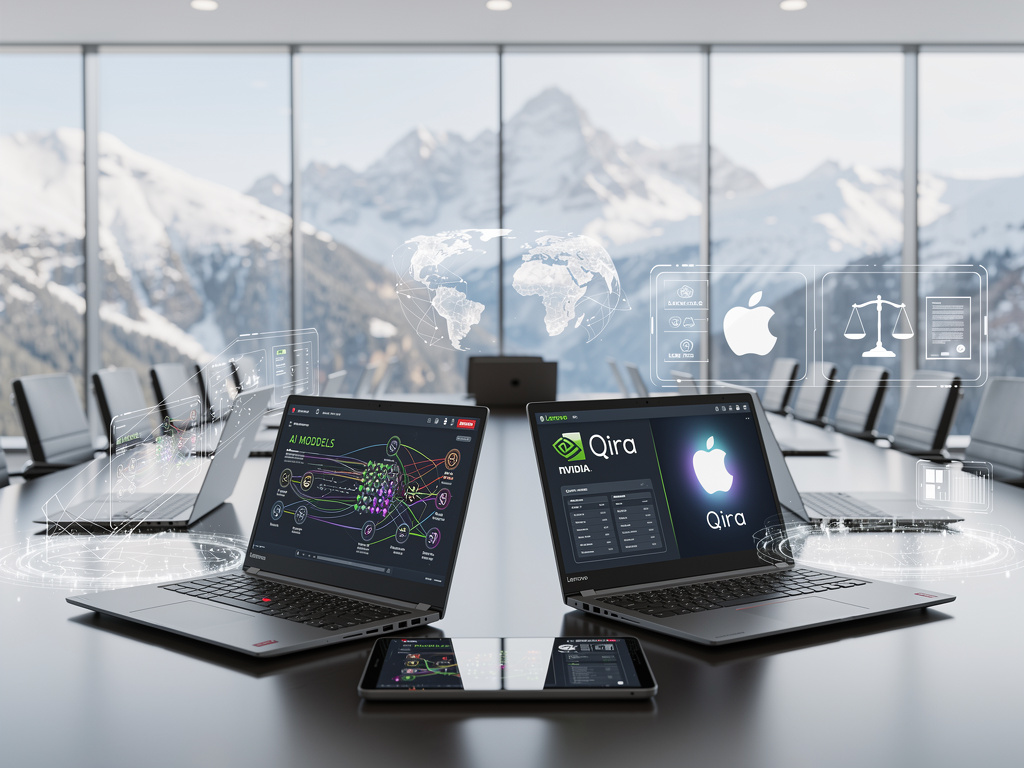
In the snowy corridors of Davos, Lenovo Group Ltd.’s chief financial officer laid out a bold blueprint for the company’s AI ambitions, revealing plans to forge alliances with a diverse array of large language models worldwide. Speaking on the sidelines of the World Economic Forum on January 21, 2026, Winston Cheng positioned Lenovo as a neutral conductor in the fractious world of artificial intelligence, opting against developing its own foundational models amid a thicket of international regulations.
“We’re taking an orchestrator approach,” Cheng told Reuters. “We’re not doing our own LLM. We’re really doing a partnership because there are regulations around the world.” This strategy contrasts sharply with competitors like Apple Inc., which relies primarily on OpenAI and Alphabet Inc.’s Google Gemini for its AI integrations. Lenovo, the globe’s top personal computer vendor by shipments, aims to embed AI across its expansive lineup—from laptops and smartphones to wearables—leveraging its rare foothold in both Windows and open Android domains.
“We are the only company besides Apple with significant market share across both PCs and mobiles, and in the open Android and Windows ecosystems,” Cheng emphasized. Potential collaborators include Humain in Saudi Arabia, Europe’s Mistral AI, and Chinese firms Alibaba Group Holding Ltd. and DeepSeek, signaling a deliberate push for geographic and regulatory diversification.
Davos Disclosure Signals Strategic Pivot
Cheng’s remarks, delivered during the 56th annual WEF gathering, underscore Lenovo’s evolution from hardware heavyweight to AI enabler. The Beijing-based firm recently unveiled Qira, a cross-device intelligence platform introduced earlier in January 2026, designed explicitly to mesh with these external LLMs. This system promises seamless AI continuity across devices, a feature Cheng highlighted as key to consumer and enterprise appeal.
Lenovo’s approach addresses mounting geopolitical tensions and data sovereignty mandates, allowing region-specific model deployment without the burdens of in-house development. Analysts note this mirrors broader industry shifts, where hardware makers increasingly position themselves as integration layers rather than model creators. Cheng, who joined Lenovo in 2024 after a stint as a tech investment banker and ascended to CFO in April 2025, brings financial acumen to these partnerships, stressing cost discipline amid AI hype.
The executive also flagged rising memory chip prices, vowing to pass increments to consumers, while cautioning on an “AI bubble” in equity markets. “The market should take a close look at operating costs, in addition to capital expenditure,” he advised Reuters reporters Selena Li and Brenda Goh.
Hybrid Foundations from CES Momentum
Lenovo’s Davos pivot builds on its CES 2026 showcase, where it unveiled the Hybrid AI Advantage portfolio, including purpose-built inferencing servers like the ThinkSystem SR675i powered by AMD Epyc CPUs and Nvidia Corp.’s Blackwell GPUs. These machines target large language model workloads in data centers and edge settings, as detailed in Lenovo’s official press release. Executive Vice President Ashley Gorakhpurwalla stated, “Enterprises today need AI that can turn massive amounts of data into insight the moment it’s created.”
At the Las Vegas event, Lenovo introduced Qira as a “personal AI super agent,” extending across Motorola smartphones and PCs to create a unified intelligence layer. Chairman Yuanqing Yang described AI’s trajectory: drawing from “individual habits, language, and experiences” to boost creativity, per Tech Wire Asia. This hybrid model—blending on-device neural processing units with cloud resources—prioritizes privacy and low latency, critical for applications from enterprise analytics to consumer workflows.
The firm’s January Nvidia partnership further bolsters this infrastructure play, focusing on liquid-cooled hybrid setups for rapid data center rollouts. Cheng noted potential expansions to Asia and the Middle East, emphasizing local manufacturing to comply with sovereignty rules, as reported by Reuters.
Navigating Regulations and Rivals
Lenovo’s multi-partner ethos hedges against U.S.-China frictions, enabling tailored AI for markets like the Middle East via Humain or Europe through Mistral. Business Today quoted Cheng stressing optimization of “silicon, operating systems, and diverse AI models.” This avoids the regulatory pitfalls that snare model builders, positioning Lenovo to scale Qira globally without sovereignty clashes.
Unlike Apple’s walled garden, Lenovo’s open-ecosystem stance invites broader developer engagement. Recent financials reflect traction: Q2 fiscal 2025/26 revenue hit a record $4.1 billion in infrastructure, with AI cloud provider sales surging, per Lenovo’s earnings release. Liquid cooling solutions grew 154% year-over-year, underscoring demand for efficient AI hardware.
Enterprise focus sharpens with Lenovo xIQ platforms and AI Factory services, integrating agentic AI for sectors like sports—witness Football AI Pro for FIFA World Cup 2026, analyzing 2,000 metrics in real time, as announced in Lenovo’s CES keynote.
Infrastructure Backbone Powers Scale
Lenovo’s server lineup, including ThinkEdge for edge inferencing, tackles the shift from LLM training to deployment, where costs mount over time. Network World highlighted the SR675i’s capacity for full LLMs in healthcare and finance simulations. Neptune cooling and TruScale as-a-service pricing mitigate energy and capex hurdles.
In Asia Pacific, 96% of firms plan AI spending hikes averaging 15%, prioritizing device integration, according to Lenovo’s CIO Playbook with IDC. Sumir Bhatia, ISG President for the region, called it “business-critical infrastructure” in CRN Asia.
Cheng’s bubble warning tempers enthusiasm, urging scrutiny of opex alongside capex. As Lenovo deploys these partnerships, its orchestrator role could redefine hardware’s place in AI, blending global models into cohesive device experiences while rivals grapple with singular dependencies.
Enterprise and Consumer Horizons
Proofs-of-concept at CES, like agentic wearables, hint at ambient computing futures, with natural-language interfaces bridging devices. Lenovo StoryHub detailed adaptive form factors enhancing productivity and well-being. Qira’s Personal AI Twin keeps data local, appealing to privacy-conscious enterprises.
For consumers, Motorola flagships integrate this intelligence, promising continuity in mobile-PC workflows. Analysts project AI PCs at 55% of shipments by year-end, fueling Lenovo’s growth. As partnerships materialize, the firm’s global/local model—rooted in its Chinese origins and worldwide reach—positions it to capture AI’s next phase, from edge inferencing to personalized agents.


 WebProNews is an iEntry Publication