
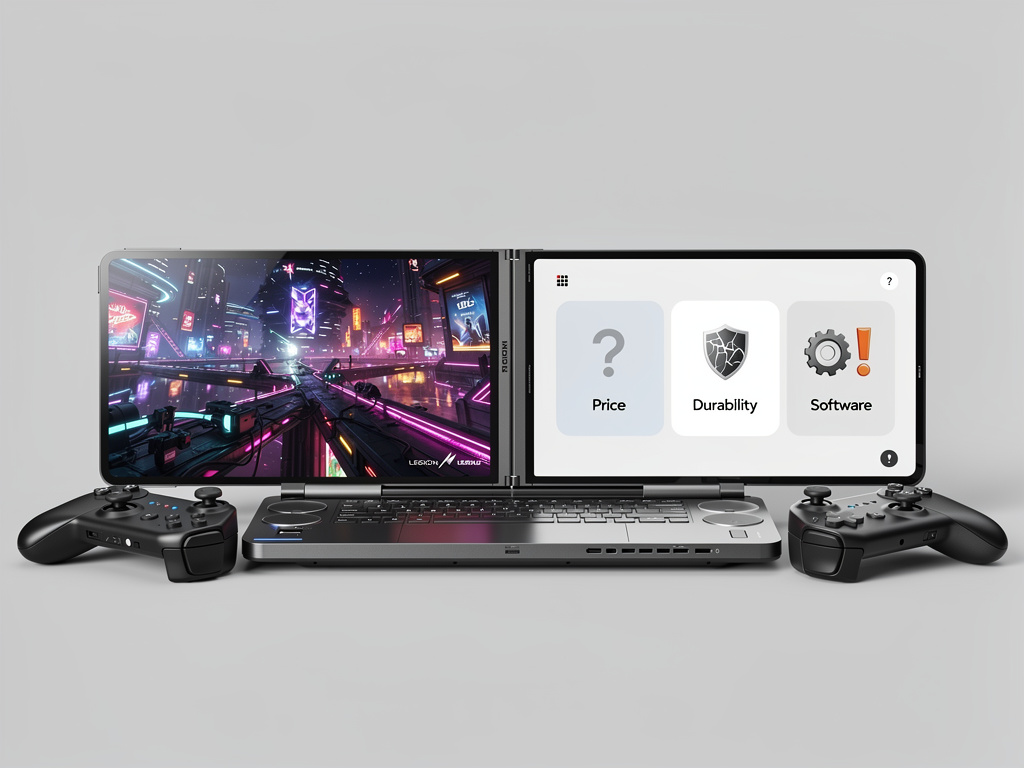
At Computex 2025, Lenovo turned heads with a concept device that looked less like a prototype and more like a finished product ready for retail shelves. The Lenovo Legion Go Fold, a foldable gaming handheld with a flexible OLED display, represents one of the most ambitious form factor experiments the portable gaming market has seen in years. But for now, it remains firmly in concept territory—a fact that has left industry watchers and gaming enthusiasts both excited and frustrated in equal measure.
The device, which Lenovo showcased at the annual Taipei tech expo, features a foldable screen that expands from a compact, pocketable size into a full gaming display. When unfolded, it offers a screen large enough to rival dedicated handheld consoles, while its folded state makes it far more portable than existing devices like the Steam Deck or Lenovo’s own Legion Go. As Lifehacker put it in its coverage, the device is “too cool to be a concept,” capturing a widespread sentiment among those who got hands-on time with the hardware.
A Hardware Design That Defies the Concept Label
What makes the Legion Go Fold stand out from the typical parade of concept devices at trade shows is the apparent level of polish. According to reports from the show floor, the unit Lenovo displayed was functional, with a working foldable OLED panel, integrated controls, and a form factor that felt deliberate rather than hastily assembled. The hinge mechanism, a critical component in any foldable device, appeared refined enough to suggest that Lenovo has invested significant engineering resources into the project.
The foldable display technology itself draws from the same advancements that have powered Samsung’s Galaxy Z Fold series and similar smartphones, but applying it to a gaming handheld introduces unique challenges. Gaming devices demand higher refresh rates, lower input latency, and durability under more aggressive use conditions than a phone typically endures. The fact that Lenovo chose to build a working prototype suggests the company believes these technical hurdles are solvable—or perhaps already solved.
The Portable Gaming Market Is Hotter Than Ever
Lenovo’s timing is not accidental. The handheld gaming PC market has exploded since Valve released the Steam Deck in early 2022, proving that there was massive consumer appetite for a portable device capable of running full PC games. Since then, companies including ASUS with its ROG Ally series, MSI with the Claw, and Lenovo itself with the original Legion Go have rushed to carve out market share. According to recent industry estimates, the handheld gaming PC segment is expected to grow substantially through the end of the decade, driven by improvements in AMD and Intel’s low-power APU designs and the maturation of Windows-based handheld software.
But the market is also becoming crowded, and differentiation is increasingly difficult. Most current handhelds share similar specifications—AMD Ryzen Z-series processors, 7-inch to 8-inch LCD or OLED screens, and roughly comparable battery life. The Legion Go Fold, if it ever reaches production, would represent a genuine departure from this formula. A foldable screen could allow for a device that is both more portable when closed and offers a larger display when opened, addressing two of the most common complaints about existing handhelds: they’re too big to carry comfortably, and their screens are too small for extended play sessions.
Why Lenovo Might Be Holding Back
Despite the apparent readiness of the prototype, Lenovo has not announced any production timeline, pricing, or availability for the Legion Go Fold. The company has characterized it strictly as a concept, which in the consumer electronics industry can mean anything from “we’re testing the waters for consumer interest” to “this is years away from being viable at a reasonable price point.” The distinction matters enormously for consumers and competitors alike.
There are practical reasons for caution. Foldable displays remain expensive to manufacture, and the yield rates for larger panels suitable for gaming are likely lower than those for smartphone-sized screens. The durability question also looms large. Smartphone foldables have improved dramatically since the first Galaxy Fold launched with well-documented screen failures in 2019, but a gaming device faces different stresses. Buttons are mashed, the device is gripped tightly during intense gameplay, and it may be tossed into bags without protective cases. Lenovo would need to be confident that the folding mechanism and screen can withstand these conditions before committing to a consumer launch.
The Software Question Nobody Is Asking
Hardware innovation alone won’t determine the Legion Go Fold’s success. One of the persistent challenges facing Windows-based handhelds is software optimization. Unlike the Steam Deck, which runs Valve’s purpose-built SteamOS based on Linux, most competing handhelds run Windows 11—an operating system that was never designed for small touchscreens or handheld form factors. Lenovo’s original Legion Go ships with Windows and a custom overlay called Legion Space, but the experience has been criticized as clunky compared to SteamOS.
A foldable device compounds this problem. Windows would need to handle transitions between folded and unfolded states gracefully, adjusting resolution, scaling, and input modes on the fly. Anyone who has used a foldable Android phone knows that even Google’s mobile OS, which has had years of foldable optimization, still struggles with some apps during screen transitions. Expecting Windows to handle this smoothly on a gaming device is a tall order. Lenovo would likely need to develop a much more sophisticated software layer, or potentially consider an alternative operating system entirely. The growing viability of SteamOS on third-party hardware, something Valve has increasingly signaled openness to, could provide one path forward.
What Competitors Are Doing in Response
Lenovo is not the only company experimenting with unconventional form factors for handheld gaming. ASUS has explored dual-screen concepts, and there have been persistent rumors about Valve working on a Steam Deck successor with an OLED display and improved ergonomics. Nintendo, meanwhile, launched the Switch 2 in 2025, sticking with a traditional form factor but upgrading to a larger screen and more powerful internals. None of these competitors have publicly shown anything as radical as a foldable gaming handheld, which gives Lenovo a potential first-mover advantage if it can bring the concept to market.
The competitive dynamics also extend to the component supply chain. Samsung Display and BOE, two of the world’s largest foldable panel manufacturers, have been expanding production capacity for flexible OLED screens. As supply increases and costs decrease, the economics of a foldable gaming handheld become more favorable. Industry analysts have suggested that by 2026 or 2027, foldable display costs could drop enough to make devices like the Legion Go Fold commercially viable at price points that enthusiast gamers would accept—likely in the $700 to $1,000 range.
The Enthusiast Community Is Already Invested
Online reaction to the Legion Go Fold has been overwhelmingly positive, with gaming forums and social media platforms lighting up with discussion following the Computex reveal. On X, numerous tech commentators and gaming enthusiasts shared images and impressions from the show floor, with many expressing a mix of excitement and skepticism. The excitement centers on the form factor’s potential; the skepticism on whether Lenovo will actually follow through.
This pattern is familiar in the tech industry. Companies frequently use concept devices to gauge public interest before committing to expensive production runs. The enthusiastic response to the Legion Go Fold likely provides Lenovo with valuable market intelligence. If the company determines that demand is sufficient to justify the investment in tooling, supply chain agreements, and software development, the concept could transition to a real product within 12 to 18 months of the initial reveal—a timeline that would put a potential launch somewhere in late 2026.
What Comes Next for Foldable Gaming
The Legion Go Fold represents more than just a single product concept. It signals that major OEMs are seriously exploring foldable technology as a solution to the fundamental tension in handheld gaming: the desire for a large, immersive display versus the need for true portability. If Lenovo—or any competitor—can crack this equation at an acceptable price point and with sufficient durability, it could establish an entirely new product category.
For now, the Legion Go Fold remains a tantalizing glimpse of what portable gaming could become. The technology exists, the market demand appears to be there, and at least one major manufacturer has demonstrated that the concept works in physical form. The remaining questions—price, durability, software, and ultimately, corporate willingness to take the risk—will determine whether this concept becomes a product that gamers can actually buy. Given the pace of innovation in both foldable displays and handheld gaming hardware, the wait may not be as long as skeptics fear.


 WebProNews is an iEntry Publication