
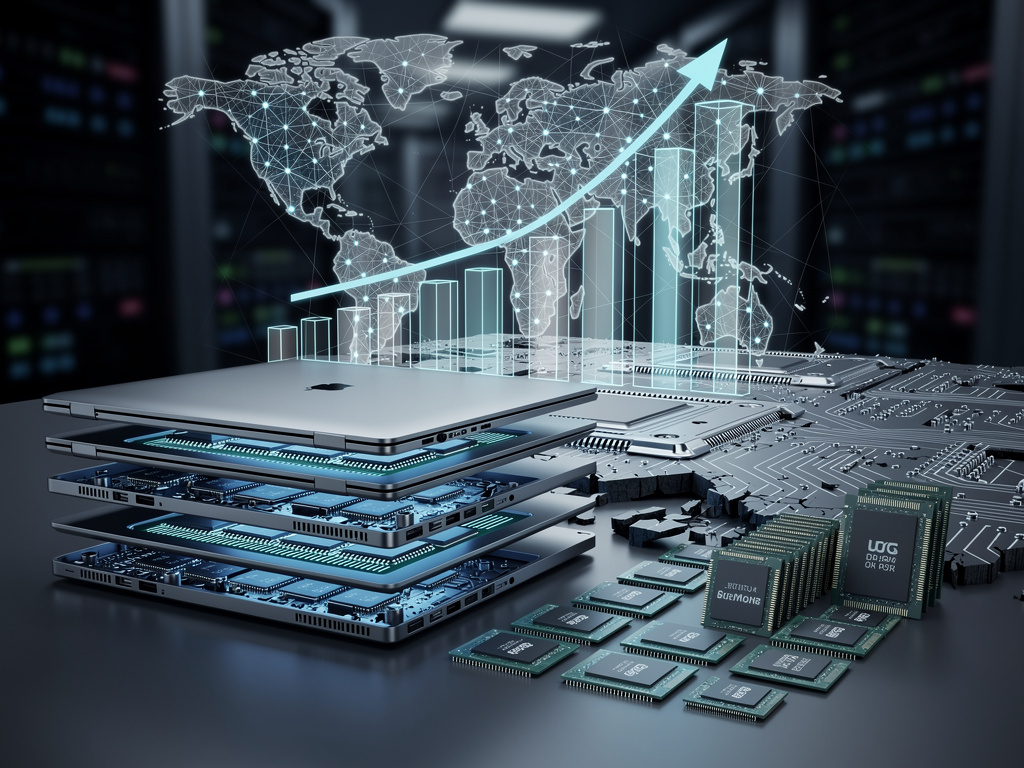
The personal computer industry is bracing for a sustained period of rising prices and constrained supply, as Lenovo Group Ltd. — the world’s largest PC maker by shipments — confirmed significant price increases on its products and warned that a worsening memory chip shortage could persist well into the future. The developments signal a new era of cost pressure for consumers and enterprises alike, one that extends far beyond the familiar tariff headlines and into the structural economics of semiconductor manufacturing.
Lenovo’s warning, delivered alongside its latest quarterly earnings, paints a sobering picture for an industry that had only recently emerged from the pandemic-era supply chain chaos. According to Digital Trends, the Chinese tech giant has already begun raising prices on its PCs, with some models seeing increases of up to 10%, and the company’s leadership has indicated that further hikes may be unavoidable as component costs continue to climb.
Tariffs and Trade Tensions Add Fuel to the Fire
The immediate catalyst for Lenovo’s price increases is the ongoing trade conflict between the United States and China. With tariffs on Chinese-manufactured goods remaining elevated, Lenovo — which assembles a significant portion of its products in China — faces a direct hit to its cost structure. The company has been working to diversify its manufacturing footprint, but such shifts take years to fully execute, and in the meantime, the tariff burden is being passed along to buyers.
Lenovo CEO Yuanqing Yang acknowledged the challenge in remarks reported by Digital Trends, noting that the company is doing everything it can to mitigate the impact but that some cost increases are simply unavoidable. Yang emphasized that Lenovo has been proactive in shifting production to facilities in Mexico, India, and other countries, but conceded that these efforts cannot fully offset the tariff-related cost pressures in the near term.
The Memory Crisis: A Structural Problem, Not a Cyclical Blip
Perhaps more concerning than the tariff situation is Lenovo’s warning about the memory market. The company flagged what it described as a prolonged crisis in DRAM and NAND flash supply — the two types of memory chips that are essential components in virtually every computing device, from laptops and desktops to servers and smartphones. According to the reporting by Digital Trends, Lenovo expects memory prices to remain elevated for an extended period, driven by a combination of surging demand from the artificial intelligence sector and insufficient investment in new manufacturing capacity during the recent downturn.
The AI boom has fundamentally altered the demand equation for memory chips. Training and running large language models and other AI workloads requires enormous quantities of high-bandwidth memory (HBM) and standard DRAM. Companies like Nvidia, which designs the GPUs that power most AI infrastructure, have been consuming memory at unprecedented rates, and the major memory manufacturers — Samsung, SK Hynix, and Micron Technology — have prioritized HBM production to meet this demand. The result is a reallocation of manufacturing capacity away from the conventional DRAM and NAND chips that go into consumer PCs, creating a supply squeeze that is now showing up in higher component costs across the board.
How the AI Hunger for Chips Ripples Through the PC Market
Industry analysts have been tracking the tightening memory market for months. The dynamic is straightforward but punishing for PC makers: as memory manufacturers shift their most advanced production lines to HBM and other AI-optimized chips, the supply of standard DDR5 DRAM and NAND flash for PCs and consumer electronics shrinks. This supply reduction, combined with steady or growing demand for PCs — particularly as the Windows 10 end-of-life deadline in October 2025 approaches, prompting a wave of enterprise upgrades — is creating a classic supply-demand imbalance.
Lenovo is not alone in feeling the pinch. Other major PC OEMs, including HP Inc. and Dell Technologies, have also signaled caution about rising input costs, though Lenovo has been the most explicit in linking the issue to a structural memory shortage. The company’s candor is notable in an industry where executives typically prefer to emphasize their ability to manage costs rather than telegraph price increases to customers and investors.
The Windows 10 Refresh Cycle Adds Urgency
The approaching end of support for Windows 10, scheduled for October 14, 2025, is expected to trigger one of the largest PC refresh cycles in years. Millions of enterprise and consumer PCs currently running Windows 10 will need to be replaced or upgraded to Windows 11, which in many cases requires newer hardware due to Microsoft’s stringent system requirements, including the need for a TPM 2.0 security chip. This anticipated wave of demand is arriving at precisely the wrong moment, as memory and other component costs are rising and tariff pressures remain unresolved.
For enterprise IT departments, the convergence of these factors means that the cost of refreshing their PC fleets will be materially higher than it would have been even six months ago. Lenovo’s price increases, while unwelcome, are a rational response to the economic realities facing the supply chain. The question for CIOs and procurement officers is whether to accelerate their purchasing timelines — locking in current prices before further increases — or to wait in hopes that the situation improves, a gamble that Lenovo’s own projections suggest may not pay off.
Memory Manufacturers Are Prioritizing AI Over PCs
The root cause of the memory crisis lies in the investment decisions made by the three dominant memory chipmakers. During the 2022-2023 downturn in the memory market, Samsung, SK Hynix, and Micron all curtailed capital expenditure and slowed the expansion of their manufacturing capacity. When the AI boom arrived with unexpected force in late 2023 and accelerated through 2024 and into 2025, these companies found themselves scrambling to meet surging demand for HBM chips, which are far more profitable than standard DRAM on a per-gigabyte basis.
SK Hynix, in particular, has emerged as the leading supplier of HBM to Nvidia, and the company has publicly stated that it has allocated the majority of its advanced packaging capacity to HBM production through 2025 and beyond. Samsung, which initially lagged in HBM yields, has been investing heavily to catch up, further diverting resources from conventional memory production. Micron, the sole major U.S.-based memory manufacturer, has similarly prioritized HBM and high-margin data center products. The net effect is a structural reallocation of the global memory supply chain toward AI applications and away from the consumer and enterprise PC market.
What This Means for Consumers and Businesses
For consumers shopping for a new laptop or desktop, the practical implication is straightforward: expect to pay more. Lenovo’s price increases of up to 10% are likely just the beginning if memory costs continue to rise. Other OEMs are expected to follow suit, as the component cost pressures are industry-wide and not specific to any single manufacturer. Budget-conscious buyers may find themselves gravitating toward models with less RAM or smaller SSDs, effectively accepting lower specifications to stay within their budgets.
For businesses, the calculus is more complex. The Windows 10 end-of-life deadline creates a hard timeline for many organizations, and delaying purchases risks both security vulnerabilities and higher future costs. At the same time, the AI-driven transformation of enterprise computing is itself driving demand for more powerful — and more expensive — hardware. Companies investing in AI-capable PCs, such as those equipped with neural processing units (NPUs) for on-device AI workloads, will face even steeper price tags as these machines require more memory and more advanced components.
Lenovo’s Strategic Response and the Road Ahead
Lenovo, for its part, is attempting to navigate the storm through a combination of supply chain diversification, strategic inventory management, and product mix optimization. The company has been building out manufacturing capacity in markets outside China — including facilities in Mexico, India, Hungary, and Brazil — to reduce its exposure to U.S.-China tariffs. It has also been working to secure long-term supply agreements with memory manufacturers to lock in pricing and ensure allocation.
But these measures have limits. The memory shortage is a global phenomenon, and no single OEM — not even the world’s largest — can unilaterally resolve a supply-demand imbalance driven by the insatiable appetite of the AI industry. Lenovo’s warning should be read as a signal to the broader market: the era of cheap computing hardware may be drawing to a close, at least for the foreseeable future. As the AI revolution reshapes the semiconductor supply chain, the costs will be borne not just by the hyperscalers building massive data centers, but by every consumer and business that relies on a personal computer. The question is no longer whether prices will rise, but by how much — and for how long.


 WebProNews is an iEntry Publication