
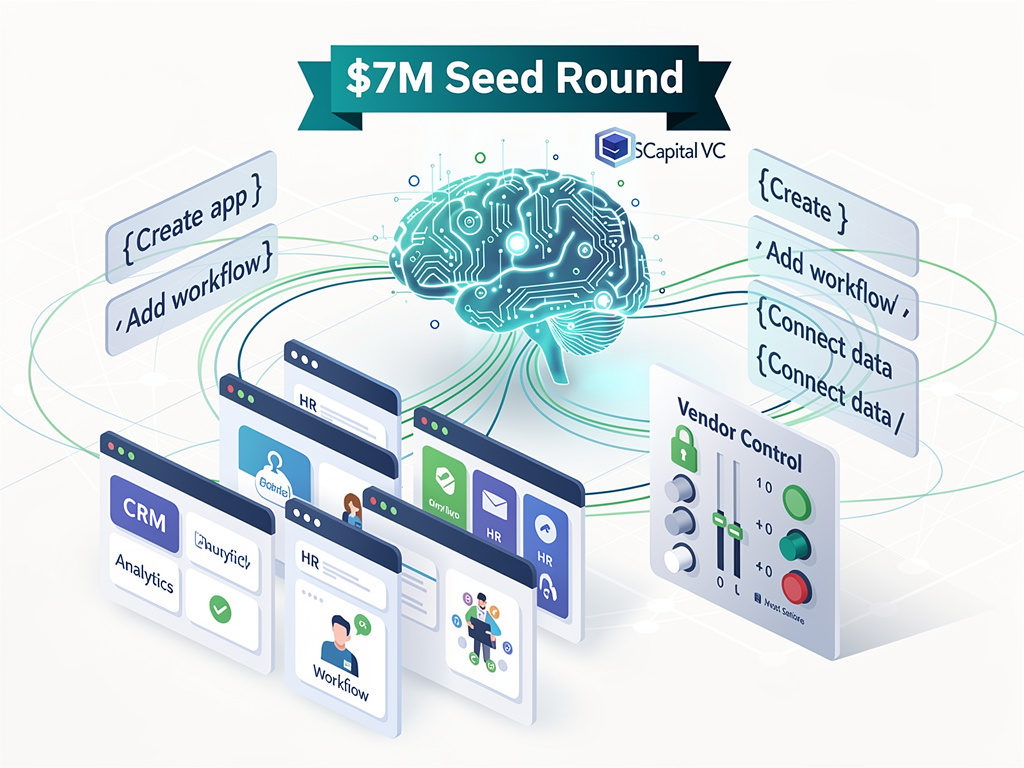
Tel Aviv-based startup Legato has secured $7 million in seed funding to embed artificial intelligence directly into enterprise software, allowing non-technical business users to craft custom applications, workflows and automations using everyday language. The round, announced January 20, 2026, was led by S Capital VC with participation from Cerca Partners, and aims to bolster research and development while expanding the company’s AI engineering team.
Founded in 2025 by CEO Dana Rochman and Chief Technology and Product Officer Shlomit Tennenbaum, both veterans of enterprise software challenges, Legato targets a persistent pain point: the lengthy, expensive customization processes that plague SaaS adoption. Customers often spend more on consultants than the software itself, leading to delays measured in months and high churn rates, according to multiple reports.
“SaaS platforms are realizing that equipping developers and admins with better no-code or vibe-coding builders is no longer enough,” Rochman told CTech. “The next battleground in the vendor AI race will be about empowering business users—those who understand the needs best—to create what they need themselves.”
Cracking the Customization Bottleneck
Enterprise software vendors have long depended on professional services teams and external consultants to tailor complex platforms, a process that can consume significant budget and time. Legato’s multi-agent AI architecture steps in as a virtual services crew, interpreting plain-language prompts to generate production-ready code within the platform’s boundaries, preserving vendor governance, visibility and data control.
The system supports creation of apps, workflows and even autonomous AI agents, all embedded natively. Users access a chat-based interface to describe needs, after which virtual agents handle QA, project management and development tasks, complete with autogenerated specs and test plans. This compresses timelines from months to minutes or hours, as noted by investors.
Aya Peterburg, managing partner at S Capital VC, highlighted the opportunity in a statement to PR Newswire: “While the multi-billion dollar professional services market continues to grow at speed, in a large part due to platform customization needs, SaaS vendors are missing out on enormous revenue generating opportunities. With Legato, customizations are compressed into hours rather than months.”
Founders’ Frontline Experience
Rochman and Tennenbaum draw from direct exposure to SaaS strains, where teams grappled with endless custom requests, overburdened services and roadmap gridlock. “The founders have faced firsthand the obstacles SaaS platforms are up against,” Peterburg added in the Tech Startups coverage. “Combining deep enterprise and AI expertise alongside an exceptional ability to execute, Legato is transforming SaaS software into fully extendable AI platforms.”
Legato’s official site details how the tool integrates via workspace embedding, marketplace publishing and internal sharing, fostering what the company terms the Platform Creator Economy. Users build vertical apps, share them community-wide, and drive organic growth for vendors—turning customers into revenue-generating partners without external dependencies.
Testimonials from early adopters underscore the shift. “With Legato, creation is no longer limited to developers—every user can shape the product they use,” said a VP of platform strategy at a leading HRTech platform, per Legato.ai. A CRM growth head echoed: “Finally, no-code is truly democratized—creation for everyone, not just developers or power users.”
Navigating a Crowded Vibe-Coding Arena
Legato enters a field buzzing with AI coding tools, where vibe-coding—natural language code generation—has exploded. Tools like GitHub Copilot and Anthropic’s Claude generate over $4 billion annually, capturing 70% market share, as reported by Forbes. Non-engineers now build software via social media-shared experiments, per recent Wall Street Journal accounts.
Yet Legato differentiates by focusing on in-platform embedding for business users, not just devs or admins. Competitors like Loveable Labs, Emergent Labs, Google’s Opal and Monday.com target broader or developer audiences, SiliconANGLE noted. “Legato brings vibe app creation directly to non-technical users, turning professional services into an autonomous, in-product experience,” Rochman emphasized to Ynet News.
Vendors retain full oversight, mitigating risks of users fleeing to third-party AI workarounds that erode stickiness. Legato already pilots with CRM and HR platforms, with eyes on finance, healthcare, telecoms and energy—any API-exposed system ripe for autonomous customization.
Investor Backing and Israeli Tech Momentum
S Capital VC, with $600 million under management across deep tech, cybersecurity and enterprise software, sees Legato as a tide-turner for slowing SaaS growth. Cerca Partners, a co-investment specialist in Israeli startups, joins to tap unique deal flow. The funding aligns with Israel’s 2026 high-tech surge, including Legato in early tallies of rounds, per CTech‘s funding list.
On X, reactions spotlight the shift: “AI creation slows when developers become gatekeepers. Business waits,” posted Jesse Landry, linking Legato’s approach to operator-led innovation. CTech and SiliconANGLE amplified the news, drawing views on enterprise AI’s democratization.
Legato’s proprietary stack mimics a world-class engineering team, delivering scalable, production-grade output. As agentic AI raises self-serve expectations, platforms embedding such capabilities could redefine growth—from shipping features to enabling ecosystems.
Path to Platform Ecosystems
By publishing user creations to marketplaces, Legato unlocks indirect revenue and partner ecosystems, much like app stores but tailored to enterprise needs. “Legato flips the model—platform growth doesn’t come from shipping more, it comes from letting others create,” a CRO at a B2B marketing platform told Legato.ai.
The startup plans R&D acceleration to refine multi-agent orchestration and domain grounding, ensuring outputs align with platform specifics. Expansion beyond SaaS targets regulated sectors where APIs enable safe, governed extension—potentially billions in untapped professional services disruption.
For industry insiders, Legato signals a pivot: AI not just automating tasks, but natively empowering end-users to evolve software in real time, under vendor control. As Rochman put it to The Jerusalem Post, it turns every user into a creator, every platform into a self-growing ecosystem.


 WebProNews is an iEntry Publication