
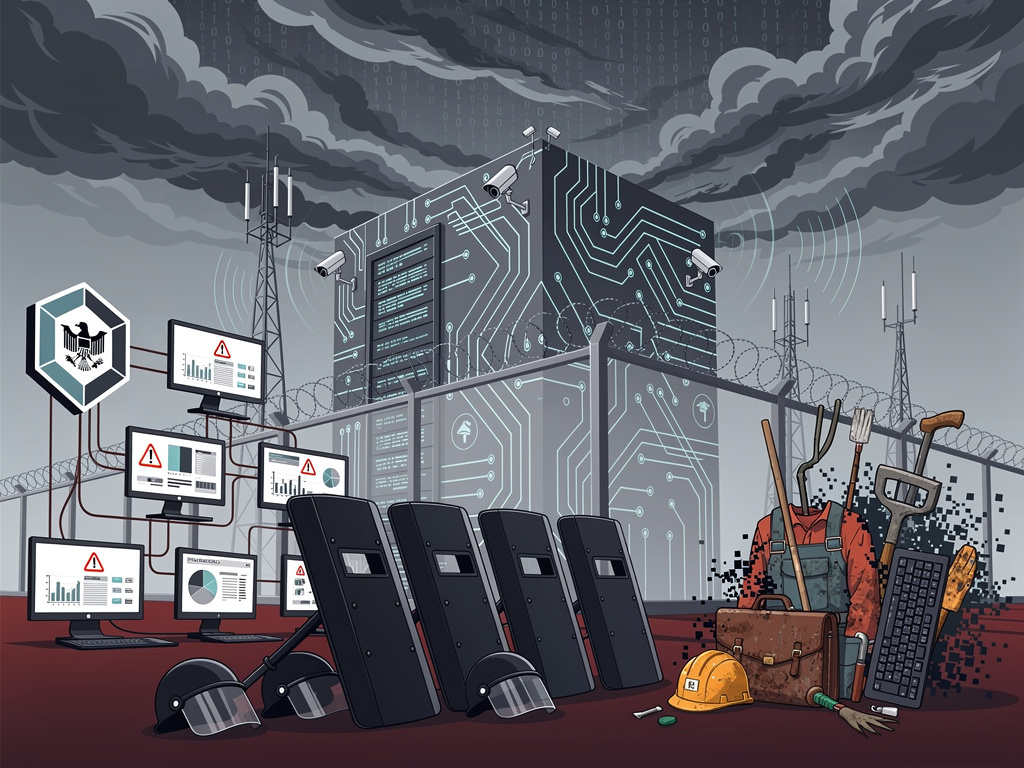
Anger at artificial intelligence has moved from online forums to streets and server farms. Protesters block data center construction. Some torch equipment. One man allegedly hurled an incendiary device toward OpenAI chief Sam Altman’s home. Authorities now watch a new category of potential threat: anti-tech extremism.
The shift marks a striking turn. Federal agencies that once focused on far-right militias or jihadist networks have begun circulating thousands of pages of internal reports on citizens worried about AI-driven job loss, spiraling electricity bills, and farmland swallowed by enormous server complexes. Documents obtained by WIRED reveal more than 1,000 unpublished bulletins from the FBI, Department of Homeland Security, and 80 fusion centers across the country. Many treat routine civic acts—attending planning meetings, photographing construction sites, or voicing concerns at county hearings—as possible precursors to violence.
But the phenomenon stretches back centuries. Early textile workers smashed mechanized looms in 19th-century England. They feared machines would destroy their livelihoods. Neo-Luddites revived those fears in the 1980s and 1990s. The Unabomber, Theodore Kaczynski, took them to a deadly extreme with a 17-year bombing campaign against symbols of industrial society. Today those same grievances find fresh fuel in generative AI and the colossal infrastructure it demands.
Three distinct currents feed the modern strain of opposition.
Insurrectionary anarchists see technology as an extension of state and corporate power that must be smashed. Eco-extremists frame the battle in almost cosmic terms, viewing humanity’s technological hubris as an assault on nature itself. Eco-fascists add a racial dimension, arguing that advanced tech erodes traditional bonds to land and people. Author Mauro Lubrano maps these overlapping ideologies in his 2025 book. He describes anti-technology extremism as flexible, leaderless, and accelerationist—traits that make it hard to track yet capable of sudden spikes in activity. (ICCT)
Recent incidents give weight to official concern. In April 2026 a suspect threw an incendiary device near Altman’s residence before issuing threats outside OpenAI’s San Francisco office, the San Francisco Standard reported. Activists have chained themselves to company gates. Arson attempts against data centers have surfaced in multiple states. A group known as the Zizians faces murder charges in connection with violence that investigators link to anti-tech beliefs.
Yet the breadth of the new watchlist alarms civil liberties advocates. Suspicious activity reports now flag simple observation of data centers or participation in public comment sessions. Spencer Reynolds, senior counsel at the NAACP Legal Defense Fund, told WIRED these reports “are incredibly unreliable, often about vague or innocent behavior.” He warns that agencies risk repeating past mistakes—surveilling Black Lives Matter, Occupy Wall Street, and environmental groups under the guise of preventing unrest.
Lubrano himself strikes a careful note. “While anti-technology violence is unacceptable, it should not be used as an excuse to securitize AI and emerging technologies, thereby silencing those who are critical of the current trajectory,” he said in the WIRED report.
The grievances run deeper than any single attack. Farmers watch prime acreage turned into windowless server buildings that guzzle water and power. Urban residents face higher utility rates to feed distant AI training runs. Workers in creative fields and routine office jobs see tasks automated at startling speed. Polls show negative views of AI outnumber positive ones by nearly two to one. A March 2026 NBC survey found only 26 percent held favorable opinions.
Data centers have become the clearest flashpoint. Hundreds of organizations in 42 states organize against new builds. Local governments field raucous town halls. Some meetings end with activists escorted out. Northern Virginia Regional Intelligence Center bulletins list photography of these sites as an indicator worth reporting. The message is unmistakable: ordinary dissent now sits inside a broader extremism framework.
And the federal posture adds tension. The current administration has pushed executive orders to accelerate AI infrastructure and limit state-level restrictions. That pro-tech stance collides with grassroots fury over energy demands and perceived corporate overreach. Rita Katz of the SITE Intelligence Group notes a measurable rise in online calls for sabotage against data centers. She argues focused monitoring of communities with proven links to harm remains necessary.
Critics counter that the category itself is dangerously elastic. It sweeps in parents fighting mandatory classroom screens, retirees worried about noise pollution from cooling fans, and labor organizers highlighting job displacement. The Android Authority piece summarizing the disclosures captured the stakes clearly: monitoring for anti-tech violent extremism now includes acts as basic as watching an AI facility. (Android Authority)
History offers mixed lessons. Past waves of anti-tech violence remained marginal. Kaczynski acted alone. Luddites were crushed by state power. Yet AI differs in scale. Its reach touches every sector. The infrastructure required to run frontier models consumes resources on a level that visibly alters communities. When those changes arrive without broad consent, resentment hardens.
Recent coverage shows the backlash gaining organized form. Protests against data centers have spread globally. Environmental groups join forces with anti-capitalist activists. Some voices celebrate infrastructure attacks as legitimate resistance. Bloomberg Opinion noted this week that even religious leaders have begun questioning AI’s societal toll, adding to a sense that technology faces a legitimacy crisis. (Bloomberg)
Law enforcement faces a genuine dilemma. Real plots must be stopped. But treating civic participation as pre-operational planning risks alienating the very public whose trust is required for intelligence work. Overbroad labeling can confirm the narrative that legitimate channels are closed, pushing moderates toward radicals.
So far the violence has stayed limited. No mass casualty events tied to anti-AI ideology have occurred. That may not hold. Lubrano’s analysis warns that material grievances—lost wages, environmental strain—combine with deeper existential fears about human purpose and autonomy. The resulting mix has fueled extremism before.
Tech executives dismiss much of the outcry as misunderstanding. They point to productivity gains and new industries. Yet public sentiment has soured. Trust in Silicon Valley sits at historic lows. When leaders appear indifferent to local costs or accelerate deployment without debate, opposition grows more resolute.
The coming years will test whether authorities can separate peaceful critics from those bent on destruction. They will also test whether the industry can address root complaints about power concentration, labor impact, and resource use. Failure on either side could turn scattered acts into something more sustained.
Right now the signals point in conflicting directions. Agencies expand their gaze. Communities dig in. Attacks remain rare but symbolic. The question isn’t whether anger exists. It’s whether institutions can channel that anger before it finds more destructive outlets.


 WebProNews is an iEntry Publication