
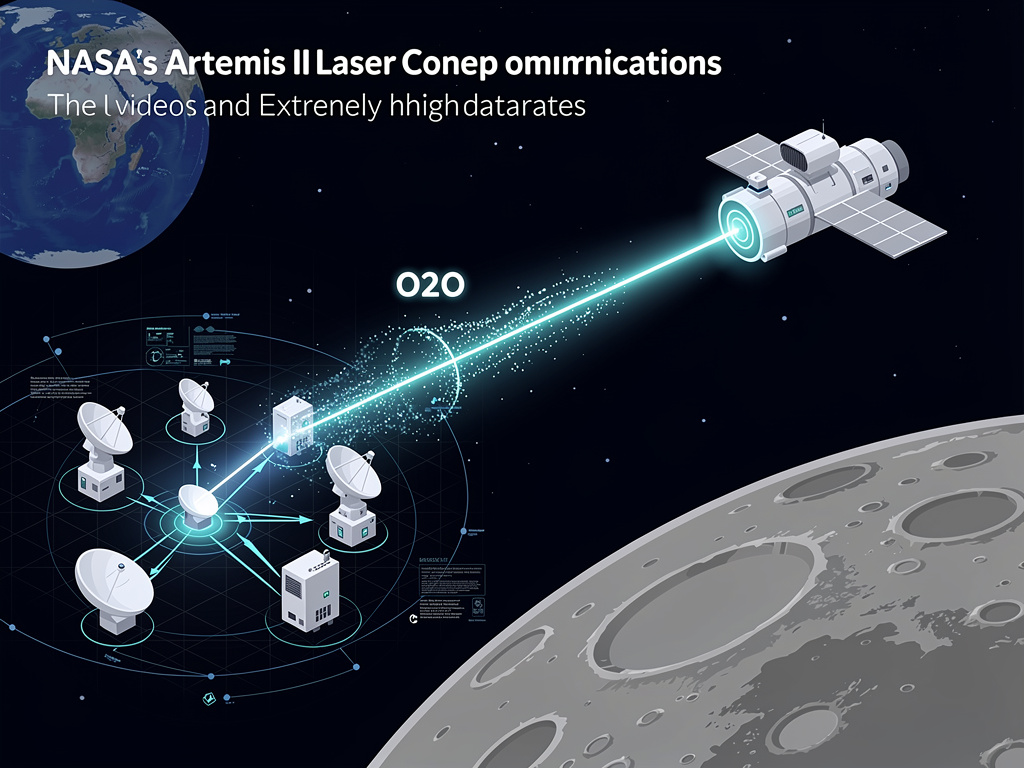
Four astronauts circled the Moon in early April 2026 aboard NASA’s Orion spacecraft during the Artemis II mission. They didn’t just test human endurance in deep space. They beamed back 4K video at blistering speeds. The secret? Laser communications. TechCrunch reported the mission hit 260 megabits per second from lunar orbit—over 300,000 kilometers away—using the Orion Artemis II Optical Communications System, or O2O.
Traditional radio waves dominated Apollo-era links. Apollo 13 managed kilobits per second, barely enough for voice and telemetry. Artemis II crushed that. It downlinked 36 gigabytes in an hour via O2O, dwarfing the 7 gigabytes per day of old S-band radio. By mission’s end on April 10 with a Pacific splashdown, over 400 gigabytes of high-res images and data poured in. That’s 100,000 times Apollo 13’s pace. TechRadar called it an impressive leap, noting NASA’s line: “More data means more discoveries.”
O2O packs a 4-inch telescope, gimbals, modem, and controller into Orion’s exterior. Infrared lasers carry the load—same speed as radio, but packed with higher-frequency info for massive throughput. Ground receivers at NASA’s Table Mountain Facility in California and White Sands in New Mexico locked on. But the real surprise came from Down Under. An experimental terminal at the Australian National University snagged the signal too. Built by startups Observable Space and Quantum Opus for under $5 million—peanuts next to the tens of millions for custom gear—it used off-the-shelf software, a telescope, and a photonic sensor. All stations pulled pristine 4K lunar footage. Mezha Media highlighted the Aussie site’s role when U.S. line-of-sight vanished.
Challenges persist. Clouds kill lasers; they demand clear skies and precise pointing. Radio stays backup for reliability. Yet Artemis II proved scalability. Dan Roelker, Observable Space CEO, told TechCrunch: “We can scale this over the next year or more.” He eyes partnerships with ground-station providers and constellation operators. Josh Cassada, former astronaut and Quantum Opus co-founder, noted Australia’s nod to the first Earthrise photo from Artemis II.
NASA’s groundwork ran deep. MIT Lincoln Laboratory built key O2O components with Goddard Space Flight Center. Their MAScOT terminal, tested via ILLUMA-T on the ISS and LCRD satellite, hit 1.2 gigabits down—beyond specs. MIT News quoted Jade Wang: “Our success with ILLUMA-T laid the foundation for streaming HD video to and from the moon.” O2O echoed that, downlinking over 100 gigabytes by flight day four, per NASA’s blog.
And the payoff? Future missions drown in data—HD streams, sensor floods, AI analytics. Lasers handle it. Artemis III skips O2O, sticking to radio for landing risks. But Artemis IV and beyond? Expect optical upgrades. NASA sees O2O paving paths to Mars. Private players like Observable Space push cheaper ground nets, turning laser links into routine infrastructure.
Costs plummet. What took bespoke millions now runs on commercial parts. Startups prove global reception without NASA’s wallet. Weather? Diversify sites. Pointing? AI gimballs nail it. By day four, O2O selfies from Orion’s solar arrays hit Earth crisp. Steve Horowitz, O2O project manager, boasted: “At 260 megabits per second, O2O is capable of sending down 4K high-definition video from the Moon.” From R&D World.
So where next? Lunar bases in 2027 demand this bandwidth for real-time ops. Constellations like Starlink eye lasers for inter-satellite hops; Earth links follow. NASA’s Deep Space Optical Comm demo beamed from 218 million miles pre-Artemis. TBIRD CubeSat hit 200 gigabits from orbit. Scale multiplies.
Artemis II wasn’t flawless. No crew laser ops yet—automation ruled. But it worked. Astronauts Reid Wiseman, Victor Glover, Christina Koch, and Jeremy Hansen saw Earthrise in HD glory. Data deluge fuels science. Lasers aren’t replacing radio tomorrow. They’re augmenting it today. Expect networks blending both, with optics dominating high-volume flows. Industry watches. Costs drop. Capabilities soar.


 WebProNews is an iEntry Publication