
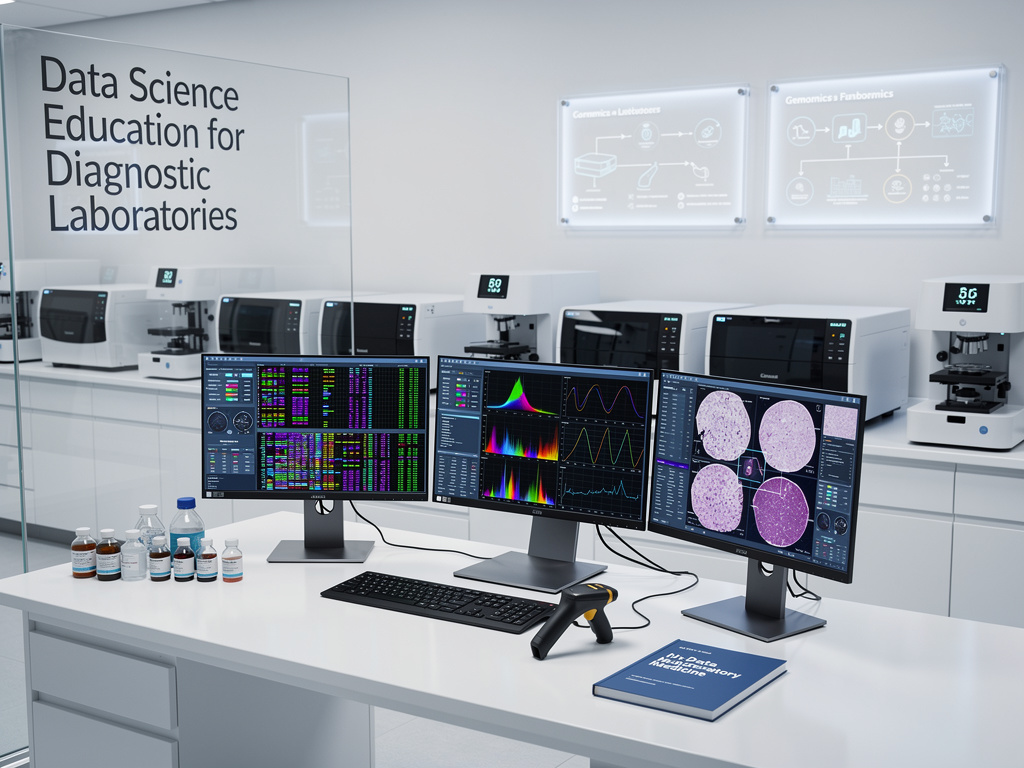
The diagnostics industry stands at a critical inflection point where traditional laboratory expertise must converge with advanced computational capabilities. The Association for Diagnostics & Laboratory Medicine (ADLM) has recognized this imperative, launching what it describes as the first comprehensive data science educational program specifically designed for laboratory medicine professionals—a move that signals the sector’s acknowledgment that algorithmic literacy has become as essential as understanding biochemistry.
According to PR Newswire, the new Data Science in Laboratory Medicine program represents a fundamental shift in how the industry approaches professional development. The initiative comes as laboratories worldwide grapple with exponentially increasing data volumes from genomic sequencing, mass spectrometry, and digital pathology platforms—technologies that generate terabytes of information requiring sophisticated analytical frameworks that extend far beyond conventional statistical methods.
The timing of ADLM’s announcement reflects broader industry recognition that laboratory professionals can no longer rely solely on traditional training. Modern diagnostic facilities process millions of test results annually, with artificial intelligence and machine learning algorithms increasingly integral to quality control, result interpretation, and predictive analytics. Yet a significant skills gap persists between the computational demands of contemporary laboratory operations and the training most professionals received during their formal education.
Bridging the Competency Chasm in Clinical Laboratories
The program’s curriculum addresses fundamental competencies that have become indispensable in modern laboratory settings. Participants will explore statistical learning theory, predictive modeling techniques, and the practical application of machine learning algorithms to laboratory data. The educational framework emphasizes hands-on experience with real-world datasets, moving beyond theoretical understanding to cultivate operational proficiency with the tools and methodologies that increasingly drive laboratory decision-making.
Industry experts have long recognized the disconnect between traditional laboratory training and the computational requirements of modern diagnostics. Clinical laboratories now routinely employ algorithms for everything from automated result validation to detecting subtle patterns in quality control data that might indicate instrument drift or reagent degradation. These applications require professionals who understand not just what algorithms do, but how they work, their limitations, and the appropriate contexts for their deployment.
The Economic Imperative Behind Computational Competency
The financial implications of this educational initiative extend beyond individual career development. Laboratories face mounting pressure to improve operational efficiency while maintaining or enhancing diagnostic accuracy. Data science methodologies offer pathways to achieve both objectives simultaneously—optimizing test utilization, reducing turnaround times, and identifying cost-saving opportunities through sophisticated pattern recognition that would be impossible through manual analysis alone.
Healthcare systems increasingly demand that laboratories demonstrate value beyond simply producing accurate results. They expect diagnostic services to contribute actionable insights that improve patient outcomes and reduce overall healthcare costs. Meeting these expectations requires laboratory professionals who can leverage advanced analytics to identify trends, predict patient trajectories, and provide decision support that extends traditional laboratory reporting. The ADLM program positions participants to deliver this expanded value proposition.
Navigating the Regulatory Complexity of Laboratory Algorithms
The educational program arrives as regulatory frameworks struggle to keep pace with algorithmic innovation in laboratory medicine. The Food and Drug Administration has issued guidance on software as a medical device and laboratory-developed tests, but significant ambiguity remains regarding validation requirements for machine learning algorithms that continuously evolve through exposure to new data. Laboratory professionals need sophisticated understanding of both the technical and regulatory dimensions of these tools to implement them responsibly.
This regulatory complexity creates particular challenges for laboratory directors, who bear ultimate responsibility for the validity of results their facilities produce. When algorithms contribute to diagnostic interpretation or result reporting, directors must understand the underlying methodologies sufficiently to assess their appropriateness and limitations. The ADLM curriculum specifically addresses these governance challenges, preparing professionals to evaluate algorithmic tools with the same rigor they apply to traditional laboratory instrumentation.
Personalized Medicine and the Data Deluge
The explosion of personalized medicine has amplified the urgency of data science education in laboratory settings. Genomic testing alone can generate gigabytes of data per patient, with interpretation requiring integration of genetic variants, clinical phenotypes, family histories, and population databases. Traditional approaches to data analysis simply cannot scale to meet these demands. Laboratory professionals must develop fluency with bioinformatics pipelines, variant calling algorithms, and the statistical frameworks that underpin clinical genomics.
Beyond genomics, proteomics, metabolomics, and other -omics disciplines generate similarly complex datasets that demand computational sophistication. The integration of multi-omic data to provide comprehensive molecular portraits of disease states represents the frontier of diagnostic medicine, but realizing this potential requires laboratory professionals who can navigate the computational challenges these approaches entail. The ADLM program equips participants with foundational competencies applicable across these diverse analytical domains.
Quality Control in the Age of Automation
Modern laboratory quality control increasingly relies on algorithmic approaches that detect subtle deviations from expected performance. Traditional Westgard rules and Levey-Jennings charts, while still valuable, represent only the beginning of what sophisticated statistical process control can achieve. Machine learning algorithms can identify complex, multivariate patterns indicative of instrument malfunction or reagent issues before they impact patient results, but only if laboratory professionals understand how to implement and interpret these tools appropriately.
The program’s emphasis on practical application proves particularly relevant in quality control contexts. Participants learn to distinguish between statistically significant deviations and clinically meaningful changes, to calibrate algorithm sensitivity to balance false positive and false negative rates, and to validate that automated quality control systems perform as intended across diverse operating conditions. These skills translate directly to improved laboratory operations and patient safety.
Workforce Development and Career Advancement
From a workforce development perspective, the ADLM initiative addresses a critical barrier to career advancement for laboratory professionals. As healthcare organizations establish data science teams and analytics departments, laboratory professionals with computational skills find themselves uniquely positioned to bridge clinical and technical domains. They understand both the biological significance of laboratory data and the analytical methods required to extract meaningful insights from complex datasets.
The program also responds to recruitment and retention challenges facing the laboratory profession. Younger professionals entering the field often expect opportunities to work with cutting-edge technologies and advanced analytical tools. Organizations that invest in data science education for their laboratory staff signal commitment to innovation and professional growth, potentially improving their competitive position in talent markets. The credential that participants earn through the program provides tangible recognition of specialized expertise increasingly valued across healthcare settings.
Implementation Challenges and Organizational Change
Despite the clear benefits, implementing data science capabilities in laboratory settings presents significant organizational challenges. Many laboratories operate with constrained budgets and limited staffing, making it difficult to allocate time for professional development even when the long-term value is evident. The ADLM program’s structure acknowledges these constraints, offering flexible learning pathways that accommodate working professionals’ schedules while maintaining rigorous educational standards.
Organizational culture represents another potential barrier. Laboratories have traditionally emphasized precision, accuracy, and adherence to established protocols—values that can create resistance to the experimental, iterative approaches characteristic of data science work. Successfully integrating these methodologies requires not just individual skill development but broader cultural evolution that embraces appropriate innovation while maintaining the quality standards essential to patient care. The educational program addresses this challenge by grounding data science techniques in laboratory contexts, demonstrating how computational approaches enhance rather than replace traditional laboratory values.
The Path Forward for Laboratory Medicine
The ADLM’s data science initiative represents more than an educational program—it signals the profession’s recognition that computational competency has become fundamental to laboratory practice. As diagnostic technologies continue advancing and healthcare systems demand increasingly sophisticated insights from laboratory data, professionals who combine domain expertise with analytical capabilities will define the future of the field. The program provides a structured pathway for developing these hybrid competencies, potentially catalyzing broader transformation across laboratory medicine.
Looking ahead, the success of this initiative will likely be measured not just by enrollment numbers or participant satisfaction, but by tangible improvements in laboratory operations, diagnostic capabilities, and patient outcomes. As graduates apply their new skills to real-world challenges—optimizing test utilization, improving quality control, enabling precision medicine, and generating actionable insights from complex datasets—the program’s impact will extend far beyond individual career development to shape the evolution of laboratory medicine itself. The question is no longer whether data science belongs in laboratory settings, but how quickly the profession can develop the workforce capabilities required to fully realize its potential.


 WebProNews is an iEntry Publication