
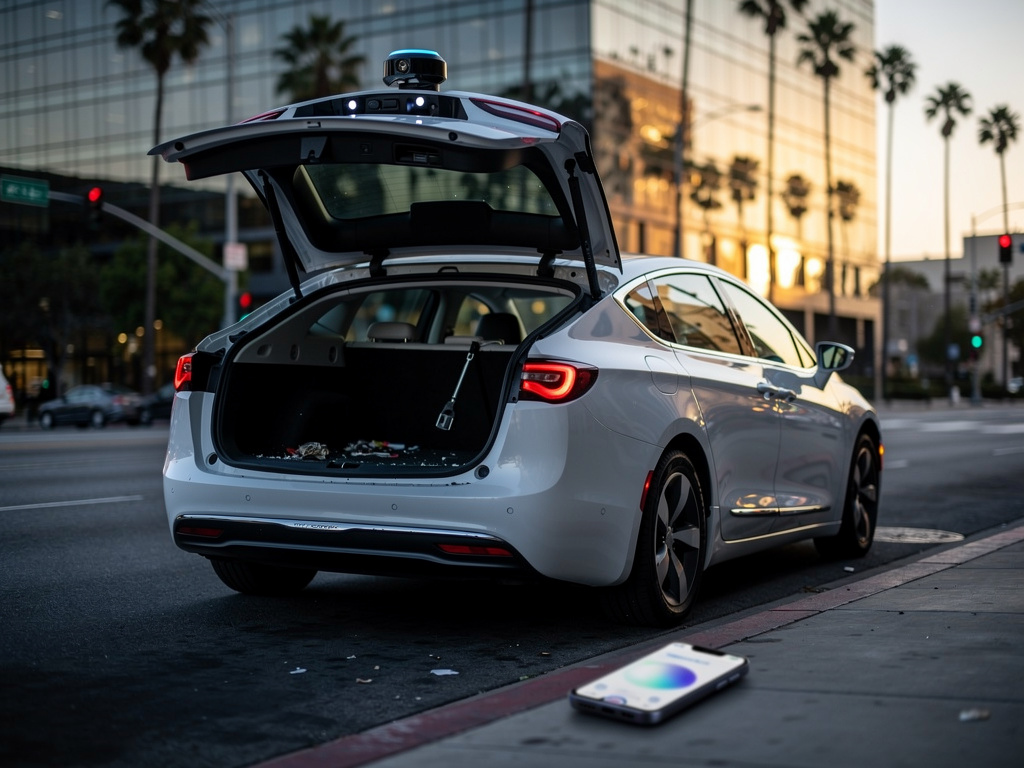
The Trunk Intruder: Safety Shadows Over Waymo’s Autonomous Ambitions
In the bustling streets of Los Angeles, where innovation often collides with the unpredictable realities of urban life, a recent incident involving a Waymo autonomous vehicle has sparked widespread concern and scrutiny. A woman, intending to hail a ride for her daughter, discovered a man concealed in the trunk of the driverless car, an event that unfolded earlier this month and quickly went viral. This peculiar episode not only highlights potential vulnerabilities in self-driving technology but also raises broader questions about security protocols in the burgeoning field of autonomous transportation.
According to reports, the woman approached the Waymo vehicle in the Westlake district of Los Angeles, only to find the stranger peeking out from behind the backseat, trapped in the trunk area. The man claimed he had been placed there by unidentified “people” and was unable to escape. Video footage of the encounter, which spread rapidly on social media, captured the woman’s shock and the man’s disoriented pleas for help. Police were called to the scene, but no arrests were made, as the individual had not committed a discernible crime at that moment.
This incident comes at a time when Waymo, a subsidiary of Alphabet Inc., is aggressively expanding its robotaxi services across major U.S. cities, positioning itself as a leader in the shift toward fully autonomous mobility. Yet, it underscores a critical challenge: how to safeguard passengers in vehicles that operate without human oversight. Industry experts are now debating whether such events could erode public trust in these technologies, especially as companies like Waymo push for wider adoption.
Emerging Details from the Scene
Delving deeper into the specifics, the event occurred when the woman opened the Waymo’s door and noticed the man huddled in the trunk space, which in these vehicles is accessible from the interior but not easily escapable without assistance. He explained that others had shut him inside, leaving him stranded. The Los Angeles Police Department investigated but determined there was insufficient evidence of criminal intent, allowing the man to leave without charges. This decision has fueled discussions on platforms like X, where users expressed outrage over perceived leniency in California’s legal system.
Sources close to the investigation, as reported by Futurism, suggest the man may have been homeless or experiencing mental health issues, adding layers of complexity to what could have been a straightforward security breach. Waymo’s response was swift: the company confirmed it is cooperating with authorities and emphasized that its vehicles are equipped with multiple cameras and sensors designed to detect anomalies. However, critics argue that these systems failed to identify the intruder before the car was dispatched to a customer.
The viral video, originally posted on TikTok and reposted across social media, shows the woman confronting the man calmly before alerting Waymo support and police. Posts on X highlighted public sentiment, with many users questioning the safety of sending unaccompanied minors in such vehicles. One post amassed hundreds of thousands of views, amplifying calls for enhanced vetting processes in autonomous fleets.
Broader Implications for Autonomous Tech
Waymo’s technology relies on a sophisticated array of lidar, radar, and cameras to navigate roads, but this incident exposes gaps in pre-ride security checks. Unlike traditional ride-hailing services with human drivers who might spot irregularities, autonomous vehicles must depend entirely on AI-driven monitoring. In this case, the trunk intrusion went undetected, prompting questions about whether Waymo’s algorithms are tuned more for road safety than for internal cabin threats.
Industry insiders point out that this isn’t an isolated hiccup for Waymo. Just days prior, two Waymo vehicles collided in a San Francisco dead-end street, blocking traffic and involving a third vehicle in the standoff, as detailed in a separate Futurism article. Such events compound concerns, especially following a software recall related to school bus detection failures. These mishaps illustrate the teething problems in scaling autonomous operations in dense urban environments.
Moreover, the trunk incident echoes earlier episodes where Waymo cars inadvertently entered tense situations, like a police standoff in Los Angeles where passengers were trapped amid law enforcement activity, according to NBC News. These occurrences highlight the unpredictability of real-world deployment, where AI must contend with human unpredictability.
Security Protocols Under Scrutiny
To understand the vulnerabilities, it’s essential to examine Waymo’s operational framework. The company’s robotaxis are designed with trunks that can be accessed via the rear seats, a feature intended for passenger convenience but potentially exploitable. After the incident, Waymo stated it would review its vehicle inspection routines, which include remote monitoring and periodic human checks at depots. However, the absence of real-time internal trunk sensors has been flagged as a oversight.
Comparisons to competitors like Cruise, which faced its own scandals including a pedestrian dragging incident, reveal common themes in the autonomous vehicle sector. Regulatory bodies, such as the National Highway Traffic Safety Administration, have ramped up oversight, demanding detailed incident reports. In this context, the trunk stowaway case could influence upcoming guidelines, pushing for mandatory biometric scans or AI-enhanced cabin surveillance.
Public reaction, as gauged from X posts, mixes fascination with fear. Some users humorously speculated about sci-fi scenarios, while others demanded accountability from tech giants. One widely shared post likened the event to a horror movie trope, underscoring the psychological barriers to adoption.
Waymo’s Response and Future Safeguards
In response to the incident, Waymo has reiterated its commitment to safety, noting that its vehicles undergo rigorous cleaning and inspection between rides. A spokesperson told FOX 11 Los Angeles that the company is working with law enforcement to prevent recurrences. This includes potential software updates to detect unusual weight distributions or movements in non-passenger areas.
Experts suggest that integrating advanced AI for anomaly detection could mitigate such risks. For instance, machine learning models trained on diverse scenarios might flag unauthorized entries. However, implementing these without infringing on privacy remains a delicate balance, as passengers value discretion in ride-sharing.
The event also spotlights socioeconomic factors, with reports from CBS Los Angeles indicating the man might have sought shelter in the vehicle, highlighting homelessness issues in tech-forward cities like Los Angeles. This intersection of technology and social challenges adds depth to the narrative, urging companies to consider broader community impacts.
Regulatory and Industry Ripples
As investigations continue, the incident is likely to influence policy discussions. California’s Department of Motor Vehicles, which oversees autonomous testing, may impose stricter protocols for vehicle security. Nationally, this could accelerate federal standards for robotaxi operations, ensuring uniform safety measures across states.
Competitors are watching closely. Tesla’s Full Self-Driving suite and Zoox’s purpose-built vehicles face similar scrutiny, but Waymo’s scale—operating in Phoenix, San Francisco, and now Los Angeles—makes it a bellwether. Analysts predict that persistent incidents could slow expansion, with investors wary of liability risks.
On X, sentiment leans toward caution, with users sharing stories of their own uneasy rides in autonomous vehicles. This grassroots feedback could pressure companies to prioritize user experience alongside technological prowess.
Lessons from the Trunk Debacle
Reflecting on the man’s claims of being trapped by “the people,” investigators are exploring whether this was a prank, a mental health episode, or something more sinister. DNYUZ reported that no foul play was confirmed, but the episode has prompted Waymo to enhance its emergency response features, such as quicker remote interventions.
For industry insiders, this serves as a case study in holistic security design. Beyond collision avoidance, future autonomous systems must address human-centric threats, from vandalism to unauthorized access. Innovations like tamper-proof compartments or AI guardians could emerge as standards.
Ultimately, while Waymo’s ambitions drive progress in mobility, incidents like this remind us that technology’s promise is only as strong as its safeguards against the unforeseen. As the sector evolves, balancing innovation with vigilance will determine its trajectory in transforming urban transport.
Evolving Narratives in Public Perception
The story’s virality, amplified by outlets like WTRF, has shifted focus from convenience to caution. Parents, in particular, are reevaluating the use of robotaxis for children, with some X users vowing to stick with human-driven options.
Waymo’s track record includes successes, such as millions of safe miles logged, but outliers like this trunk intruder challenge the narrative of infallibility. Company executives have publicly addressed the need for continuous improvement, signaling a proactive stance.
In the wider context, this incident contributes to ongoing debates about AI ethics and responsibility. As autonomous vehicles become ubiquitous, ensuring they enhance rather than endanger lives remains paramount.
Path Forward for Autonomous Innovation
Looking ahead, Waymo plans to expand to more cities, but with heightened scrutiny. Collaborations with urban planners and security experts could fortify defenses against similar breaches.
The event also underscores the value of transparency. By sharing incident data openly, companies can build trust, turning mishaps into opportunities for advancement.
As Los Angeles grapples with this bizarre chapter, it exemplifies the growing pains of a tech-driven future, where every ride could redefine safety norms.


 WebProNews is an iEntry Publication