
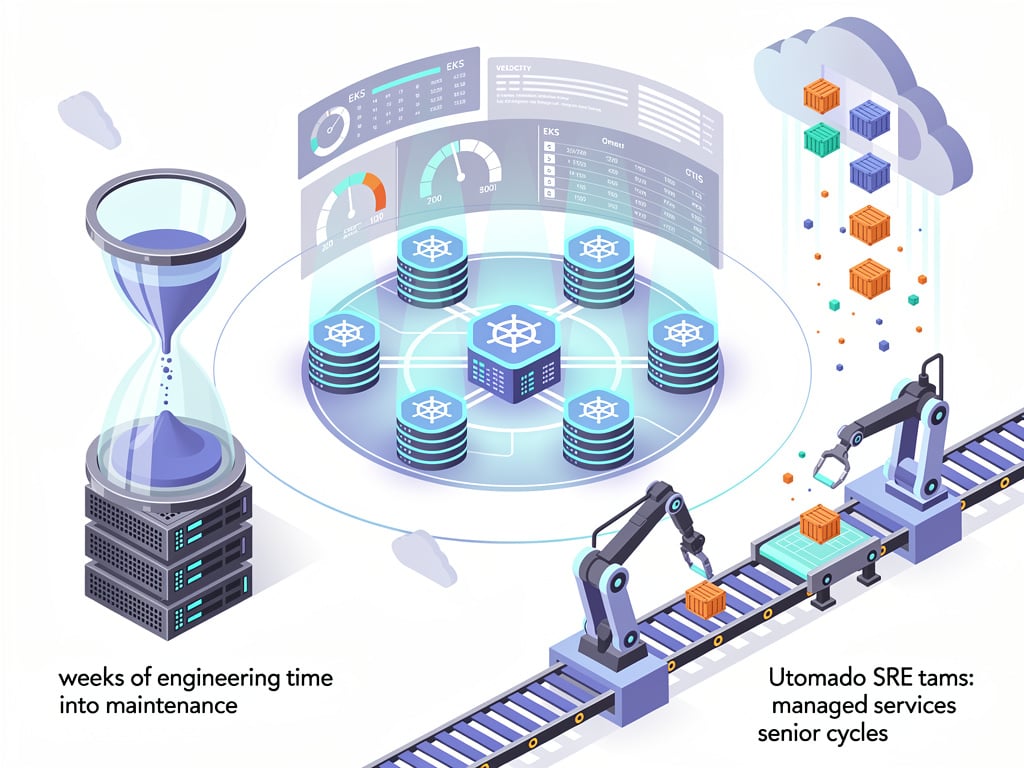
Senior engineers at many companies spend weeks every year on Kubernetes version bumps. They chase API deprecations. They fix add-ons that suddenly break. None of it moves customer metrics. A single minor upgrade across three regions in a mid-size Amazon EKS setup can eat four to six weeks of effort. That pushes two or three planned features off the roadmap.
Roadmaps slip. Cloud bills creep higher. The best talent splits focus between infrastructure toil and actual product work. But some organizations have found a different path. They treat platform operations as its own discipline. They shift the load. And they reclaim senior engineering cycles for work that shows up in revenue, reliability, and speed.
Munib Ali, director of engineering for SRE at Fairwinds, laid out the problem and practical responses in a CNCF blog post published today. The piece draws directly from operational data Fairwinds sees across hundreds of clusters. It matches patterns reported elsewhere.
Teams lose roughly 34 workdays per year resolving Kubernetes-related incidents, according to Komodor’s 2025 Enterprise Kubernetes Report. Nearly 80% of production outages trace back to recent system changes. That adds up to about one and a half months of team time spent simply returning to steady state. Over 65% of workloads run on less than half their requested CPU or memory. More than 80% show misalignment between requests and actual usage. The result is chronic overspend on top of the operational drag.
Security adds another layer. Black Duck’s 2026 Open Source Security and Risk Analysis report found 87% of commercial codebases contain at least one vulnerability. Seventy-eight percent carry high-risk issues. Forty-four percent include critical ones. Upgrades and patching cannot be skipped. The only variables are who performs the work and how efficiently they do it.
And the pace keeps accelerating. Cloud providers push faster adoption even though each minor Kubernetes version receives 12 months of support. New releases introduce deprecated APIs that break existing Helm charts. Add-on incompatibilities surface at inconvenient moments. Configuration drift multiplies across clusters, regions, and environments. One CVE can land right in the middle of an upgrade window. Teams then face an ugly trio of choices: delay the launch, accept extra risk, or burn weekends. None appear cleanly on a dashboard. All carry real cost.
Fairwinds sees the pattern repeatedly. When upgrades, patching, and add-on management move off product teams’ backlogs and onto a dedicated Kubernetes SRE group, organizations reclaim weeks of senior engineering time annually. The shift lets internal staff focus on developer experience, internal guardrails, and higher-order platform enablement.
But building and retaining that dedicated SRE capability requires deliberate investment. Not every company can or should staff it internally. For many, the smarter move is to standardize on a stable, predictable platform and reassign the freed cycles to performance tuning that cuts churn, reliability work that lowers incident volume, or experiments that open new revenue streams.
The question shifts. Instead of asking whether to run Kubernetes in-house, leadership should examine how much senior headcount they want to lock into maintenance where success means customers never notice. The Kubernetes project itself has evolved with discipline. It avoided bloat by pushing storage to CSI, runtimes to CRI, and other concerns outward. That focus helped it scale from container orchestrator to substrate for AI workloads and edge computing. Yet the operational burden of staying current still lands on users.
Platform engineering teams have responded with automation and process. A January CNCF post outlined maintenance realities across 14 open source components integrated into typical platforms. Administrators can expect two to five major upgrades, 43 to 52 minor ones, and 276 to 327 software patches yearly. The numbers explain why manual approaches collapse at scale.
One recommended practice is a conformance smoke test. Render all manifests. Test them statically against the Kubernetes OpenAPI schema, including custom resource definitions. This catches breaking changes before they hit production. For Helm charts, the advice is to treat the platform as a product. Review rendered diffs between versions. Run dry deployments against test clusters. Custom operators can manage changes to immutable fields such as Deployment label selectors that standard Helm upgrades struggle with.
Persistent data adds complexity. Many charts bundle databases with persistent volumes but lack proper lifecycle operators. Major version upgrades then require careful migration. The guidance is clear. Avoid embedding SQL databases directly in application Helm charts. Instead deploy them via specialized operators like CloudNativePG that handle storage constraints and version transitions.
Automation helps at the supply chain level too. Scripts can scan for new versions via GitHub APIs and Helm repositories. Mono repositories and private container registry caches reduce rate limiting and deprecation surprises. Integration tests on live clusters plus long-term Prometheus monitoring catch runtime issues such as OOMKilled pods, CPU throttling, or disk pressure.
Recent industry coverage reinforces these points. A March analysis on Security Boulevard echoed the four-to-six-week estimate per minor upgrade and highlighted managed Kubernetes-as-a-Service as a force multiplier. Platform engineering adoption continues to climb. Gartner had projected 80% of organizations would embrace it by 2026. Mature platform teams report 40% to 50% drops in developer cognitive load and up to 3.5 times higher deployment frequency per DORA benchmarks.
Tools have matured in response. GitOps solutions like Argo CD bring continuous synchronization and drift detection. Management platforms from Rancher to Gardener automate cluster lifecycle tasks including upgrades across clouds. Lightweight distributions such as K3s lower the bar for testing and edge use cases. AI-assisted offerings now scan cluster state, suggest fixes, and optimize resource allocation without constant human oversight. Yet none eliminate the need for governance. The organizations that gain the most combine automation with clear ownership and policy-as-code guardrails.
Consider the alternative. Keep everything on product engineers. Every sprint includes some fraction of upgrade rehearsal, dependency patching, and resource tuning. Velocity suffers. Burnout rises. Competitive features stay on the backlog. Or accept that Kubernetes operations is a specialized craft. Staff it accordingly or partner with providers who already run it at scale. The latter option has proven effective for companies where Kubernetes supports the business but is not the product itself.
The CNCF catalog of case studies shows organizations of varying sizes using managed services to reach reliability and agility targets without owning every detail. They still maintain control through policy, observability, and internal platform layers. The infrastructure becomes predictable enough that teams rarely think about it. That is the point. Not invisibility for its own sake. A solid foundation that frees attention for work customers actually feel.
Leadership teams evaluating their 2026 plans should run the numbers. Calculate fully loaded cost of the weeks spent on upgrades last year. Add incident time tied to configuration changes. Factor in delayed features and cloud waste from misaligned resources. Then compare against the cost of a dedicated SRE function or managed service. In most cases the math favors reclaiming the time.
Because those reclaimed weeks add up. One team might redirect them to latency reductions that retain users. Another to new AI capabilities that open markets. A third to security hardening that avoids breach costs. The common thread is focus. Kubernetes will keep advancing. New versions will arrive. CVEs will appear. The organizations that treat the operational layer as solved will move faster than those who keep wrestling it in-house.
The data is consistent across reports. The patterns hold at scale. And the solutions exist. Dedicated ownership. Automation layered on top of testing and monitoring. Strategic use of managed platforms. Clear separation between platform foundations and product innovation. Teams that adopt this model don’t just reduce toil. They accelerate.


 WebProNews is an iEntry Publication