
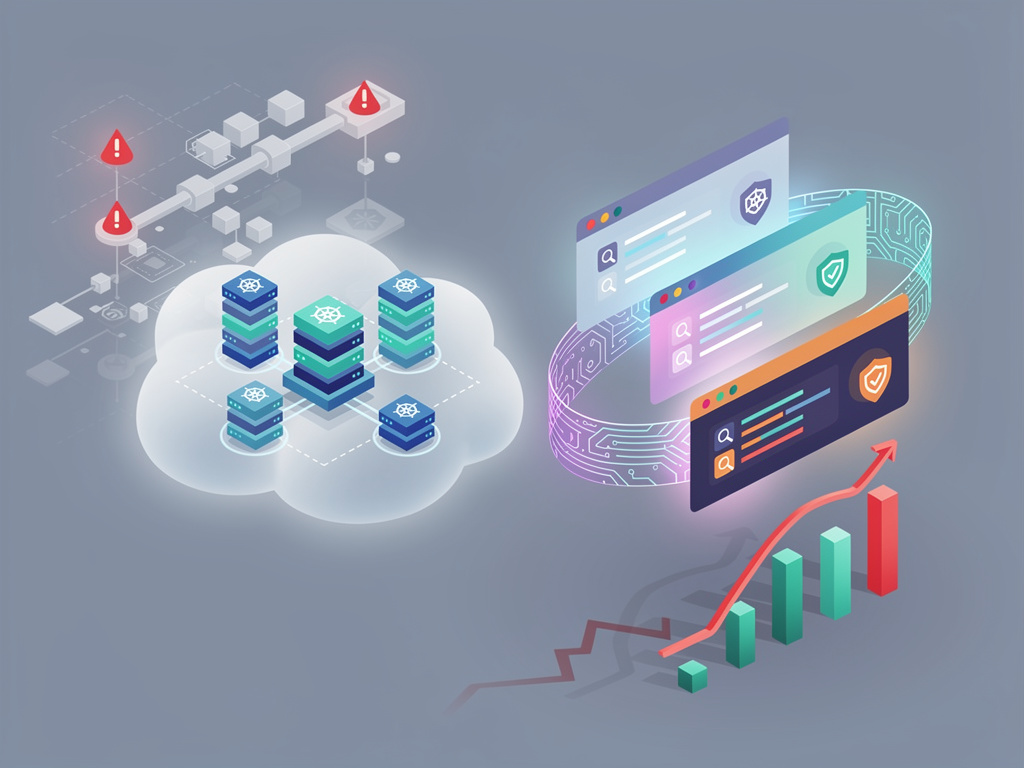
Kubernetes gives teams speed and flexibility. It also hands them configuration headaches that lead to outages and breaches. A large share of those problems trace back not to faulty application code but to misconfigured resources. Think missing resource limits, permissive security contexts or loose RBAC bindings. These errors surface often. They prove subtle. And they show up far too late in most organizations.
Sajal Nigam laid this out clearly in a CNCF blog post published May 25, 2026. Policy-as-code tools have matured inside the CNCF projects. Open Policy Agent, Kyverno and Conftest let platform teams write declarative rules. Yet the dominant enforcement points sit at CI/CD pipelines and admission controllers. By then the developer has moved on. Context evaporates. The fix becomes another context switch and another commit.
That cycle repeats daily across enterprises. A CI job flags a violation. The pull request already sits reviewed and mentally closed. The developer returns, patches the YAML, and pushes again. Nothing wrong with the policies themselves. The timing simply fails the people writing the code.
Platform engineers increasingly talk about the enforcement locus. Not just what rules to write or how to apply them. But exactly where and when the check fires and feedback reaches the author. Current setups cluster around late stages. IDE and command-line checks deliver instant signals yet stay invisible to the broader team. Pull-request reviews offer collaboration and shared context but often get bypassed. CI pipelines bring auditability at the price of slow loops. Admission controllers deliver the strongest gate yet arrive after intent has hardened.
The gap sits squarely at review time. Code review remains the moment when decisions crystallize. Trade-offs get debated. Intent gets clarified. Yet policy violations typically land later in isolated logs. They never join the conversation that shaped the change.
Experiments now test browser-based policy engines that run directly inside the pull-request interface. These tools scan the diff for Kubernetes manifests. They evaluate them client-side against the same policy sets used downstream. Violations appear as inline comments visible to author and reviewers alike. No CI pipeline change required. No cluster access needed. Evaluation stays entirely in the browser.
Projects such as GuardOn, alongside extensions from Kyverno and OPA, explore this space. The CNCF article highlights early results. Feedback arrives immediately. Issues get fixed before merge while context remains fresh. Violations become part of the review discussion instead of buried artifacts. Shared awareness grows. The volume of downstream failures drops.
But review-time checks carry limits. They prove bypassable because they run client-side. They cannot consult live cluster state or existing resources. They offer no hard enforcement guarantee. Admission controllers still provide that final barrier. So do pipeline scans. The new layer supplements rather than supplants. It forms one rung in a defense-in-depth ladder.
A complete model spreads validation across stages. Edit-time tools give individuals fast private signals. Review-time surfaces context to the team. Pipeline scans deliver centralized audit. Admission controllers block non-compliant objects at the API server. Each stage optimizes for different goals. Early ones prioritize speed and developer experience. Later ones prioritize guarantees.
Recent Kubernetes releases have strengthened native options. ValidatingAdmissionPolicy, now generally available, lets clusters write CEL expressions directly in the API server. No webhook round-trip. Better performance. Lower operational overhead. The Kubernetes documentation details how these controllers intercept requests before objects reach etcd. Kubernetes.io admission controllers overview explains the mechanics.
Yet native capabilities alone rarely suffice for complex organizational rules. Teams still layer Kyverno or Gatekeeper on top. A May 2026 GitHub update to the Kyverno project underscores its continued evolution as a Kubernetes-native policy engine for validation, mutation, generation and reporting. It works alongside, not instead of, built-in ValidatingAdmissionPolicies.
Industry conversation has also sharpened around shifting checks earlier. A CrowdStrike analysis from late 2024 already framed the tension between shift-left tactics and shield-right enforcement. Newer 2026 commentary extends that thinking. One Medium guide published this month maps a full 2026 Kubernetes security stack. It places linters and scanners in the earliest phases, policy engines in the middle, and runtime controls at the end. The piece stresses that early detection cuts rework costs dramatically. The Ultimate Kubernetes Security Tooling Guide for 2026.
Checkmarx took a similar view in its 2026 container security report. It calls out admission controls paired with policy-as-code as essential for consistent guardrails. Early validation of configurations, the report notes, minimizes expensive production remediation. Container Security in 2026: 7 Key Components, Risks & Defenses.
So what should platform teams actually do? Avoid single points of enforcement. A lone gate at admission creates bottlenecks and inflates remediation expense. Distribute checks so each stage catches what it does best. Focus as much on feedback timing as on enforcement strength. A violation spotted during review costs orders of magnitude less to address than one caught at deploy time.
Make policy expectations visible inside the surfaces where engineers already collaborate. Pull requests. Code comments. Review threads. When governance joins the conversation instead of arriving as an after-the-fact audit, teams absorb the intent faster. Compliance stops feeling like external pressure.
The CNCF post goes further. It eyes AI agents as the next evolution. Current review-time tools flag a missing resource limit. An embedded agent could explain why that limit matters for this workload, how it interacts with neighboring configurations, and what risk profile emerges from the surrounding namespace and RBAC. It could propose a concrete YAML patch. Accept, tweak or reject without leaving the browser. The agent could even distinguish deliberate exceptions from genuine drift by reasoning over metadata and context.
Longer term, multi-agent systems might analyze trends across hundreds of pull requests. They could flag systemic policy gaps and suggest refinements to the platform team. Natural-language policy authoring could lower the bar so domain experts, not just Rego specialists, contribute rules. None of this replaces deterministic enforcement. The layered model persists. AI simply makes the early layers smarter and more conversational.
Kubernetes governance has already reached production scale thanks to mature CNCF projects. OPA, Kyverno, Conftest and kube-linter demonstrate that. The frontier now lies in tighter integration with developer workflows and smarter interfaces to the knowledge already captured in those policies. Placing checks where humans make decisions, and where the cost of correction stays lowest, delivers measurable gains in velocity and reliability.
Teams that adopt this fuller spectrum, from edit-time linters through review-time visibility to admission-time gates, report fewer surprises at deploy. Fewer hotfixes. Sharper shared understanding of what safe configuration actually looks like. The policy engines already exist. The question is whether organizations will move them upstream enough to matter.


 WebProNews is an iEntry Publication