
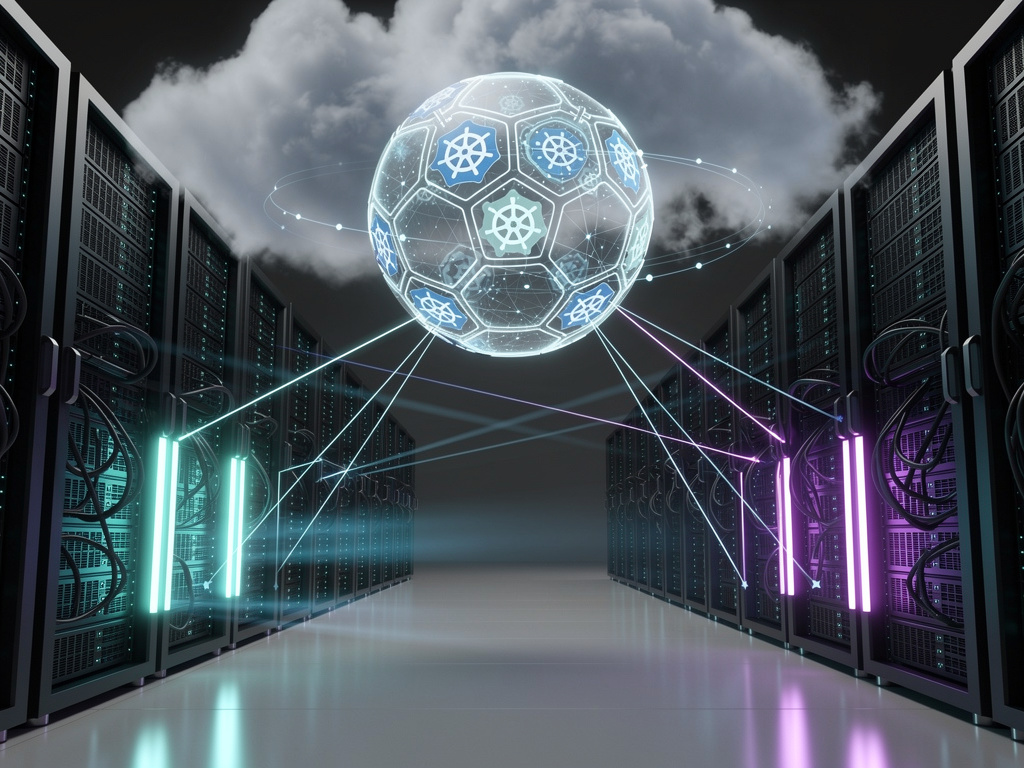
Google and the Cloud Native Computing Foundation have formally launched what amounts to an industry-wide standardization effort for running artificial intelligence workloads on Kubernetes. The new AI Conformance Program, announced in April 2026, establishes for the first time a shared set of technical requirements that cloud providers and platform vendors must meet if they want to claim their Kubernetes distributions are ready for AI. It’s a move that sounds bureaucratic on the surface. Underneath, it’s a power play that could reshape how enterprises choose where to train and deploy their models.
The program didn’t materialize out of thin air. For more than a year, engineers across Google, Red Hat, NVIDIA, Microsoft, and a constellation of smaller vendors have been working within the CNCF’s Kubernetes community to define what “AI-ready” actually means in concrete, testable terms. According to the Google Open Source Blog, the effort grew directly out of frustration: organizations were spending enormous engineering hours trying to get AI training and inference pipelines to work consistently across different Kubernetes distributions. What ran on one provider’s managed Kubernetes service would break on another’s. GPUs wouldn’t be detected. Scheduling behavior for multi-node training jobs would differ in subtle, maddening ways.
So the community built a conformance program modeled on the original Kubernetes Conformance Program — the one that, starting around 2018, brought order to the chaos of competing Kubernetes distributions by requiring them to pass a standard battery of API tests. That earlier effort is widely credited with making Kubernetes portable enough to become the default container orchestration platform across the industry. The new AI conformance effort applies the same logic to a harder problem.
Here’s what the program actually requires. Vendors seeking the AI Conformance certification must demonstrate that their Kubernetes distributions correctly support a defined set of APIs and features specifically needed for AI workloads. The Google Open Source Blog details several key areas: proper GPU and accelerator device plugin support, topology-aware scheduling that understands the physical layout of GPUs within and across nodes, support for gang scheduling (where all pods in a distributed training job must be scheduled simultaneously or not at all), and correct implementation of the Dynamic Resource Allocation (DRA) API that landed in recent Kubernetes releases.
That last item — DRA — deserves particular attention. Dynamic Resource Allocation represents a fundamental change in how Kubernetes handles hardware resources like GPUs, FPGAs, and custom AI accelerators. Under the older device plugin model, GPUs were treated as simple countable resources. You’d request two GPUs, and the scheduler would find a node with two available. But it couldn’t express preferences about which specific GPUs, whether they shared a high-bandwidth NVLink interconnect, or whether the allocation should consider the NUMA topology of the host machine. DRA changes that by allowing resource drivers to participate in the scheduling decision, providing rich metadata about available devices and their relationships.
For AI training workloads — especially large-scale distributed training across dozens or hundreds of GPUs — these details aren’t academic. A poorly placed GPU allocation can cut training throughput by 30% or more. The conformance program essentially says: if you call your distribution AI-ready, you must handle this correctly.
The timing is conspicuous. Enterprise adoption of AI has reached a point where the infrastructure questions are no longer optional. According to recent industry surveys, more than 70% of organizations running AI workloads in production are using Kubernetes as their orchestration layer. But the experience varies wildly. A machine learning engineer at a Fortune 500 company might have a team of platform engineers who’ve spent months tuning their Kubernetes clusters for AI. A smaller company using a managed Kubernetes service from a cloud provider is at the mercy of whatever that provider has implemented.
The conformance program creates a floor. Not a ceiling — vendors can and will differentiate above it — but a guaranteed baseline.
Google’s role in driving this effort forward is both natural and strategic. The company invented Kubernetes, donating it to the CNCF in 2015, and has maintained outsized influence over its technical direction ever since. Google Cloud’s GKE (Google Kubernetes Engine) service has been aggressively adding AI-specific features, including tight integration with Google’s TPU accelerators and partnerships with NVIDIA for GPU-accelerated workloads. By helping define the conformance standard, Google ensures the baseline aligns with capabilities it has already built — while also, to its credit, doing so through an open governance process where competitors have equal say.
And competitors are participating. The Google Open Source Blog notes that the working group behind the conformance program includes contributors from Red Hat (whose OpenShift platform is the dominant enterprise Kubernetes distribution), Microsoft (Azure Kubernetes Service), Amazon (Elastic Kubernetes Service), and NVIDIA, whose hardware underpins the vast majority of AI training infrastructure worldwide. The involvement of all major cloud providers suggests the industry has reached a consensus that fragmentation in AI infrastructure support is a problem worth solving collectively.
NVIDIA’s participation is especially significant. The company’s dominance in AI accelerator hardware gives it enormous influence over how software platforms interact with GPUs. NVIDIA has been pushing its own standards — the GPU Operator for Kubernetes, the NVIDIA Container Toolkit, and more recently its NIM (NVIDIA Inference Microservices) platform. By participating in the CNCF conformance effort, NVIDIA is signaling that it sees value in a vendor-neutral standard rather than relying solely on its own proprietary integration points. Or perhaps more accurately, it’s ensuring that the standard doesn’t evolve in a direction that disadvantages its hardware.
The technical scope of the conformance tests goes beyond just GPU scheduling. The program also validates support for features like Job-level APIs for batch and training workloads (including the newer JobSet API for coordinating groups of related jobs), proper handling of preemption and priority for AI workloads that may need to be interrupted and resumed, and integration with the Kubernetes networking stack for high-performance inter-node communication — critical for distributed training where gradient synchronization across nodes can become the bottleneck.
There’s a philosophical dimension to this that industry veterans will recognize. Kubernetes was originally designed for stateless web applications. Microservices. The classic twelve-factor app. Running AI workloads on it has always been something of a square-peg-round-hole exercise. Training jobs are long-running, stateful, resource-intensive, and sensitive to hardware topology in ways that a typical web server simply isn’t. The AI conformance program is an acknowledgment that Kubernetes has to evolve — that the platform’s center of gravity is shifting toward AI workloads, and the project’s governance and testing infrastructure need to reflect that.
Not everyone is convinced this is the right approach. Some in the ML infrastructure community have argued that Kubernetes itself is too complex for AI workloads, and that purpose-built platforms — or at least much thicker abstraction layers on top of Kubernetes — are what practitioners actually need. Tools like Ray, which provides its own cluster management and scheduling for distributed Python workloads, have gained significant traction precisely because they hide Kubernetes complexity from data scientists. The counterargument, and it’s the one the conformance program implicitly makes, is that Kubernetes isn’t going away as the foundational layer, so it had better work correctly for AI regardless of what sits on top of it.
The practical implications for enterprise buyers are straightforward. Once the conformance program is fully operational, procurement teams evaluating Kubernetes distributions for AI workloads will have a simple initial filter: is the distribution AI-conformant or not? This doesn’t eliminate the need for deeper technical evaluation — performance characteristics, support quality, pricing, and integration with specific ML frameworks will still matter enormously. But it does eliminate the risk of choosing a platform that fundamentally can’t handle the basics.
For startups building AI infrastructure tooling, the conformance program is a double-edged development. On one hand, a standardized base layer makes it easier to build portable tools that work across multiple Kubernetes distributions. On the other, it raises the floor of what the platform itself provides for free, potentially commoditizing capabilities that some startups were selling as value-added features.
The CNCF plans to publish the first wave of conformance results later in 2026, with major distributions expected to certify quickly. The testing framework is open source, following the precedent set by the original Kubernetes conformance tests, and vendors can run the tests against their own distributions before submitting results publicly.
What happens next will depend on adoption speed and whether the conformance criteria evolve fast enough to keep pace with AI infrastructure requirements. The current spec focuses on training and inference workloads using GPUs and similar accelerators. But the AI hardware world is diversifying rapidly — custom ASICs from companies like Cerebras, Groq, and d-Matrix are entering production, and each brings its own resource management requirements. The conformance program will need to accommodate these without becoming so broad that it loses its usefulness as a meaningful standard.
There’s also the question of whether conformance will extend to operational concerns beyond pure API compatibility. Things like observability for AI workloads (GPU utilization metrics, training job progress tracking), security considerations specific to model serving (input validation, model integrity), and cost management for expensive accelerator resources are all areas where standardization would be valuable but where consensus is harder to reach.
For now, the AI Conformance Program represents the clearest signal yet that Kubernetes’ stewards view AI as the platform’s primary growth vector. Not the only one — Kubernetes still runs an enormous volume of traditional application workloads and will continue to. But the energy, the engineering investment, and now the governance infrastructure are increasingly oriented toward making Kubernetes the definitive platform for AI. Whether that bet pays off will depend on execution. The standard is written. The tests are built. Now the industry has to actually pass them.


 WebProNews is an iEntry Publication