
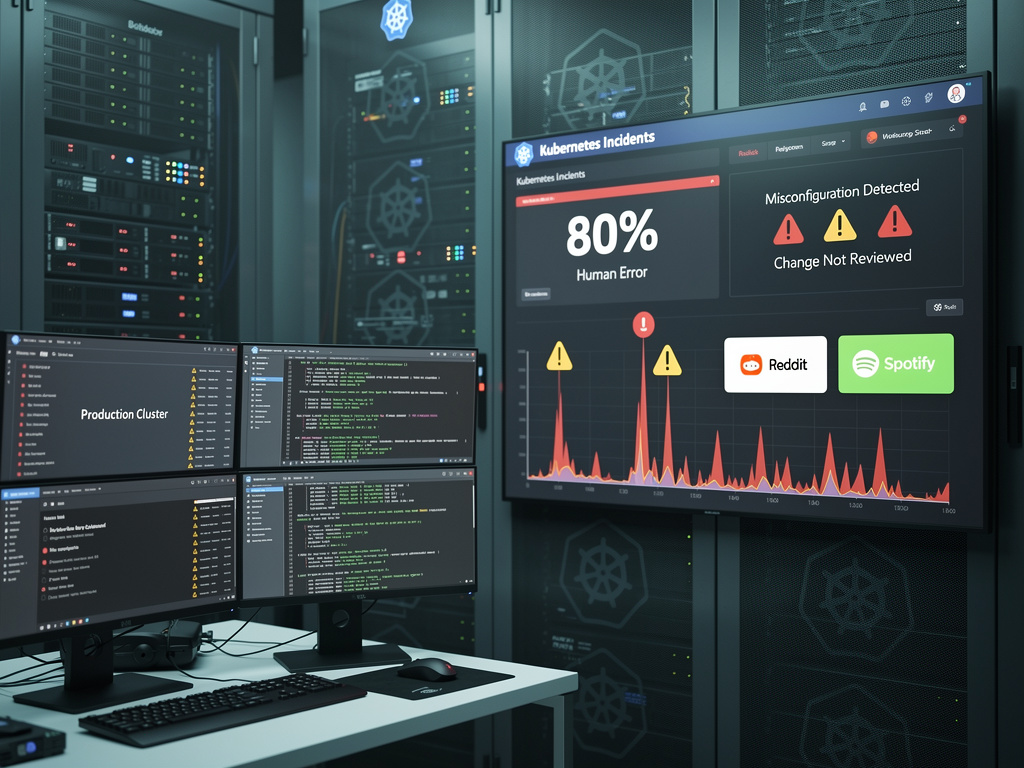
In the high-stakes world of cloud-native infrastructure, Kubernetes reigns supreme, orchestrating containers across enterprises from startups to Fortune 500 giants. Yet beneath its declarative power lies a sobering reality: most outages stem not from core platform defects, but from human missteps amid mounting operational complexity. A Komodor 2025 Enterprise Kubernetes Report reveals nearly 80% of production incidents trace to recent system changes, costing teams an average of 34 workdays annually on troubleshooting alone.
This pattern holds across industries. Operators routinely battle undocumented configurations, overlooked resource limits, and cascading failures triggered by routine deployments. As one X post from engineer Branko detailed, a junior developer’s tweak to a ConfigMap logging level from INFO to DEBUG flooded node disks in eight minutes, crashing kubelets cluster-wide and demanding 45 minutes of manual recovery via SSH. “The fix was one word. The impact was 45 minutes of total downtime,” Branko noted on X.
Misconfigurations: The Silent Cluster Killers
Common pitfalls amplify these risks. Without liveness or readiness probes, pods loop endlessly in restarts while traffic pounds dead endpoints, as highlighted in AsyncTrix’s X analysis of prod outages. Missing resource requests and limits let one pod starve the cluster, sparking evictions. PodDisruptionBudgets absent during rollouts can wipe services entirely, and secrets exposed in env vars leak credentials into logs.
Reddit Engineering’s transparency underscores this. On November 20, 2024, a daemonset rollout for Calico route reflectors overwhelmed control plane memory, halting API servers and severing data plane connectivity. Authors Jess Yuen and Sotiris Nanopoulos explained in their Reddit postmortem: “A daemonset deployment pushed us over limits on the control plane VMs.” Recovery involved manual interventions, prompting fixes like memory limits on API servers and phased daemonset tooling.
Upgrade Traps and Label Nightmares
Kubernetes upgrades expose similar vulnerabilities. Reddit’s Pi Day outage in March 2023 stemmed from deprecated ‘master’ node labels in route reflector selectors after upgrading to 1.24, which purged legacy references. As detailed in their postmortem, “The nodeSelector and peerSelector for the route reflectors target the label `node-role.kubernetes.io/master`… This is the cause of our outage.” Control plane isolation failed, cascading to full downtime until label migrations.
Spotify’s 2018 mishap saw an engineer delete their live US cluster mistaking it for a test environment, per Kubevious analysis. Reconstruction dragged three hours due to faulty deployment scripts. Such errors persist; a 2025 X anecdote described 340 pods evicted at 2 a.m. from unchecked debug logs ballooning 47x, filling ephemeral storage silently for weeks.
Cascades from the Control Plane Down
Control plane overloads amplify human oversights. HackerNoon’s piece argues, “Kubernetes failures are rarely technical. Human error, undocumented complexity, and hero engineering turn powerful platforms into fragile systems.” OpenAI’s outage, echoed by Vercel’s Guillermo Rauch on X, involved rollout-induced load compounding into cascades, delaying precise root cause isolation.
Microsoft’s October 2025 Azure incident blamed a Kubernetes crash for portal and Entra downtime, per The Register. Cyble’s four-hour 2025 disruption stemmed from cluster misconfig, disrupting threat intel amid surging ransomware, as reported by WebProNews.
Drift and Change: The Entropy Engine
Configuration drift fuels 70% of outages, per a cited 2025 Gartner finding echoed in AWS in Plain English. Uptime Institute’s 2025 report notes human errors from procedure lapses rose 10 points to 58%. Komodor data shows 65% of workloads idle below half requested resources, bloating bills while inviting instability.
X users recount disk-filling logs, absent anti-affinity landing replicas on single nodes, and autoscaling to 200 nodes crashing apps. “80% of Prod outages trace back to these 5 Kubernetes mistakes,” AsyncTrix posted, listing probes, limits, budgets, secrets, and affinity failures.
Guarding Against the Human Element
Lessons converge on prevention: enforce resource limits, phased rollouts, GitOps for traceability, and node-disk alerts. Reddit now isolates route reflectors on worker nodes and tools daemonset deploys. Komodor urges pre-vetted templates and guardrails, reducing toil. As Branko implemented post-typo: PR reviews for ConfigMaps, log rotation, disk monitoring.
AI emerges as counterweight; Komodor’s Klaudia auto-remediates pod crashes and misconfigs. Yet core advice endures: version everything, monitor aggressively, simulate failures. Enterprises lose hours to mean-time-to-resolution near one hour per Komodor. Proactive discipline turns fragility into resilience.
Scale’s Relentless Demand
At hyperscale, stakes soar. Zalando’s tales in Kubernetes Failure Stories compilation detail etcd splits, OOMs from 50,000 replicas, DNS flakes. Nordstrom’s KubeCon talk cataloged 101 crash vectors. Even giants falter: Pinterest’s outage proved Kubernetes solves scaling, not operations, per Medium postmortem.
Operators must embed safeguards—anti-affinity, disruption budgets, probes—from day zero. X’s Branko warns: “Small changes can have big consequences.” In Kubernetes’ declarative realm, human vigilance remains the ultimate orchestrator.


 WebProNews is an iEntry Publication