
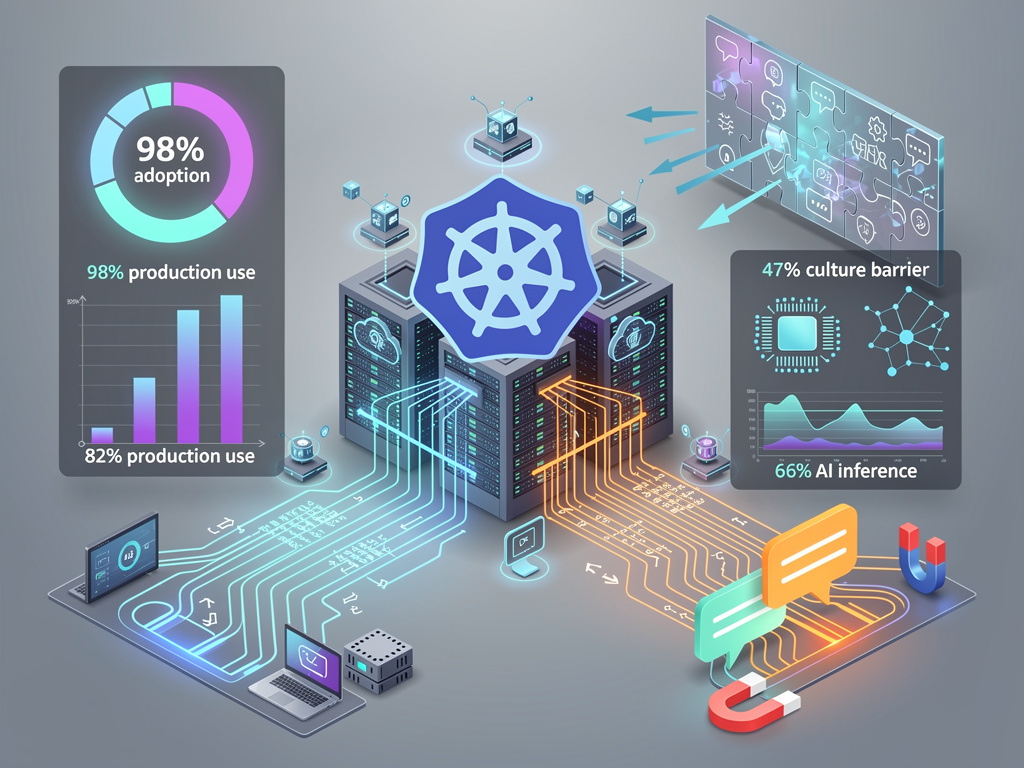
Cloud native technologies have reached near-universal adoption, with 98% of organizations embracing them according to the CNCF Annual Cloud Native Survey 2025. Kubernetes, the orchestration powerhouse, now runs in production for 82% of container users, up from 66% in 2023. Yet as these tools mature into enterprise standards, a human hurdle looms larger than ever: organizational culture.
The Techzine.eu report captures this shift starkly, noting that container rollouts now grapple with ‘personal convictions’ rather than technical glitches. CNCF data confirms: 47% of respondents pinpoint cultural changes with development teams as the top obstacle, eclipsing security (36%), lack of training (36%), and complexity (34%). ‘The struggle for full adoption is no longer about stripping away technical complexity, but about persuading personnel to embrace further change,’ the analysis states.
This cultural bottleneck arrives just as Kubernetes cements its role in AI. Sixty-six percent of generative AI model hosts rely on it for inference workloads, yet only 7% deploy models daily, with 47% doing so occasionally. ‘The gap between ambition and reality is stark,’ says Jonathan Bryce, executive director of cloud and infrastructure at the Linux Foundation, highlighting how human operators are yielding ground to AI agents.
Kubernetes Entrenches as AI Backbone
Hilary Carter, senior vice president of research at Linux Foundation Research, explains in the CNCF announcement: ‘Enterprises are aligning around Kubernetes because it has proven to be the most effective and reliable platform for deploying modern, production-grade systems at scale—including AI.’ Production Kubernetes use hit 82% in 2025, signaling its evolution from experimental tool to ‘de facto operating system’ for intelligent systems.
Among container users, 56% now run most or all production applications in containers, per Forbes analysis of CNCF data. GitOps adoption marks maturity divides: 58% of ‘innovators’ use it extensively, versus 0% of explorers. OpenTelemetry surges as the second-fastest-growing CNCF project, underscoring observability’s rise amid scaling pressures.
AI integration amplifies these trends. Kubernetes unifies scaling, deployment, and management of pre-trained models, where over half of organizations focus rather than training. ‘Success requires treating AI/ML as a first-class infrastructure challenge, not just an algorithmic one,’ the CNCF blog emphasizes.
Cultural Barriers Eclipse Technical Hurdles
Techzine.eu details how 25% of organizations have shifted nearly all development and deployment to cloud native, with 34% covering the majority and 32% partial. But explosive growth stalls, tethered to overall IT expansion. Cultural resistance—cited by 47%—demands persuasion over code tweaks.
Forbes identifies cultural change with development teams (47%) as the top container challenge, followed by training and security shortages (both 36%). This maturity pivot means bottlenecks now reside in operating models and skills, not YAML syntax. ‘Maturity bottlenecks increasingly live in operating models and skills,’ the article notes.
AI agents exacerbate divides. They don’t fit traditional admin-user categories or dashboards, per Techzine.eu. Identity firms now classify them distinctly, signaling infrastructure mismatches. Human persuasion propelled Kubernetes to best-practice status; the same ‘analog power’ is vital for AI transitions.
AI Workloads Reshape Orchestration Demands
Sixty-six percent Kubernetes adoption for generative AI underscores its AI traction, yet deployment risks persist. Bryce warns of human-AI operator disconnects: infrastructure built for people ill-suits autonomous agents. Tools like MCP servers and Agent2Agent frameworks risk technical debt if AI demands simpler architectures sans layers.
CNCF’s Certified Kubernetes AI Conformance Program, launched November 2025, standardizes AI workloads across Amazon EKS, Google GKE, and others. Version 2.0 targets 2026 release, addressing portability. Cloud Native Now reports Microsoft enhancing Azure Kubernetes Service for AI, tackling CNCF-noted gaps in security and complexity.
Fairwinds predicts 2026 MLOps as heaviest Kubernetes AI loads, coordinating bursty training with inference. ‘The question isn’t whether Kubernetes wins – it already has,’ but deliberate use via platform engineering will define maturity.
Technical Debt Looms in Mature Ecosystems
Cloud native abstractions—Docker, Kubernetes, composable infrastructure—offer strengths but pitfalls for AI efficiency. Techzine.eu cautions they may complicate where simplicity reigns, echoing legacy rigidity risks. All IT accrues debt: unmaintained code breeds vulnerabilities and costs; 2026 trends could seem quaint by 2036.
CNCF stresses evolution through collaboration. Jonathan Bryce in the announcement: ‘Kubernetes isn’t just scaling applications; it’s becoming the platform for intelligent systems. This community has the expertise to shape how AI runs at scale.’ Platform engineering and GitOps investments signal advantages for adapters.
X discussions echo real-world friction. DevOps engineer Akhilesh Mishra posts: AI excels at templates but falters on complex networking, compliance, or novel issues. ‘The future isn’t AI replacing DevOps engineers. It’s DevOps engineers who understand how to leverage AI efficiently versus those who don’t.’
Platform Engineering Emerges as Maturity Marker
Backstage, now CNCF’s #5 velocity project, powers internal developer portals, easing cultural shifts. Observability profiling hits 20% adoption. CNCF webinar ‘Infrastructure of AI’s Future’ on February 3, 2026, will dissect these dynamics.
Forbes lists 10 CNCF signals: containers span portfolios, GitOps as maturity marker, AI pressuring sustainability. Komodor forecasts AI SRE adoption, GPU-driven scheduler evolutions like KEP-4671 Gang Scheduling.
Veeam notes AI optimizing Kubernetes itself—predictive autoscaling, anomaly detection—while challenges like GPU management persist. ‘This convergence—AI on Kubernetes and AI for Kubernetes—marks a turning point,’ it states.
Persuasion Powers Next Evolution
Techzine.eu reassures: Kubernetes succeeded via professional buy-in, not overnight overhauls. CNCF data shows 59% with much or nearly all work cloud native; innovators invest in people and platforms. Carter: ‘The next phase of cloud native evolution will be as much about people and platforms as it is about the tech itself.’


 WebProNews is an iEntry Publication