
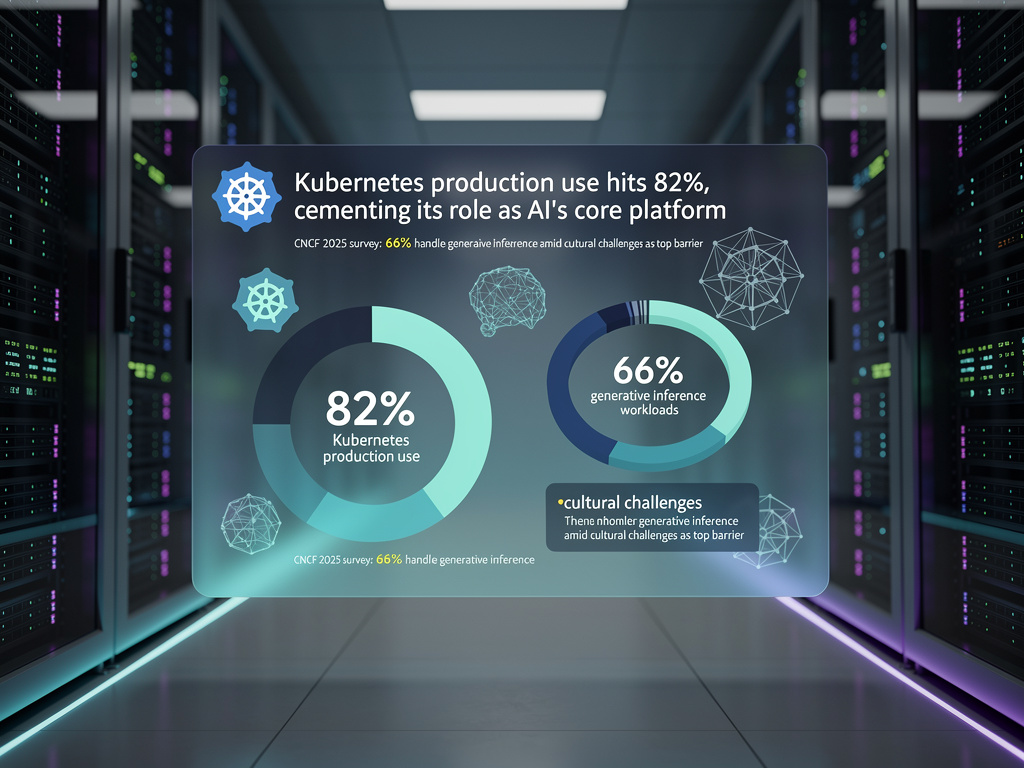
In the high-stakes arena of cloud infrastructure, Kubernetes has emerged as the indispensable platform powering artificial intelligence at scale, with production deployment reaching 82% among container users according to the Cloud Native Computing Foundation’s 2025 Annual Cloud Native Survey. This milestone, detailed in the PRNewswire release, marks a sharp rise from 66% in 2023, signaling Kubernetes’ transformation from container orchestrator to the foundational layer for enterprise AI operations.
“Over the past decade, Kubernetes has become the foundation of modern infrastructure,” said Jonathan Bryce, executive director of CNCF. “Now, as AI and cloud native converge, we’re entering a new chapter. Kubernetes isn’t just scaling applications; it’s becoming the platform for intelligent systems.” The survey, conducted by Linux Foundation Research in September 2025 with 628 practitioners, underscores near-universal cloud native adoption at 98% of organizations, as organizations shift from experimentation to standardization.
Containers now underpin most production applications for 56% of respondents, up from 41% in 2023, with pilots dropping to 6%. This maturation positions Kubernetes as the de facto control plane for AI inference, where 66% of generative AI hosts rely on it for some or all workloads.
Kubernetes Powers AI Inference Surge
AI integration reveals a pragmatic approach: while 44% of organizations have yet to run AI/ML on Kubernetes, those deploying models favor inference over training. Only 7% deploy models daily, with 47% doing so occasionally, and over half not building or training models at all. Hosting splits show 37% using managed APIs, 25% self-hosting, and 13% at the edge, per analysis in Forbes.
The CNCF blog emphasizes Kubernetes bridging the gap between AI ambition and infrastructure reality. “Success requires treating AI/ML as a first-class infrastructure challenge, not just an algorithmic one,” it states, highlighting unified scaling for pre-trained models amid cautious deployment frequencies.
Production Kubernetes use solidifies its role, with 82% of container users operationalizing it for stability and scale—critical for AI’s resource-intensive demands. This convergence, noted in CNCF’s announcement, positions the open-source project as AI’s operational core.
Maturity Markers: GitOps and Platform Engineering
Operational excellence distinguishes leaders, with “innovators” adopting GitOps at 58% versus 0% among “explorers,” and CI/CD at 91% for top performers. Backstage, for internal developer portals, ranks as the fifth-fastest CNCF project by velocity. Stateful containers hit 79% production among innovators, serverless 64%, and service meshes 39%.
“Enterprises are aligning around Kubernetes because it has proven to be the most effective and reliable platform for deploying modern, production-grade systems at scale—including AI,” said Hilary Carter, senior vice president of research at Linux Foundation Research, in the PRNewswire release. Platform engineering accelerates as 59% report much or nearly all development and deployment as cloud native.
Observability leads innovation, with OpenTelemetry as the second-highest-velocity project boasting over 24,000 contributors and nearly 20% using profiling tools. These practices enable innovators to manage complexity as workloads expand.
Cultural Shifts Eclipse Technical Hurdles
For the first time, organizational culture tops barriers at 47%, surpassing lack of training (36%), security (36%), and complexity (34%). “The hardest part of cloud native is people, not primitives,” notes Forbes analysis of maturity stages from explorers to innovators.
This pivot reflects technical maturity: with primitives proven, focus turns to team dynamics, communication, and leadership alignment. CNCF’s blog warns of sustainability risks from AI-driven pressures on 234 projects and 270,000 contributors, urging contributions to avoid a “dangerously fragile premise.”
New adoption slows at 10% early-stage or non-users, concentrating efforts on optimization. Recent X discussions from @CloudNativeFdn affirm: “Kubernetes is now the backbone of production infrastructure.”
Observability and Emerging Frontiers
OpenTelemetry’s rise underscores observability’s strategic role, providing vendor-neutral insights for dynamic AI systems. Profiling adoption at 20% signals priorities for performance tuning amid inference scale.
WebAssembly lags, with 65% no experience and 5% full deployment, per Forbes. Yet, Kubernetes’ ecosystem—spanning finance, healthcare, and beyond—drives AI readiness, as WebProNews notes sectors leveraging it for efficient scaling despite skills gaps.
CNCF’s Linux Foundation posts on X highlight maturity and culture as differentiators, aligning with survey data on AI infrastructure needs.
Strategic Imperatives for Enterprises
Organizations must invest in culture, platforms, and sustainability to capitalize on Kubernetes’ dominance. Upcoming CNCF webinars, like February 3’s on AI’s future infrastructure, offer deeper dives with Carter.
As Bryce envisions, the community shapes AI at scale through open collaboration. With 82% production footing, Kubernetes demands enterprise strategies prioritizing people alongside technology for competitive edge in AI-driven operations.


 WebProNews is an iEntry Publication