
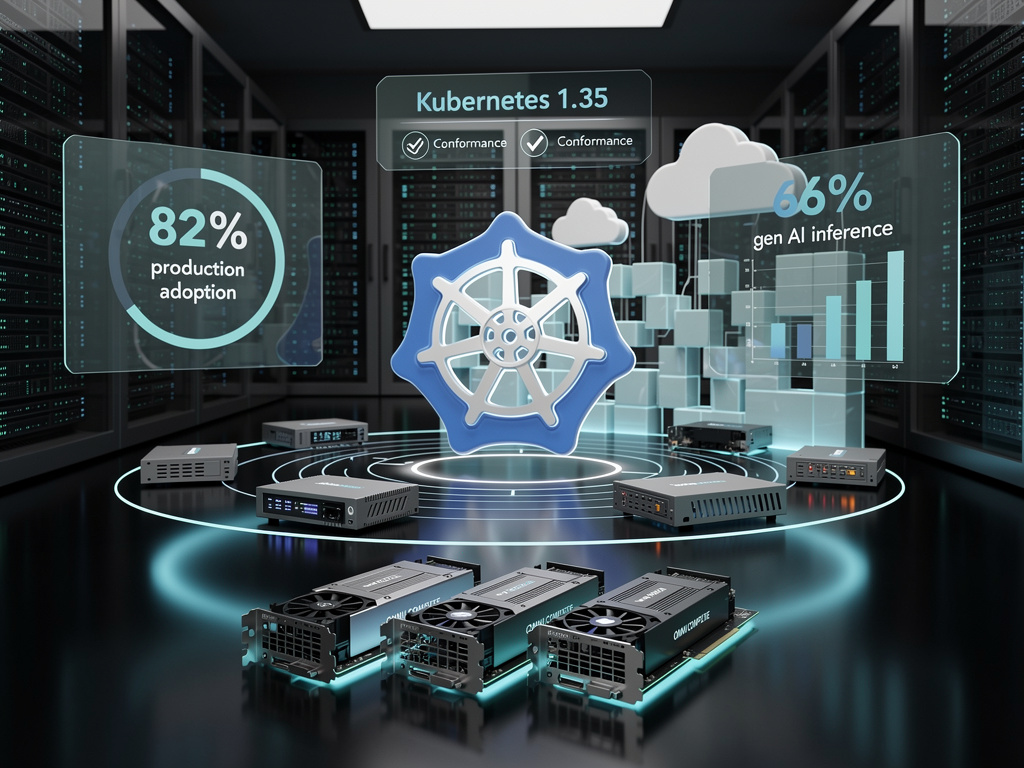
Kubernetes, the open-source container orchestration powerhouse, is evolving from a staple of cloud-native deployments into the foundational platform powering artificial intelligence at scale. Recent data from the Cloud Native Computing Foundation’s (CNCF) 2025 Annual Cloud Native Survey reveals that 82% of container users now run Kubernetes in production, up significantly from 66% in 2023, cementing its role as the de facto operating system for AI workloads. “Over the past decade, Kubernetes has become the foundation of modern infrastructure,” CNCF Executive Director Jonathan Bryce said. “Now, as AI and cloud native converge, we’re entering a new chapter.”
Among organizations hosting generative AI models, 66% leverage Kubernetes to manage inference workloads, highlighting its prowess in delivering the scale, stability, and innovation required for production environments. Yet maturity remains nascent: only 7% deploy AI models daily, 47% occasionally, and 44% have yet to run any AI or machine learning tasks on the platform. This gap presents a ripe opportunity, as enterprises using Kubernetes prove twice as likely to scale edge AI applications and 20% more confident in ROI presentations, according to a Spectro Cloud survey reported by SDxCentral.
Vendors are racing to capitalize. Miami-based Cast AI recently achieved unicorn status with a valuation over $1 billion, launching OMNI Compute, a unified control plane that dynamically connects Kubernetes clusters to GPUs across clouds and regions without code changes. “Enterprises don’t just need cheaper infrastructure, they need infrastructure that adapts automatically,” Cast AI CEO Yuri Frayman told SDxCentral. Oracle Cloud Infrastructure now feeds its AI GPUs into OMNI, enabling seamless access for users on any hyperscaler.
Production Surge Signals Maturity
The CNCF survey underscores Kubernetes’ entrenched position: 98% of organizations adopt cloud-native technologies, with 59% reporting most development and deployment as cloud native. GitOps usage hits 58% among innovators, while OpenTelemetry boasts over 24,000 contributors. Cultural shifts top challenges at 47%, edging out training, security, and complexity at 36% each. “Enterprises are aligning around Kubernetes because it has proven to be the most effective and reliable platform for deploying modern, production-grade systems at scale—including AI,” Linux Foundation Research SVP Hilary Carter stated.
ABI Research links this momentum to telco needs, urging platforms that blend Kubernetes automation with carrier-grade security for distributed AI inferencing in the next supercycle phase. Spectro Cloud’s findings align, noting Kubernetes users’ edge in scaling AI amid cost pressures. As AI inference dominates—coordinating bursty training jobs with constant services—MLOps platforms on Kubernetes emerge as heavy hitters, per Fairwinds’ 2026 playbook.
Microsoft advances the front with Azure Kubernetes Service (AKS) enhancements, integrating Retrieval-Augmented Generation into the Kubernetes AI Toolchain Operator (KAITO) for on-cluster search and vLLM for faster inference. Futurum Research deems 2025 “the year of Kubernetes dominance,” with 41% of cloud-native orgs using it for some workloads and 19% for most, as detailed in Cloud Native Now.
Conformance Standards Lock In Reliability
In November 2025, CNCF launched the Certified Kubernetes AI Conformance Program at KubeCon North America, standardizing AI workloads for portability across environments. Version 1.0 tests GPU integration, volume handling, and job-level networking; v2.0 targets 2026. Amazon EKS earned early certification, validating GPU management, distributed scheduling, and scaling. “This certification validates our comprehensive AI capabilities,” AWS Container Services Director Eswar Bala said. Participants like Google Cloud, Microsoft Azure, Oracle, Red Hat, and VMware followed suit.
Kubernetes 1.35, dubbed “Timbernetes,” bolsters AI with generally available in-place pod resizing for dynamic resource tweaks sans restarts, alpha gang scheduling for synchronized AI training pods, and the PodGroup API for core-level job grouping, as covered by InfoQ. Deprecating Ingress NGINX pushes migration to Gateway API by March 2026; 1.36 arrives April.
Platform engineering rises, with Internal Developer Platforms (IDPs) standardizing golden paths for AI via GitOps and policy-as-code. Fairwinds predicts Kubernetes as the unifying layer for MLOps in 2026, handling GPU bin-packing and prioritization. AIOps enables self-healing via anomaly detection and automated remediations, reducing incidents through refined control loops.
Edge and Multi-Cloud Push Boundaries
Spectro Cloud’s 2025 report shows 90% expecting AI/ML workload growth on Kubernetes, driving 50% to production edge deployments—up from 38%. AI ranks third in cluster placement after multicloud and on-premises shifts; 28% use dedicated GPU clouds. Costs bite at 42%, but 92% eye AI optimization tools, per the survey.
Salesforce migrated over 1,000 EKS clusters to Karpenter for faster scaling and efficiency, cutting latency in mid-2025 pilots to full production by early 2026, InfoQ reports. Tigera CEO Ratan Tipirneni forecasts 2026 agentic workloads supplanting microservices, with Gateway API eclipsing ingress controllers.
Komodor CTO Itiel Shwartz warns AI inference will strain SREs, urging GPU SLOs and right-sizing. Pulumi eyes beyond-YAML automation with AI-assisted IaC and policy enforcement. As CNCF’s TCG AI notes on X, 66% of enterprise AI inference runs on Kubernetes, demanding unified control planes.
Challenges Ahead Shape Innovation
While technical hurdles recede, cultural adoption at 47% looms largest. CNCF urges platform investments and evolved observability/security. DevOps veteran Akhilesh Mishra counters AI hype on X, stressing human expertise for complex debugging and architecture beyond template copying.
FinOps gains traction amid TCO scrutiny from proliferating AI clusters, per ArcFra. AI-powered tools promise 70% cost cuts via scaling and prediction, Medium’s Neel Shah notes. Kubernetes’ ecosystem—Kubeflow, Argo, Numaflow—powers pipelines, as CNCF TCG AI webinars highlight.
ABI’s Dimitris Mavrakis envisions Kubernetes with telco-grade features for network-wide inferencing. As Bryce envisions, the community shapes open AI at scale. Enterprises investing in platforms and people hold the edge in this convergence.


 WebProNews is an iEntry Publication