
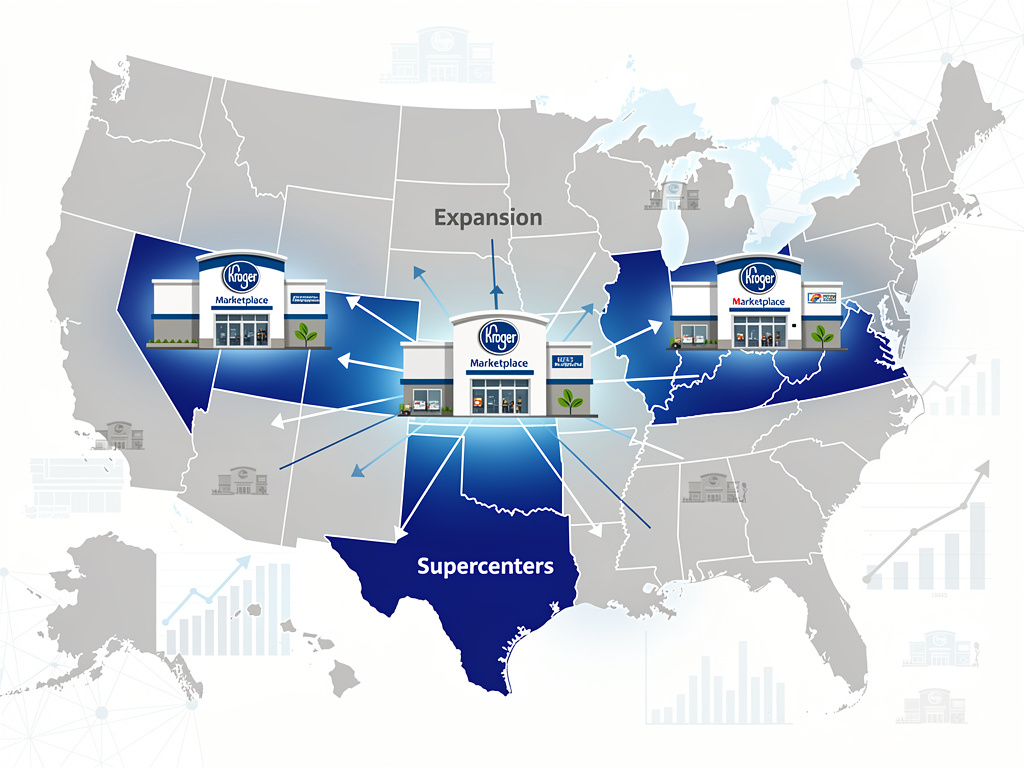
As discount retailers and traditional supermarkets scramble to right-size their footprints in an era of e-commerce dominance, Kroger Co. is charting a decidedly contrarian course. The Cincinnati-based grocery giant is preparing to launch an aggressive expansion of its largest-format stores, betting that bigger is indeed better when it comes to capturing market share in America’s increasingly competitive food retail sector.
According to Grocery Dive, Kroger plans to open numerous Marketplace locations across Indiana, Texas, and West Virginia over the next two years, signaling a strategic commitment to large-format retail at a time when many competitors are exploring smaller, more urban-focused concepts. These Marketplace stores, which typically span 120,000 to 145,000 square feet—roughly double the size of conventional supermarkets—combine full-service grocery departments with expanded general merchandise sections including apparel, home goods, electronics, and outdoor equipment.
The expansion comes as Kroger navigates a complex operating environment marked by persistent inflation, changing consumer shopping habits, and the pending $24.6 billion merger with Albertsons Companies that remains under regulatory scrutiny. Yet rather than adopting a wait-and-see approach, the grocer appears determined to strengthen its competitive position through physical expansion, particularly in markets where it already maintains a strong presence or sees opportunity for growth.
The Marketplace Model: Kroger’s Answer to Walmart and Target
Kroger’s Marketplace concept, first introduced in 2004, represents the company’s direct response to the supercenter phenomenon pioneered by Walmart. These sprawling stores aim to capture not just the weekly grocery trip but also the discretionary spending that might otherwise flow to big-box retailers or specialty chains. By offering everything from organic produce to patio furniture under one roof, Kroger positions itself as a one-stop shopping destination capable of competing on both selection and convenience.
The strategic rationale extends beyond mere square footage. Marketplace stores typically feature expanded departments that conventional supermarkets cannot accommodate, including full-service pharmacies, fuel centers, Starbucks cafes, Murray’s Cheese shops, and extensive prepared foods sections. These amenities serve dual purposes: driving foot traffic and improving profit margins through higher-margin categories that complement traditional grocery sales.
Geographic Strategy: Fortifying Strongholds and Expanding Reach
The selection of Indiana, Texas, and West Virginia for the latest Marketplace expansion reveals a calculated geographic strategy. Indiana represents Kroger’s home territory, where the company operates under multiple banners including Kroger, Pay Less Super Markets, and Owen’s Market. Deepening penetration in this core market allows Kroger to leverage existing distribution infrastructure and brand loyalty while defending against incursions from competitors like Meijer and Walmart.
Texas presents a different opportunity entirely. The Lone Star State, where Kroger has struggled to match its Midwest dominance, offers enormous growth potential given its expanding population and robust economy. The state’s preference for large-format shopping and car-centric development patterns makes it ideal terrain for Marketplace stores. Meanwhile, West Virginia represents a strategic opportunity to strengthen Kroger’s Appalachian presence, where the company faces limited competition from other national chains.
Swimming Against the Retail Tide
Kroger’s doubling down on large-format stores stands in stark contrast to broader retail trends. Over the past decade, many retailers have embraced smaller footprints, driven by rising real estate costs, shifting consumer preferences for convenience, and the growth of online shopping. Target has invested heavily in small-format stores for urban and college markets. Walmart, while maintaining its supercenter fleet, has focused new growth on smaller Neighborhood Market locations and e-commerce fulfillment.
Even within the grocery sector, the momentum has favored compact concepts. Aldi and Lidl have expanded their limited-assortment, small-box models across the United States. Amazon’s acquisition of Whole Foods was followed by experiments with cashierless Amazon Go stores and compact Amazon Fresh locations. The prevailing wisdom suggested that the future of grocery retail would be omnichannel, with smaller stores serving as fulfillment nodes for online orders rather than destinations for large shopping trips.
The Economics of Scale in Modern Grocery Retail
Yet Kroger’s commitment to Marketplace stores reflects a belief that physical scale still matters, particularly when leveraged correctly. Large-format stores offer operational advantages that smaller competitors struggle to match. The ability to house extensive inventory on-site reduces stockout rates and allows for more efficient replenishment. Expanded backroom space can accommodate pickup and delivery operations without compromising the shopping experience for in-store customers.
Moreover, Marketplace stores generate sales volumes that justify investments in premium services and departments. A conventional 60,000-square-foot supermarket might struggle to support a full-service seafood counter or extensive wine selection, but a 130,000-square-foot Marketplace can offer these features profitably. This creates a virtuous cycle: better selection drives higher traffic, which supports further investment in differentiation, which in turn attracts more customers.
Labor and Technology Integration
The expansion also reflects Kroger’s evolving approach to labor and technology within its stores. Marketplace locations provide the physical space necessary to integrate automated fulfillment systems for online orders while maintaining traditional shopping aisles. Kroger has invested billions in digital capabilities and supply chain modernization, and large-format stores offer the flexibility to deploy these technologies without completely reimagining store layouts.
The company’s partnership with Ocado to build automated customer fulfillment centers represents a parallel strategy for handling online orders, but Marketplace stores can serve as hybrid facilities that blend traditional retail with digital fulfillment. This dual-purpose approach may prove more economically viable than maintaining separate e-commerce infrastructure, particularly in markets where population density doesn’t justify standalone fulfillment centers.
Competitive Positioning Amid Industry Consolidation
The Marketplace expansion unfolds against the backdrop of Kroger’s proposed merger with Albertsons, a combination that would create a grocery behemoth operating nearly 5,000 stores across the United States. While regulatory approval remains uncertain, the merger’s logic rests partly on achieving scale economies that can fund investments in price, technology, and store experience—precisely the areas where Marketplace stores excel.
Should the merger proceed, the combined company would face intensified scrutiny over market power and pricing. Investing in enhanced store formats that offer genuine value beyond basic groceries could help justify the combination by demonstrating commitment to improving the customer proposition rather than simply eliminating competition. Marketplace stores, with their expanded assortments and services, embody this value-added approach.
Real Estate and Development Considerations
The feasibility of Marketplace expansion depends critically on real estate availability and development costs. Large-format stores require substantial land parcels, typically 15 to 20 acres, with ample parking and highway access. Such sites are increasingly scarce in established markets but remain available in growing suburban and exurban areas—precisely where Kroger is focusing its expansion efforts.
Development costs for a Marketplace store can exceed $20 million, representing a significant capital commitment. However, Kroger’s approach often involves partnering with developers who build and own the properties, with Kroger signing long-term leases. This model reduces upfront capital requirements while providing flexibility to adjust the store portfolio over time. The company’s strong credit rating and track record make it an attractive anchor tenant for shopping center developments.
Risks and Challenges Ahead
Despite the strategic logic, Kroger’s Marketplace expansion carries meaningful risks. The format’s success depends on sustained consumer willingness to make large shopping trips rather than fragmenting purchases across multiple channels and retailers. If online grocery adoption accelerates beyond current levels, or if consumers increasingly favor quick trips to nearby convenience stores over weekly stock-up missions, the Marketplace model could face headwinds.
Competition from Walmart Supercenters remains formidable, particularly in price-sensitive markets. Walmart’s scale advantages in general merchandise categories give it pricing power that Kroger may struggle to match. Additionally, the rise of off-price retailers like TJ Maxx and Ross for apparel and home goods could undermine the non-food departments that differentiate Marketplace stores from conventional supermarkets. The company must also navigate ongoing labor challenges, as larger stores require more staff at a time when retail wages are rising and worker availability remains constrained in many markets.
The Path Forward for Physical Grocery Retail
Kroger’s Marketplace expansion represents more than a simple bet on store size. It reflects a comprehensive strategy that leverages physical assets to deliver experiences and services that pure-play e-commerce cannot easily replicate. The ability to see, touch, and select fresh produce; the convenience of combining grocery shopping with other errands; the immediate gratification of taking purchases home rather than waiting for delivery—these attributes retain value for many consumers.
As the grocery industry continues evolving, success will likely require multiple formats tailored to different occasions and customer needs. Kroger operates various store sizes and concepts, from small-format Fresh Fare stores to conventional supermarkets to sprawling Marketplace locations. The question is not whether large-format stores will completely dominate but whether they can profitably serve a meaningful segment of shoppers while complementing digital channels and smaller formats. By committing to Marketplace expansion even as others retreat from large-format retail, Kroger is making a clear statement: in the right markets, with the right execution, bigger stores still have a vital role to play in the future of American grocery retail.


 WebProNews is an iEntry Publication