
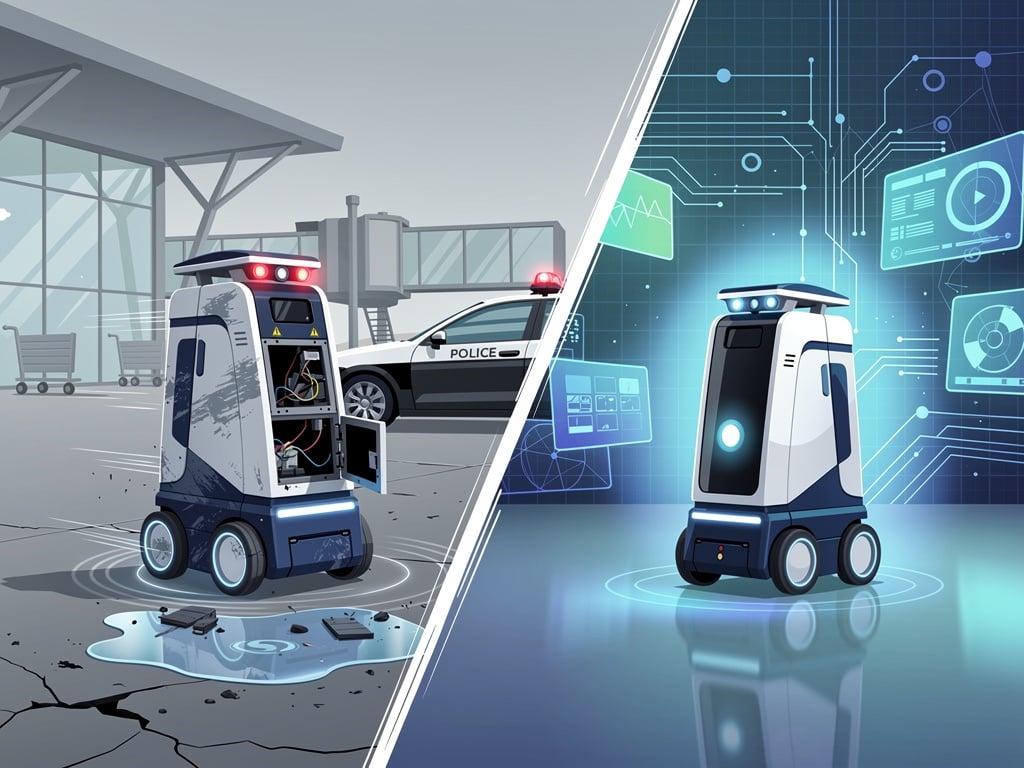
Knightscope once promised fleets of vigilant machines that would patrol parking lots, airports and neighborhoods without tiring. The reality has proven far messier. Short circuits. Drownings. Crashes into toddlers. And now, as deployments flop one after another, the company has turned to something stranger: AI-generated short stories that cast its robots as flawless heroes.
The latest example surfaced this week. Futurism reported that Knightscope’s website now hosts a section of slick-looking fiction under titles like “Bot Noir.” One snippet reads simply, “The name matched. The money moved. Baby Bob was back.” The stories portray K5 units solving kidnappings, thwarting heists and earning grateful thanks from police chiefs. They read like corporate wish fulfillment. But they arrive at a moment when actual Knightscope robots are being quietly retired across the country.
Take Dublin, Ohio. Last summer the police department rolled out a K5 nicknamed DubBot to watch a parking garage. It carried 360-degree cameras, two-way audio and an emergency button. Ten months later officials pulled the plug. The robot logged zero arrests, issued zero tickets and flagged zero incidents worth a human response. Taxpayers spent $67,548 before a refund. Similar stories emerged from New York City subways and San Antonio’s airport. Navigation failures. Constant need for human babysitters. Expensive hardware that mostly gathered dust.
The Gap Between Promise and Performance
Knightscope launched in 2013, born from the Sandy Hook shooting. Founder Stacy Stephens, a former police officer, envisioned machines that would act as extra eyes and ears. The flagship K5 stands five feet tall, weighs roughly 400 pounds and rolls on four wheels. It promises 24/7 monitoring, license-plate recognition, thermal imaging and live alerts. Marketing materials once claimed dramatic crime reductions. Clients received glossy case studies of robots helping catch vandals or sexual predators.
Yet field results tell another tale. In 2016 a K5 at Stanford Shopping Center rolled over a 16-month-old boy’s foot, according to the Incident Database. The child suffered minor injuries. A year later another unit famously drowned in a decorative fountain at a Washington, D.C., office complex. Photos of the half-submerged robot went viral. The company called it a learning experience. Critics called it emblematic.
San Antonio International Airport leased a K5 in early 2024 for about $21,000 a year. The plan was simple: respond to door alarms in the secure area. During testing the robot struggled to move in straight lines, navigate crowds or focus its camera on employee badges. Video feeds refused to stream properly to mobile devices. Employees found themselves chained to desktop monitors. “It didn’t have the agility that we were looking for,” Ryan Rocha, assistant director of operations, told the San Antonio Express-News in May. The airport shipped the machine back to California in February 2025 after an abbreviated trial. No public payment was made. Airport Director Jesus Saenz said it would stay out of public view.
CEO William Santana Li pushed back in the same article. “Of course stuff is going to go wrong,” he said. “Technology is kind of complicated.” He suggested some clients simply don’t listen to guidance. The pattern, however, has grown hard to ignore. Multiple cities have walked away. Maintenance demands proved higher than advertised. Public enthusiasm cooled when the robots failed to deliver measurable safety gains.
And yet Knightscope refuses to shrink. In March the company announced it had bought Event Risk, a national provider of armed and unarmed guarding services. The deal, detailed in a press release on its own site, combines robots with human officers under one contract. Knightscope now pitches an “Autonomous Security Force” that mixes machines, monitoring centers and licensed responders. The acquisition gives the firm the legal structure to act as a full-service security provider rather than just a hardware vendor. Shares trade under NASDAQ: KSCP. Revenue remains modest. Losses continue.
The turn to fiction feels like an odd pivot. Instead of new performance data or independent audits, visitors to Knightscope.com now encounter polished AI slop. Stories star heroic K5s that never get stuck, never roll over children and never sink in fountains. One appears to involve a kidnapping resolved through quick robot thinking. Another celebrates an armed robbery stopped in its tracks. The prose is generic. The outcomes are perfect. No mention of the real-world retirements or the Dublin parking garage that saw nothing but a rolling 400-pound paperweight for nearly a year.
Industry watchers have taken notice. Recent social media chatter on X, including posts from accounts like @Rainmaker1973 and local critics, mocked the DubBot retirement. “Waste of money,” one user wrote alongside the news. Knightscope itself posted promotional material about its new integrated model the same week. The contrast could not be sharper.
Supporters still exist. Some convention centers and police departments praise the robots for deterrence and extra camera coverage. Orange County Convention Center staff once said the K5 expanded monitoring capacity. Yet even friendly clients admit the machines work best as supplements, not replacements. They require human backup, frequent charging and careful route planning. Weather, crowds and uneven pavement remain stubborn obstacles.
The broader question looms larger than any single failure. Public safety budgets are tight. Cities want results, not prototypes. When a machine costs tens of thousands upfront plus ongoing service and still produces no measurable enforcement activity, patience disappears. Knightscope’s pivot to human guarding services acknowledges this. Robots alone were never going to suffice. The AI stories, however, suggest the company still clings to a certain dream.
Those stories are generated quickly. They follow familiar formulas. Brave robot spots clue. Robot alerts team. Criminals captured. Credits roll. The narrative never includes the part where the robot gets lost, the feed drops or the police end up carrying the unit back to its dock. That version stays offline.
So what happens next? Knightscope will keep selling the combined offering. Some departments will experiment. Others will watch the retirements and pass. The K5 itself may evolve. New sensors, better navigation, tighter software. But the gap between marketing and deployment has persisted for more than a decade now. Fan fiction won’t close it. Only consistent, documented performance in tough real-world conditions can.
Until then the robots keep rolling. Some keep failing. And on the company homepage, flawless digital versions keep solving crimes that their physical cousins never quite manage to reach.


 WebProNews is an iEntry Publication