
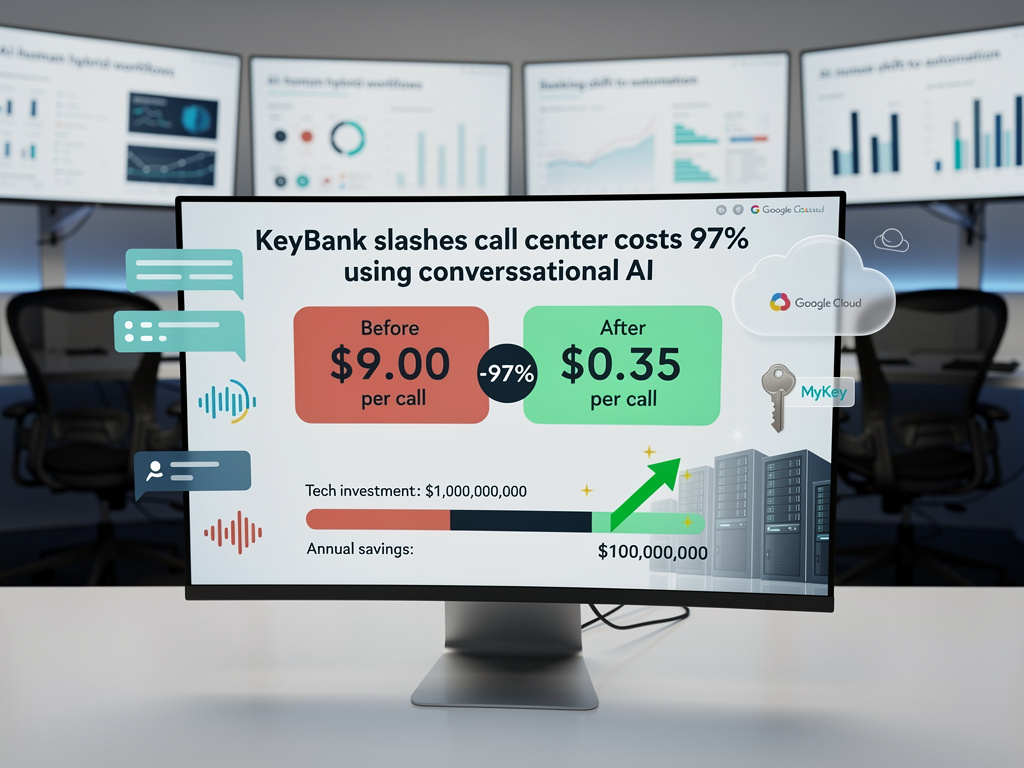
KeyBank, the Cleveland-based regional powerhouse with nearly $190 billion in assets, has unleashed conversational AI on its call centers, delivering a staggering 97% reduction in per-call costs. CEO Christopher Gorman revealed during the bank’s Q4 2025 earnings call that AI-handled interactions now cost about 35 cents each, compared to $9 for human agents—a 36-fold efficiency gain that underscores why financial institutions are racing to automate customer service. This move aligns with broader industry shifts, where banks deploy AI to handle routine inquiries, freeing humans for complex tasks while slashing operational expenses.
The bank’s technology budget has swelled to around $1 billion annually, up from an $800 million to $900 million run rate, fueling digital transformations that have already yielded $100 million in yearly savings through continuous improvements, including generative and conversational AI. These tools interpret customer intent more accurately than outdated interactive voice response systems, routing calls efficiently or resolving them outright, and addressing longstanding bottlenecks in traditional contact centers. Gorman emphasized that while broad AI efficiencies are still emerging, the per-interaction savings are immediate and compelling.
From Pilots to Production: Building MyKey
KeyBank’s journey began years ago with partnerships like Google Cloud, enabling the 2022 launch of MyKey, its intelligent virtual assistant integrated into the mobile app for transactions, answers, and seamless handoffs to live agents. Dean Kontul, EVP and Chief Information Officer for Intelligent Automation and Contact Center, led the development through a ‘test and learn’ approach, assembling a dedicated team for product, technology, analytics, and conversational design to integrate AI without disrupting operations, as detailed in The Financial Brand.
Earlier cloud migrations with Google and UJET cut contact center expenses by 10% within a year, reduced agent call volumes by 15%, and boosted digital chats by 50%, per American Banker. MyKey now powers real-time assistance, summarizing conversations and providing context to agents, which has kept headcount lean while improving productivity, according to Emerj Artificial Intelligence Research.
Industry Momentum Accelerates Automation
Banks nationwide echo KeyBank’s strategy. Wells Fargo expanded with Google Cloud for agentic AI handling balance checks and document reviews. Lloyds Bank rolled out Athena for query automation and staff support, while KakaoBank leverages Microsoft Azure OpenAI for natural app-based interactions, as reported in PYMNTS. Gartner forecasts conversational AI will trim global contact center labor costs by $80 billion by 2026, automating one in 10 interactions from today’s 1.6%.
Charles Schwab integrates AI into customer service for representative efficiency, and BNY advances with Google’s Gemini for its in-house platform. These deployments not only cut costs—Alibaba saved $150 million yearly by handling 75% of queries—but also lift satisfaction by 25%, per industry analyses cited in WebProNews.
Tech Stack Powers Precision Routing
KeyBank’s Google Cloud Contact Center AI, now generally available, offers virtual agents via Dialogflow for natural conversations, real-time agent assist, and insights from conversation data. “With Google Cloud and CCAI Platform, we will quickly move our contact center to the cloud, supporting both our customers and agents with industry-leading CX innovations,” Kontul stated in a Google Cloud Blog post. This setup equips agents with customer data like pending charges before connections, streamlining resolutions.
Additional tools like Personetics’ Enrich categorize transactions to preempt the top call driver—inquiries—while Emily Gessner, SVP of consumer digital, eyes pilots for real-time offers via Engage, advancing toward ‘cognitive banking’ as covered in American Banker. Such integrations ensure AI handles volume while humans provide empathy for edge cases.
Quantifying the Savings Surge
KeyBank’s math is stark: AI at 25-35 cents per call versus $9 human-handled, per Gorman and executive Clark Khayat on earnings calls, as noted by eMarketer. This funds expansions, with 40 AI proofs-of-concept underway, according to Ken Gavrity, head of commercial banking, in FinAi News. X discussions highlight the ‘simple math’ driving $1 billion investments, with posts from @AITechTLDR emphasizing the 36x gap.
Peers report similar wins: NIB Health Insurance saved $22 million, cutting service costs 60%; Federal Bank achieved 98% accuracy and 50% cost drops while boosting queries 133%. Juniper Research projects $7.3 billion annual bank savings by 2026 from AI chatbots, aligning with McKinsey’s 40-60% first-year reductions.
Balancing Efficiency with Customer Trust
While savings dominate, challenges persist. AI excels at routine tasks but struggles with nuance, prompting hybrids where bots brief agents for warm transfers. Forrester notes only 15% of executives saw margins gains last year, urging data quality and change management. KeyBank maintains human oversight for judgment-heavy interactions, preserving empathy amid automation.
Customer sentiment varies; 72% prioritize personalization, per PYMNTS Intelligence, and AI deepens engagement by capturing insights. Yet backlash exists—some revert to agents after frustration. KeyBank’s approach positions AI as a value generator, enhancing retention through faster, 24/7 service without eroding trust.
Future Horizons in AI-Driven Banking
Looking ahead, KeyBank eyes agentic AI for proactive actions like subscription cancellations, expanding MyKey’s scope. Industry-wide, conversational AI evolves from deflection to revenue drivers, with Forrester calling it banking’s next strategic edge. As Gorman noted, transformational activities loom, promising deeper efficiencies and personalized coaching apps.
With $500 billion in global customer service spend at stake, banks like KeyBank lead the charge, blending AI scale with human insight to redefine service economics.


 WebProNews is an iEntry Publication