
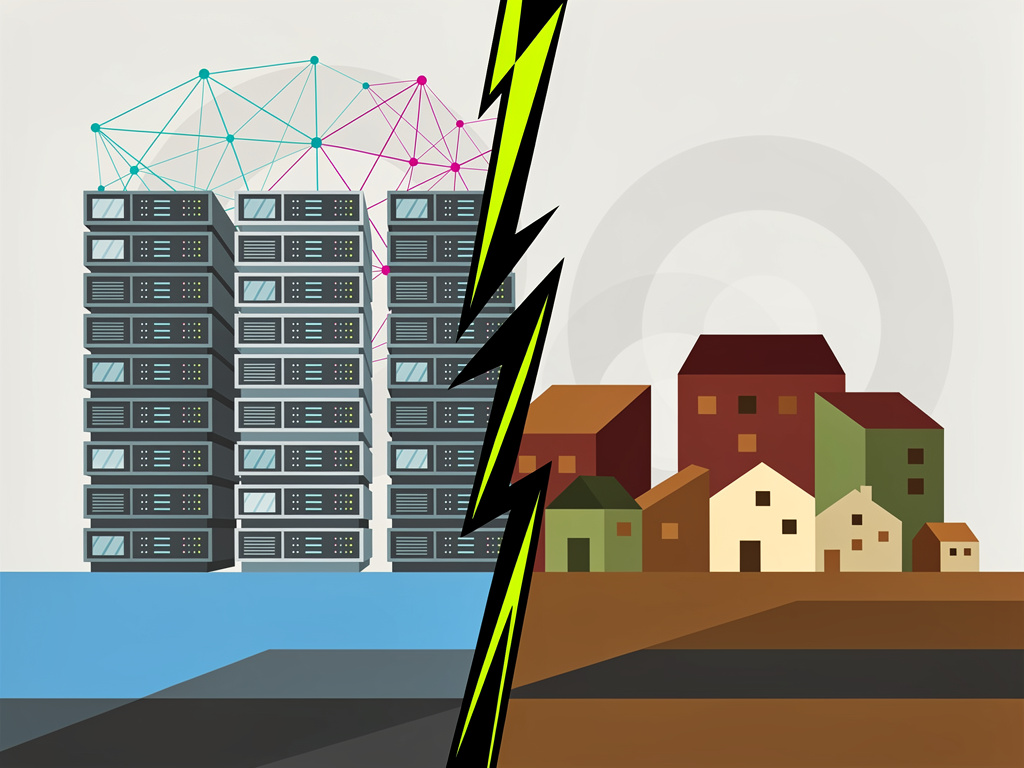
Kevin O’Leary does not mince words. The Shark Tank star and chairman of O’Leary Ventures has built a public brand on blunt financial advice. Lately he finds himself at the center of two heated debates that reveal tensions in American markets and infrastructure. One pits him against politicians eager to restrict Wall Street money from single-family homes. The other draws him into clashes with residents alarmed by his ambitious push into AI data centers.
In late May, O’Leary took to X to push back against growing calls to limit institutional investors in housing. “Institutional investors are being blamed for everything happening in housing right now,” he wrote. “But people forget what happened during the financial crisis.” He pointed to 2008. When markets froze and home values plunged, institutional buyers stepped in with capital others lacked. “Without it, things could have been far worse for average Americans,” O’Leary wrote, according to a Yahoo Finance report.
His message carried a warning. Policies meant to push institutions out amount to government manipulation. “It’s government trying to manipulate markets, and history shows that usually ends badly,” he added. O’Leary sees pension funds, sovereign wealth, and other large capital flows as essential. They form a bedrock for the economy. Disrupt that flow at your peril.
Critics counter that such investors drive up prices and convert neighborhoods into rental operations. They crowd out families. Lawmakers from both parties have floated bills to cap ownership or add taxes. Yet O’Leary insists the real problems run deeper. Underbuilding, zoning rules, and chronic inventory shortages matter more than any corporate landlord. His stance aligns with those who view institutional capital as stabilizer rather than villain.
But O’Leary’s defense of markets does not stop at housing. He has poured resources into physical infrastructure for artificial intelligence. His Stratos Project in Utah aims to create one of the largest data center campuses on record. Plans call for some 40,000 acres in Box Elder County. The development could encompass dozens of facilities, dedicated power systems, and supporting industrial sites. Estimates once placed its scale near $1 billion for initial phases, though broader ambitions have been described in far larger terms.
Local reaction came fast and sharp. Residents packed meetings and took to streets in Salt Lake City. They cite water demands in a drought-prone state. They fear grid strain that could lift electricity costs for everyone. Noise from cooling systems, land disruption across vast stretches, and waste heat worry them too. One physics professor at Utah State University offered a striking comparison. The facility’s thermal output might equal that of 23 atomic bombs daily. The figure underscored the sheer energy scale involved.
O’Leary responded with a provocative charge. He claims foreign interference fuels much of the opposition. Specifically, he points to China. In interviews and posts, he has asserted that hundreds of millions of dollars flow from Chinese sources, often routed through third countries, to fund protests and spread doubt about American AI progress. He has said many demonstrators in Utah appeared bused in, with as much as 90 percent lacking local ties. The goal, in his view, is to hobble U.S. dominance in a critical technology while Beijing builds its own capacity unchecked.
Trump administration officials echoed similar suspicions. Interior Secretary Doug Burgum described the resistance as “not organic and local.” He pointed to “foreign source dark money” at work. Pro-industry voices amplified the narrative. Yet a detailed examination by The Washington Post found scant evidence to support these specific claims of orchestrated foreign campaigns driving American protests. Researchers and local organizers dismissed the accusations as gaslighting. One three-time Trump voter organizing against a Google project in Oklahoma called it a way to discredit genuine community concerns.
The backlash against data centers has spread. Similar fights play out in Virginia, Arizona, Georgia, and Texas. In each case residents voice parallel worries. Power consumption on the scale of mid-sized cities. Competition for scarce water. Noise and environmental toll. A single hyperscale AI facility can require more than one gigawatt. That matches the draw of hundreds of thousands of households. The four largest hyperscalers plan to spend more than $725 billion this year alone on related infrastructure, according to estimates cited by Goldman Sachs and Morgan Stanley and reported in a 24/7 Wall St. analysis.
Wall Street analysts have begun to compare data centers to the railroads of an earlier era. They see them as foundational. Without them AI cannot scale. Yet the physical demands create new friction points. Chips, memory, copper, and above all reliable power and cooling now dictate progress as much as any algorithm. Local resistance may prove the toughest variable. A one-year delay on multibillion-dollar projects cascades. It affects semiconductor orders, utility commitments, and cloud service timelines.
O’Leary remains undeterred. His investment thesis centers on the picks and shovels. Power contracts, land with permits, fiber connections. He has highlighted positions such as Bit Digital, where attractive energy deals matter more than token prices. In his telling, AI already touches every economic sector. It drives productivity gains and margin expansion even amid turbulence. Markets hit records partly for this reason. Physical infrastructure, not just models or applications, holds the key.
Still the divide sharpens. On one side sit those who see institutional capital and massive builds as necessary for growth and stability. On the other stand communities that bear immediate costs. Water diverted. Power prices up. Landscapes altered. Petitions circulate in Canada too, targeting O’Leary-linked projects over emissions and consumption. Protests there warn of returns to coal-era pollution levels from natural gas reliance.
And here lies the tension O’Leary’s positions expose. He warns against government meddling in housing markets because history teaches bad outcomes. Yet scaling AI infrastructure invites exactly the sort of regulatory and community pushback that can stall progress for years. Both debates circle around the same question. Who decides how capital flows and how land and resources get used?
O’Leary bets on markets and scale. He argues institutional money prevented worse pain in 2008. He sees data centers as essential to American leadership in AI. Opponents see overreach. They point to lived impacts on families and environments. Evidence for foreign plots remains thin. Real grievances over power, water, and heat appear widespread and homegrown.
Resolution will not come easily. Housing affordability fixes demand more building, not fewer buyers. AI ambitions require unprecedented energy and land commitments. Both test political patience and public tolerance. O’Leary has picked his side. He defends capital allocation that many now question. Whether his bets on housing stability and data center dominance prove correct may depend on how governments, residents, and markets reconcile these competing pressures in the months ahead.


 WebProNews is an iEntry Publication