
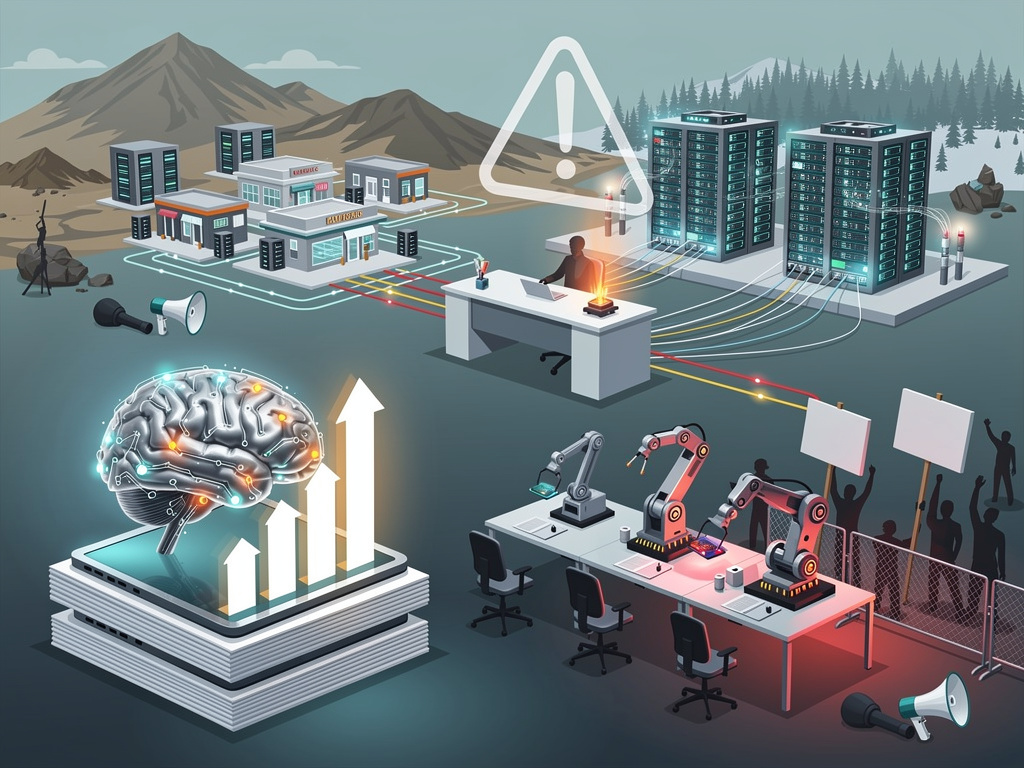
Kevin O’Leary knows exactly what artificial intelligence does to employment. It destroys jobs. He says so openly. Yet the Shark Tank investor and chairman of O’Leary Ventures watches his portfolio companies pocket major savings and post higher earnings. The contrast defines his stance. Markets, he argues, still undervalue the technology’s grip on corporate financials.
“People are not giving enough credit to what’s going on on balance sheets and income statements based on the enhancement of AI,” O’Leary told Fox Business. He continued without pause. “I know jobs are being lost, but at my companies, wow, we are saving a ton of dough. Our earnings are going up.” The Yahoo Finance article captured his blunt assessment in mid-May 2026. Tech layoffs reached 81,747 in the first quarter alone. Goldman Sachs data shows AI trimmed monthly job growth by roughly 16,000 positions over the past year and nudged the unemployment rate up 0.1 percentage point. Those figures land hard on workers. O’Leary sees the other side of the ledger.
His message lands with force across sectors. AI touches all 11 areas of the economy. Not just software. Not just hardware. Manufacturing. Retail. Construction. Every one gains productivity and fatter margins. “What people didn’t take into account, and I think in some ways it’s just sheer luck, is that AI has had a major impact in all 11 sectors of the economy,” he explained. “It’s not just technology. Every single sector is enjoying the benefits of margin enhancement and productivity enhancement because of these AI tools that are being adopted into business, both large and small.” The gains compound. Tasks once measured in days finish in hours. Marketing copy. Financial models. Even photography workflows. O’Leary applies the tools himself. He reports speed that once seemed impossible.
But speed alone fails to satisfy him. Blind adoption spells trouble. CEOs who chase AI outputs without strategy court disaster. “CEOs who blindly pursue AI are ‘dead in the water’,” O’Leary declared in March. He insists execution matters more than generation. Critical thinking. Clear communication. The ability to shape a compelling narrative. Those skills separate winners from also-rans. “In business, it’s about critical thinking and communication, period,” he posted on X. Liberal arts training suddenly looks valuable again. Storytellers who master AI see salaries soar. One example he cited moved from $48,000 to $600,000. The market rewards the combination.
Young entrepreneurs hear a different pitch. If O’Leary were 25 today he would chase two targets. Implementation help for small businesses. And data center construction. Thirty-six million small U.S. firms generate nearly half the country’s GDP. Many want AI capabilities yet lack the expertise to deploy them. “Small businesses are desperate to adopt AI but need help executing it,” he said in a video that circulated widely in March. They will pay consultants who bridge the gap. Not traditional advice. Practical setup. Training. Integration that delivers measurable results. The demand feels insatiable.
Data centers represent the bigger bet. O’Leary calls them the backbone. Real estate with a technology twist. Supply lags far behind need. Goldman Sachs projected a 165 percent jump in data center power demand by 2030. Only five gigawatts sit under construction now. Hyperscalers hunger for more. O’Leary positions himself to meet that hunger. “I think AI growth is going to be exponential,” he told Fortune. The biggest pain point in the entire field sits right there. Power. Land. Infrastructure. He treats it as development opportunity.
His projects match the rhetoric. In Alberta he backs a $70 billion initiative billed as the world’s largest AI data center park. Capacity could reach 17 gigawatts eventually. Stages begin smaller. Permits. Turbines. Grid connections. All move slowly until approvals clear. Utah raises the stakes further. The Stratos Project, also called Wonder Valley, spans 40,000 acres in rural Box Elder County. Up to nine gigawatts of power. A natural gas plant on site. Total investment approaches $100 billion. O’Leary joined local partners through a joint venture. He frames the effort in stark terms. Competition with China. National security. Defense contracts. “The potential of what we’re creating is so important for defense, for the economy,” he told CNN. “It should be, for everybody, a mission. We can’t let the Chinese beat us.”
Local residents disagree. Hundreds packed a county commission meeting in early May. Signs read “Don’t sell us out” and “Streams over streaming.” They worry the project will drain the shrinking Great Salt Lake. Cooling demands could accelerate toxic dust storms. Energy consumption would exceed the state’s current total annual use. Ecosystems. Migratory birds. Ranching heritage. All feel threatened. The approval process struck many as rushed. Calls for independent environmental studies went unheeded. Protesters gathered signatures for a referendum. One resident captured the mood. “The question is: Will the jobs be worth the cost?” Robert Davies asked. “One needs to think about, ‘What kind of community do I want my children and grandchildren in 30 years from now, 50 years from now?’” Caroline Gleich added her perspective. She supports technology yet demands accountability. “Big Tech has shown us that they are not accountable… It’s very concerning and difficult to be a proponent of this, with the amount of land, energy and the impacts to our communities, without guardrails, accountability and transparency.”
O’Leary pushes back. The facility creates 10,000 construction jobs and 2,000 permanent positions. Tax revenue flows to the county. The on-site power plant shields the existing grid from strain. Water concerns he labels ridiculous. Efficient technologies and regulatory compliance will handle impacts, he says. He has spent $20 million already. And he suggests some opposition carries foreign fingerprints. Chinese-linked bots and misinformation campaigns aim to slow American compute capacity. Tucker Carlson pressed him hard on the Tucker Carlson Show in mid-May. The pair clashed over surveillance risks, energy consumption, and whether the AI race justifies such massive bets. O’Leary held firm. Lose the compute race and the United States loses future conflicts. The nation that builds the best models wins.
His portfolio companies already demonstrate the upside. Costs fall. Productivity climbs. Earnings expand. The pattern repeats across his holdings. Yet he warns against overreliance. AI functions as a tool. Human judgment steers it. Companies that forget this lesson risk irrelevance. So do leaders who treat the technology as a complete substitute for strategy or creativity.
Recent conversations amplify the tension. In April O’Leary declared AI adoption no longer optional. Businesses that sit on the sidelines hand advantage to rivals. His own operations reflect that conviction. Finance. Marketing. Content creation. All accelerated. The February Fox Business appearance that sparked the latest Yahoo Finance coverage highlighted the same theme. Balance sheets improve faster than analysts forecast. Income statements surprise on the upside. Observers who focus only on headcount reductions miss half the story.
O’Leary’s bets carry risk. Data center projects face regulatory delays. Community resistance. Enormous capital requirements. Power generation at that scale invites political scrutiny. Environmental trade-offs spark lawsuits. And the job displacement he acknowledges continues. Tech sector cuts show no sign of slowing. Goldman Sachs models suggest further pressure on employment statistics. The savings he celebrates at his firms translate into leaner operations elsewhere. The net effect on the broader labor market remains contested.
Still his voice carries weight. Millions watch Shark Tank. Thousands follow his investment commentary. When he speaks about exponential AI growth or the necessity of data center infrastructure, executives listen. Young professionals weigh his career advice. Implement AI for small firms. Develop the physical plants that power the models. Those paths, he believes, offer clear opportunity while the technology reshapes everything around them.
The Utah project now tests his thesis in public view. County commissioners granted approval despite the protests. Referendum efforts continue. O’Leary keeps pressing the national security angle. Beat China. Secure American leadership in compute. Create the jobs of the future even if their exact shape stays uncertain. “You can’t get an answer from me because nobody knows what jobs (AI) is going to create yet,” he conceded during one exchange. The uncertainty does not slow him. He moves forward. Building. Investing. Speaking. The AI wave, in his view, has already arrived. Companies either ride it for margin gains and efficiency or watch competitors pull ahead. There is no neutral ground.


 WebProNews is an iEntry Publication