
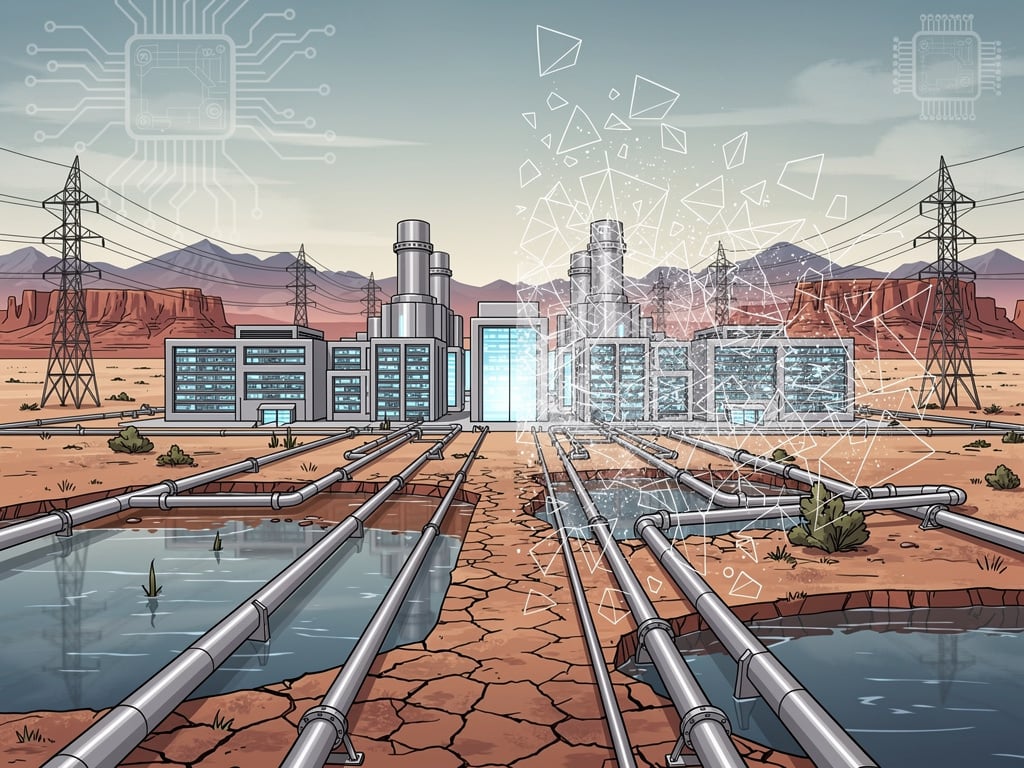
Four months ago Kevin O’Leary stood beside Utah officials and pitched a 40,000-acre AI data center complex. The site in Box Elder County would dwarf Manhattan. It would consume gigawatts of power. And it would draw water in a state already rationing every drop. Today the Shark Tank investor says he will cut the project roughly in half.
O’Leary’s Shift Follows Intense Political and Public Pressure
The reversal landed Thursday in a letter to Utah Senate President J. Stuart Adams. O’Leary signaled he would shrink the footprint after Adams and other state leaders demanded major reductions. NBC News reported the celebrity investor now acknowledges political heat from all sides. He had dug in days earlier. “I’m not walking away,” O’Leary told The Salt Lake Tribune on June 1. He called Adams’ initial push for a 75 percent cut “outrageous.” The comparison stung. “This is not the deal I had with Adams. That’s not what we agreed to. Cutting back the deal 75% is like me selling you a house, and you get to live in the upstairs toilet.”
But something changed. Fast. By Thursday O’Leary accepted the need to scale back. The original plan called for up to 30 buildings across land twice the size of Manhattan. Developers spoke of 7.5 gigawatts eventually. Phase one alone targeted 1.5 gigawatts generated on site through natural gas and solar. Yet residents and lawmakers fixated on two numbers. Water. And power.
Utah sits in perpetual drought. The Great Salt Lake shrinks. Agriculture and urban lawns already strain supplies. Data centers need constant cooling. Critics calculated the project could pull thousands of acre-feet. O’Leary’s team countered with closed-loop systems and on-site water rights. They insisted the campus would return treated water and use less than local farms. Few bought the argument. Hundreds showed up at county meetings. Thousands filed comments. “People over profits,” some shouted.
The approval process only fueled suspicion. O’Leary first approached Gov. Spencer Cox in January 2026. The public learned details in late April. Box Elder County commissioners approved the partnership with the state’s Military Installation Development Authority after a rushed hearing. Residents complained they received little notice. Commissioners temporarily delayed action then reversed under pressure from the governor’s office. Cox framed the project as a national security imperative. The country that masters AI wins future wars, O’Leary repeated. China must not get there first.
Yet the military angle clashed with local reality. Box Elder County already hosts data infrastructure. Utah ranks among the nation’s densest data center markets. Adding another hyperscale campus on unincorporated desert land next to a dying lake struck many as tone deaf. Even some Republican lawmakers balked. Adams’ letter marked the breaking point. He wanted the project cut to about 10,000 acres. O’Leary’s Thursday response split the difference. Roughly 20,000 acres gone. The investor still plans to build. Just not at the scale first advertised.
And the economics? Promoters promised thousands of construction jobs, then permanent engineering and support roles. Tax revenue would reach tens of millions for Box Elder County. Skeptics noted many positions would prove temporary. Power generation claims also drew scrutiny. The team pointed to the existing Ruby Pipeline for natural gas and a planned on-site solar farm. They said the facility would eventually feed surplus power back into the grid. Opponents countered that even phase one could rival significant portions of state demand. Full buildout might exceed total current Utah consumption.
O’Leary pushed back against what he labeled misinformation. In video interviews and LinkedIn posts he insisted the campus would never drain the Great Salt Lake. The 40,000-acre parcel would see only 9,000 acres developed over a decade. “There’s a lot of misinformation,” he told NBC’s Tom Llamas. He even suggested foreign actors might fund some opposition groups. Most evidence pointed to local voices. Petitions carried Utah addresses. Protesters lived nearby.
The episode reveals deeper tensions. Artificial intelligence demands unprecedented compute. Hyperscalers race to secure sites with cheap power, available land and tolerable regulation. Western states offer space. They also face water limits and wary residents. Similar fights play out in other states. Yet few projects carry the personal brand of a television personality. O’Leary’s involvement turned a technical permitting dispute into political theater.
His Alberta project offers a cautionary parallel. Announced in late 2024 with similar fanfare, that 7.5-gigawatt campus has slipped timelines. Construction now looks unlikely before 2028. Permitting hurdles and local questions slowed progress. Utah officials watched closely. So did Adams.
Now the Utah version shrinks. Details remain thin. Exactly how much power capacity stays? Which parcels get cut? Will the military partnership survive a smaller footprint? O’Leary’s team has not released updated renderings or financial models. The original designs from Gensler featured glass panels and office space meant to look more like a campus than anonymous server sheds. Paul Palandjian, CEO of O’Leary Digital, once called it the “sexiest, coolest construction posting in America.” That vision just got smaller.
State government responded with new guardrails. Gov. Cox signed an executive order setting higher standards for future data centers. Lawmakers ordered an environmental impact study. The Military Installation Development Authority launched a transparency dashboard. These steps suggest the O’Leary episode accelerated policy changes that were already brewing.
Still, the core question lingers. Can the American West host the physical infrastructure of the AI age without sacrificing its environment or alienating its citizens? O’Leary’s halved project offers one data point. It shows celebrity clout and national security rhetoric only carry so far when voters worry about their taps running dry. Developers must now prove they can deliver jobs and revenue without imposing hidden costs on power bills or lake levels.
Thursday’s letter marks a concession. But not surrender. O’Leary keeps the project alive. He retains his stake in the AI infrastructure boom. And Utah keeps debating how much of its desert it wants to turn into server farms. The answer, for now, is smaller than first promised. But the conversation has only begun.


 WebProNews is an iEntry Publication