
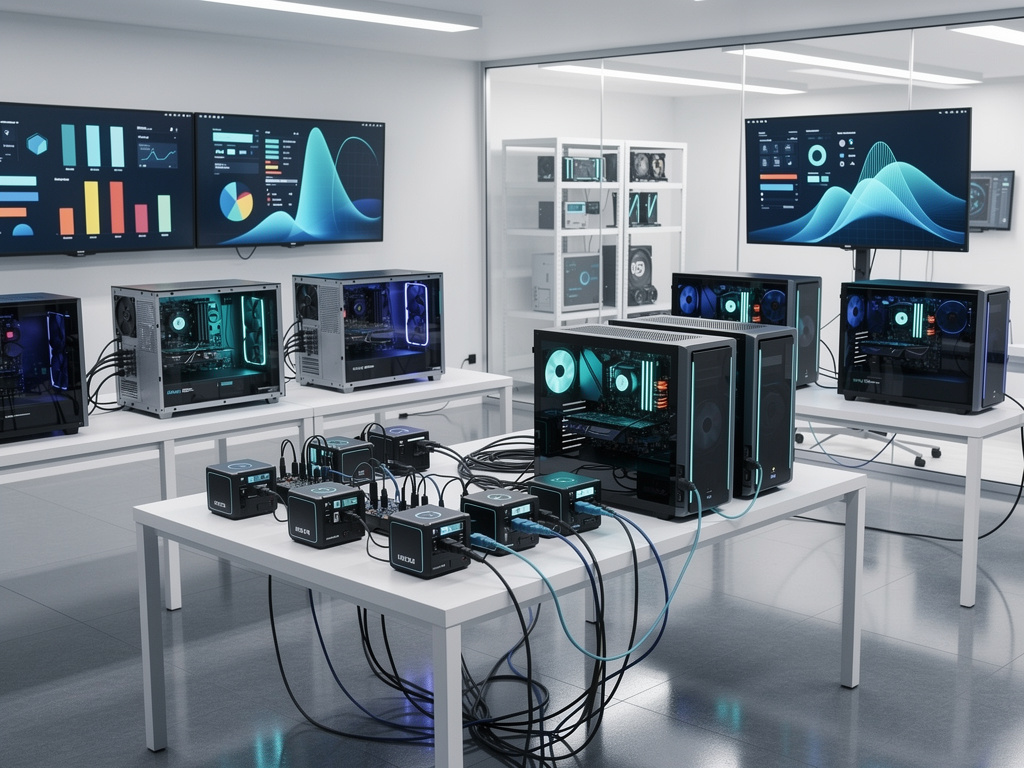
For years, Linux desktop performance tuning has been something of a volunteer sport — talented developers squeezing out optimizations in their spare time, often working blind without standardized hardware to benchmark against. That era may be drawing to a close. The KDE project, one of the most prominent open-source desktop environments in the world, is making a deliberate and well-funded push to establish dedicated performance-testing hardware, signaling a new level of seriousness about making the Linux desktop not just functional, but fast.
The initiative, first reported in detail by Phoronix, centers on KDE’s effort to procure and maintain hardware specifically designated for continuous performance benchmarking and regression testing. Rather than relying on the varied and often inconsistent personal machines of contributors scattered around the globe, KDE aims to create a stable, reproducible environment where performance changes — both improvements and regressions — can be detected with scientific precision.
From Ad Hoc Testing to Institutional Rigor
The move reflects a maturation within the KDE community and the broader Linux desktop ecosystem. Historically, performance work on open-source desktops has been reactive rather than proactive. A user might notice that window animations stutter after a particular update, file a bug report, and then a developer would attempt to reproduce the issue on whatever hardware happened to be at hand. This approach, while functional in the early days of open-source development, has become increasingly inadequate as KDE Plasma has grown into a sophisticated desktop environment used by millions of people worldwide, from individual hobbyists to enterprise deployments.
The concept of dedicated performance labs is well-established in the proprietary software world. Microsoft maintains extensive testing infrastructure for Windows, Apple does the same for macOS, and even Google’s ChromeOS team has rigorous hardware-based performance benchmarking pipelines. For an open-source project to pursue a similar strategy represents a significant philosophical and logistical step forward. It acknowledges that performance is not merely a nice-to-have feature but a core deliverable that must be systematically measured and defended against regression with every single code commit.
The Technical Case for Standardized Benchmarking
At the heart of this initiative is a fundamental truth about performance engineering: you cannot improve what you cannot measure, and you cannot measure reliably without controlling your variables. When KDE developers test on their personal machines — which might range from aging ThinkPads to cutting-edge workstations, running different kernel versions, different distributions, and different firmware — the results are inherently noisy. A performance improvement on one developer’s machine might not manifest on another’s, and a regression might go entirely undetected if the tester’s hardware happens to mask it.
Dedicated testing hardware solves this problem by providing a fixed reference point. With a known CPU, GPU, memory configuration, and storage subsystem, performance numbers become directly comparable across time. This makes it possible to implement automated continuous integration pipelines that flag performance regressions the moment they are introduced, before they ever reach end users. As reported by Phoronix, the KDE community has been actively discussing the specific hardware configurations that would be most representative and useful for this purpose, including considerations around both Intel and AMD platforms, as well as different GPU vendors to ensure broad coverage.
Nate Graham and the Community’s Performance Crusade
The push for better performance infrastructure has been championed by several prominent KDE contributors, including Nate Graham, whose regular “This Week in KDE” blog posts have become essential reading for anyone tracking the project’s progress. Graham has repeatedly highlighted performance improvements in Plasma and related components, but has also been candid about the challenges of ensuring those improvements stick without proper regression testing infrastructure. His advocacy has helped build community consensus around the idea that performance work needs institutional support, not just individual heroism.
The KDE project’s governance structure, centered around KDE e.V., the nonprofit organization that supports the community, plays a crucial role in making this kind of investment possible. KDE e.V. manages the project’s finances, which come from donations, corporate sponsorships, and event revenues. Allocating funds for dedicated hardware represents a strategic decision to invest in infrastructure rather than, say, additional developer sprints or marketing efforts. It is a bet that the long-term payoff of systematic performance engineering will exceed the immediate gratification of other spending priorities.
Why Performance Matters More Than Ever for Linux Desktops
The timing of this initiative is not coincidental. The Linux desktop is experiencing a period of renewed interest and growth, driven by several converging factors. Valve’s Steam Deck, which runs a KDE Plasma desktop atop Arch Linux, has introduced millions of gamers to the Linux desktop experience. Enterprise adoption of Linux workstations continues to grow, particularly in software development, data science, and creative industries. And the ongoing dissatisfaction with certain directions in Windows — from aggressive AI integration to advertising in the operating system — has driven a steady trickle of users to explore Linux alternatives.
In this environment, performance is a competitive differentiator. Users coming from Windows or macOS have expectations shaped by billions of dollars of optimization work. They expect smooth animations, instant application launches, and responsive window management. Any perceptible lag or stutter can be enough to send a potential convert back to their previous operating system. KDE’s leadership clearly understands this dynamic, and the hardware lab initiative is a direct response to the competitive pressure of needing to deliver a polished, performant experience to an increasingly demanding user base.
The Broader Open-Source Infrastructure Challenge
KDE’s hardware initiative also highlights a broader challenge facing the open-source world: the gap between the software sophistication of major projects and the infrastructure available to support them. The Linux kernel itself has benefited enormously from corporate investment in testing infrastructure — companies like Intel, Google, and Red Hat operate extensive kernel testing labs. But desktop environments, which sit higher in the stack and are often perceived as less critical than the kernel, have historically received far less infrastructure investment.
This disparity has real consequences. Kernel developers can catch performance regressions quickly because they have access to tools like the 0-day testing service and continuous benchmarking frameworks. Desktop developers, by contrast, have often had to rely on user reports — which means regressions can ship in stable releases before anyone notices. By building out its own testing hardware, KDE is attempting to close this gap and bring the same level of engineering discipline to the desktop that the kernel has enjoyed for years.
What This Means for the KDE Plasma Roadmap
Looking ahead, the availability of dedicated performance hardware is likely to influence KDE’s development priorities in meaningful ways. With reliable benchmarking in place, the project can set concrete performance targets — for example, specifying that Plasma startup time must not exceed a certain threshold, or that frame rates during window compositing must remain above a minimum level. These kinds of quantitative goals are common in commercial software development but have been difficult to enforce in open-source projects without the infrastructure to back them up.
The initiative could also attract new contributors who are specifically interested in performance engineering. The open-source world has no shortage of developers who are passionate about making software faster, but many of them gravitate toward projects that already have the tooling and infrastructure to support that work. By investing in hardware and benchmarking pipelines, KDE makes itself a more attractive home for this type of contributor, potentially creating a virtuous cycle of performance improvement.
A Signal of Ambition for the Entire Linux Desktop Ecosystem
KDE’s decision to invest in dedicated performance hardware is more than a technical footnote — it is a statement of ambition. It says that the project is no longer content to be “good enough for Linux” and is instead aiming to be genuinely competitive with proprietary desktops on every axis, including raw performance. For the millions of users who depend on KDE Plasma as their daily driver, this is welcome news. And for the broader open-source community, it sets a precedent that other projects would do well to follow.
The road ahead will not be without challenges. Hardware requires maintenance, benchmarking frameworks require ongoing development, and the results need to be integrated into KDE’s existing development workflows in a way that is useful without being burdensome. But the fact that the conversation has moved from “should we do this?” to “how do we do this?” represents genuine progress. If the initiative succeeds, it could mark a turning point — the moment when the Linux desktop stopped competing on ideology alone and started competing on engineering excellence, one carefully measured benchmark at a time.


 WebProNews is an iEntry Publication