
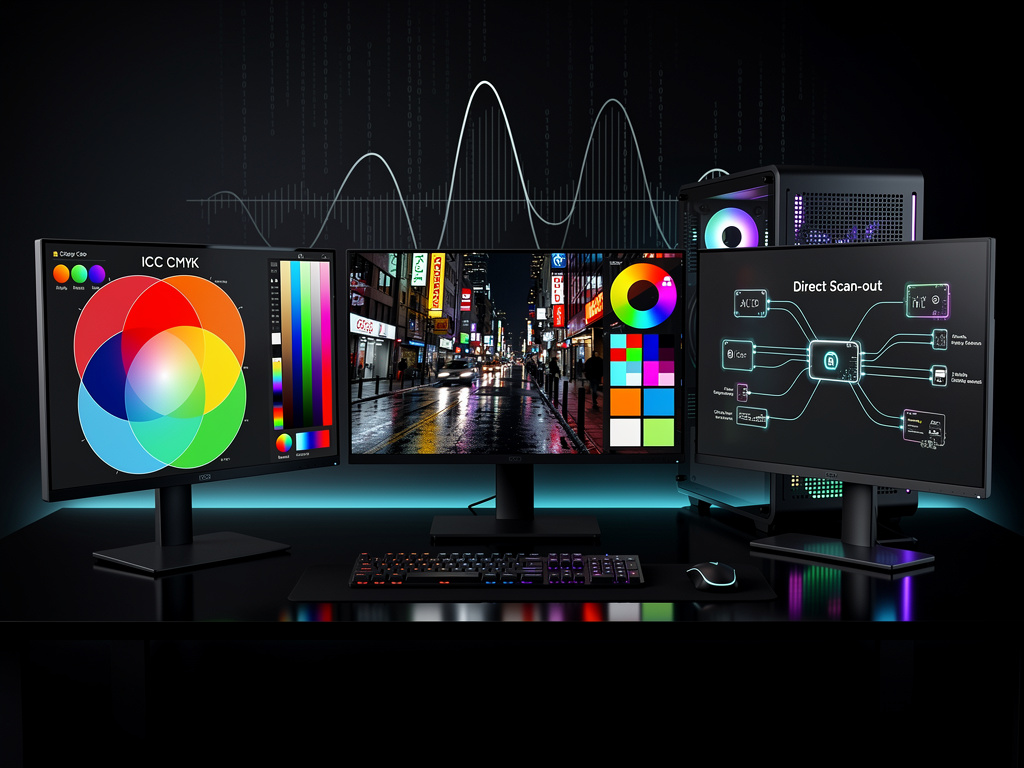
KDE developers have closed a notable gap in color accuracy for high dynamic range setups. With Plasma 6.7, users can now apply ICC profiles while HDR mode runs in KWin. The change, credited to developer Xaver Hugl, addresses a long-standing limitation first outlined years earlier.
Previously, enabling HDR forced the system to rely on EDID data from the display. Colors often looked off. White points drifted. Calibration efforts went to waste once HDR switched on. That ends here. ICC support in HDR mode marks a concrete step forward for professional workflows on Linux desktops.
The update arrived in the latest This Week in Plasma report from KDE Blogs. Feature work for Plasma 6.7 has wrapped up. The next month focuses on polishing and fixes ahead of the mid-June stable release. Beta testing begins May 14.
Xaver Hugl fixed bug KDE Bugzilla #514239. The commit lets color-managed displays retain their calibrated profiles under PQ transfer functions and Rec.2020 color spaces. Monitors stay true to their measured characteristics instead of defaulting to generic values. Photographers, video editors, and anyone with a calibrated panel notice the difference immediately.
But this isn’t an isolated tweak. It builds on years of HDR foundation work in KWin. Back in late 2023, Xaver Hugl detailed the initial rollout in his blog post. Plasma 6 introduced static HDR metadata signaling with the display’s preferred brightness values. It set the color space to Rec.2020 and added controls for SDR brightness and color intensity. Those adjustments helped tone-map SDR content without washing it out.
Yet color management stayed incomplete. Apps remained locked to sRGB. Xwayland offered even less flexibility. The December 2023 post on zamundaaa.github.io spelled out the constraints clearly. Without a full upstream color management protocol for Wayland, applications could not declare their own color spaces. KWin applied the display profile, but the pipeline had gaps.
Progress continued. Plasma 6.6 refined HDR calibration and unified rendering between fullscreen and windowed modes. Now 6.7 removes a key blocker. Professionals who invest hours in DisplayCAL or ArgyllCMS profiles can keep those corrections active in HDR. No more choosing between dynamic range and accuracy.
Additional changes accompany the color work. Users gain control over adaptive backlight modulation on newer AMD Ryzen laptops. The feature dims and shifts colors at low brightness to boost visibility. Some find it distracting. Hugl’s second contribution, tied to bug #511801, lets owners disable it or dial down its strength. A small but welcome adjustment for laptop users tired of inconsistent panel behavior.
Performance gains appear elsewhere too. KWin’s heuristics for direct scan-out improved. Fullscreen windows, especially games running under Proton-GE on Wayland, now trigger the optimization more reliably. Power consumption drops. Frame delivery smooths out. The enhancement traces back to reports where the same title worked under Xwayland but stuttered in native Wayland sessions.
CPU-rendered applications also benefit. QtWidgets-based tools, common in KDE apps, see better efficiency thanks to refinements in wl_shm handling. Xaver Hugl explored the topic further in a dedicated post on his blog. These backend improvements compound. They make the desktop feel more responsive even as visual fidelity climbs.
Other tweaks fill out the release. Discover handles Flatpak duplicates with greater care. Info Center respects system-wide temperature units. The Kickoff launcher lets users drag favorites away more intuitively. Printer widgets display job badges for enterprise environments. Small touches, yet they reflect steady attention to daily friction points.
Bug fixes target both the upcoming 6.7 and the current 6.6 series. Power buttons reappeared for some systemd 260 users. Multi-GPU stutter vanished in certain configurations. Custom shortcuts survive package upgrades on tricky distributions. Secondary screens no longer stay dim after sleep in specific cases. Stability matters as much as new capabilities.
The broader context matters. Linux desktop HDR adoption has lagged behind Windows and macOS. Games drove early demand. Valve’s work on gamescope and Vulkan layers helped. Proton titles gained HDR support through custom protocols co-developed with KDE contributors. Yet the desktop compositor itself needed to catch up. KWin has done so methodically.
Early HDR implementations exposed metadata problems. Some displays reported incorrect peak brightness. KWin added hidden overrides adjustable via command line, with GUI plans mentioned later. Transfer function choices received scrutiny. Switching to gamma 2.2 for sRGB content fixed dark-area washout that the piecewise sRGB curve created in HDR mode. Details like these separate workable support from production-grade tools.
Industry observers note the pace. Phoronix covered the ICC landing within hours of the blog post, highlighting its significance alongside the direct scan-out work. Michael Larabel’s reporting has tracked these incremental steps for years. Each one narrows the gap with proprietary platforms.
Limitations remain. Full application-level color management still awaits wider protocol adoption. Screenshots and screen recording in HDR need more work. Not every app declares its output correctly. Xwayland titles face extra hurdles. The ICC addition in 6.7 does not solve every problem. It does remove one major pain point for calibrated workflows.
Look at the contributor list. Xaver Hugl appears repeatedly. His focus on KWin color pipelines, HDR signaling, and performance heuristics has defined this area of Plasma development. Nate Graham and others coordinate the weekly summaries that keep the community informed. This collaborative model produces results that feel both ambitious and reliable.
Plasma 6.7 ships with Qt 6.10 and KDE Frameworks 6.26. The schedule holds. Beta one drops mid-May, followed by a second before the June 16 target. Distro packagers will soon offer early access. Users with HDR-capable monitors should test the ICC behavior thoroughly. Feedback on the bug tracker will shape final adjustments.
The desktop has come far since the first HDR experiments. What began as basic metadata signaling has grown into a system that respects professional calibration data even in demanding modes. Accuracy and dynamic range no longer stand in opposition. They coexist. For engineers, designers, and enthusiasts who demand both, the message from KDE is straightforward. The tools keep getting better.


 WebProNews is an iEntry Publication