
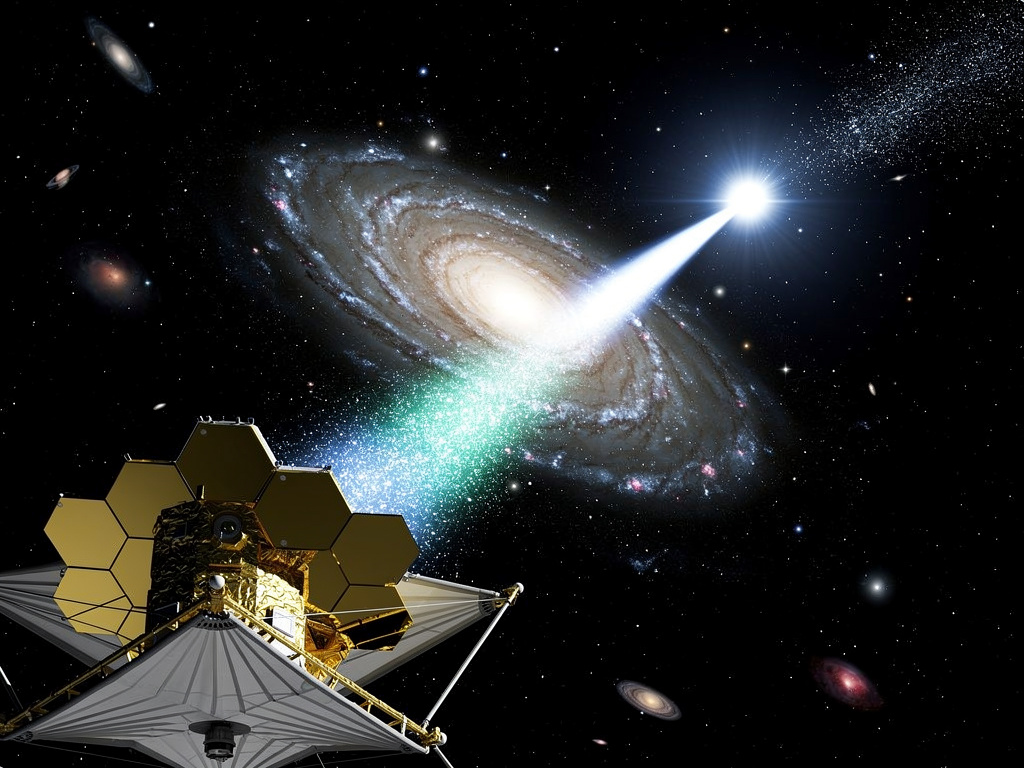
The Cosmic Outlaw: James Webb’s Revelation of a Supermassive Black Hole on the Run
In the vast expanse of the universe, where galaxies collide and stars are born and die, astronomers have long theorized about the chaotic behaviors of supermassive black holes. These colossal entities, often lurking at the hearts of galaxies, can sometimes be ejected from their homes through violent gravitational interactions. Now, for the first time, the James Webb Space Telescope (JWST) has confirmed the existence of such a runaway supermassive black hole, hurtling through space at an astonishing 2.2 million miles per hour. This discovery, detailed in a recent report from Space.com, marks a pivotal moment in our understanding of black hole dynamics and galactic evolution.
The black hole in question, with a mass equivalent to 10 million suns, was first spotted careening away from its host galaxy, leaving behind a trail of newly formed stars. This phenomenon was initially observed through ground-based telescopes, but it was JWST’s infrared capabilities that provided the definitive confirmation. Researchers describe the scene as the black hole pushing a massive plume of gas and dust ahead of it, compressing the material into conditions ripe for star formation. As reported in the same Space.com article, this runaway object is not just escaping; it’s actively reshaping the interstellar medium in its path.
The discovery stems from observations of a peculiar structure dubbed the “Cosmic Owl” due to its owl-like appearance in certain imaging. Within this galactic grouping, the black hole’s trajectory suggests it was flung out following a merger event involving three supermassive black holes. Such triple mergers are rare, but they can result in one black hole being ejected at tremendous speeds, as gravitational waves carry away momentum asymmetrically.
Unraveling the Mechanics of Ejection
To appreciate the significance of this find, it’s essential to delve into the physics of black hole ejections. Supermassive black holes typically reside at galactic centers, anchored by immense gravitational pull. However, when galaxies merge, their central black holes can spiral toward each other, eventually coalescing. In cases involving three black holes, the dynamics become more complex, often leading to a slingshot effect that propels one outward.
JWST’s Near-Infrared Spectrograph (NIRSpec) played a crucial role in analyzing the light from the trailing stars and the black hole’s wake. Data revealed Doppler shifts indicating high velocities, confirming the black hole’s speed at about 1,000 kilometers per second. This aligns with predictions from simulations, but seeing it in action provides empirical evidence that theorists have sought for decades.
Comparisons to previous candidates highlight why this confirmation is groundbreaking. Earlier observations, such as those from the Hubble Space Telescope, hinted at possible runaways, but lacked the resolution or wavelength coverage to rule out alternatives. JWST’s superior sensitivity in infrared has pierced through cosmic dust, offering clarity that was previously unattainable.
A Trail of Stellar Births
One of the most intriguing aspects of this discovery is the black hole’s role in star formation. As it barrels through space, the supermassive object compresses gas clouds, triggering gravitational collapse and igniting new stars. This process creates a luminous trail stretching over 200,000 light-years, visible as a streak of young, hot stars.
Astronomers, as noted in a piece from Gizmodo, liken this to a cosmic plow, tilling the interstellar soil and sowing seeds of stellar nurseries. The black hole’s immense gravity pulls material along, but the compression at the front leads to rapid star birth, a phenomenon rarely observed in such isolation.
This observation challenges traditional models of star formation, which often emphasize galactic environments or supernova triggers. Here, a solitary black hole acts as a catalyst, suggesting that ejected black holes could contribute significantly to the universe’s stellar population over cosmic timescales.
Implications for Galactic Evolution
The confirmation opens new avenues for studying black hole populations and their influence on galaxy formation. If runaways are more common than thought, they could explain some unexplained high-velocity objects and peculiar galactic structures observed in deep-field surveys.
Furthermore, this discovery ties into broader questions about the early universe. JWST has already revealed rapidly growing black holes in ancient epochs, as covered in a NASASpaceFlight.com report on a black hole from just 700 million years after the Big Bang. Linking these findings, ejected black holes might seed new galaxies or disrupt existing ones, influencing the cosmic web’s architecture.
Industry insiders in astrophysics are buzzing about the potential for follow-up observations. Proposals for time on JWST and complementary telescopes like the upcoming Nancy Grace Roman Space Telescope aim to hunt for more runaways, potentially mapping their distribution and ejection rates.
Hidden Monsters in Infrared Light
Parallel discoveries underscore JWST’s prowess in unveiling concealed cosmic phenomena. In a related find, the telescope identified a supermassive black hole hidden within a “Jekyll and Hyde” galaxy, appearing benign in visible light but monstrous in infrared. This, detailed in Live Science, suggests many such objects might evade detection without advanced infrared imaging.
The runaway black hole’s confirmation builds on this, demonstrating how dust-obscured regions can hide dynamic events. By penetrating these veils, JWST is rewriting our inventory of black holes, from quiescent lurkers to high-speed fugitives.
Social media platforms like X (formerly Twitter) reflect public fascination, with posts from users and outlets amplifying the news. For instance, accounts sharing updates on JWST discoveries express awe at the black hole’s speed and star-forming wake, indicating widespread interest beyond academic circles.
Theoretical Ramifications and Future Probes
Theorists are now refining models to incorporate this empirical data. Simulations must account for the precise conditions leading to ejections, including the role of gravitational waves detected by facilities like LIGO. This runaway provides a real-world testbed for predictions about wave emissions during mergers.
Moreover, the black hole’s path through the Cosmic Owl galaxies offers insights into intergalactic medium interactions. As it traverses relatively empty space, its effects on sparse gas could inform studies of cosmic reionization and the universe’s thermal history.
Looking ahead, astronomers anticipate that JWST’s ongoing surveys will uncover more such phenomena. The telescope’s ability to observe in multiple wavelengths allows for comprehensive spectral analysis, crucial for distinguishing runaways from impostors like active galactic nuclei.
Challenges in Observation and Interpretation
Despite the excitement, challenges remain in interpreting these observations. The vast distances involved mean that light from these events has traveled billions of years, capturing snapshots from the universe’s youth. Disentangling redshift effects and foreground contamination requires sophisticated data processing.
Collaboration across institutions is key. Teams from NASA, ESA, and various universities pooled resources for this confirmation, as highlighted in reports from Mid-Day. Such partnerships underscore the global effort needed for cutting-edge astrophysics.
Critics note that while this is the first confirmed runaway, statistical rarity might limit immediate follow-ups. However, with JWST’s queue of observations, the hunt is on, potentially leading to a catalog of ejected black holes.
Broader Cosmic Context and Analogies
Placing this discovery in context, it’s worth noting JWST’s track record of black hole revelations. Earlier this year, it spotted mergers of black holes from the universe’s infancy, as shared in posts on X from engineering-focused accounts. These findings collectively paint a picture of a dynamic cosmos where black holes are not static anchors but active participants in evolution.
Analogies to terrestrial phenomena help conceptualize the scale. Imagine a bowling ball shot from a cannon through a field of cotton candy, compressing and igniting it along the way—this crudely mirrors the black hole’s stellar trail.
For industry insiders, the implications extend to technology transfer. Advances in infrared detection honed for JWST could enhance Earth-based applications, from medical imaging to environmental monitoring.
Echoes from the Early Universe
Tying back to the runaway’s origins, the triple black hole merger likely occurred in the early universe, a period JWST is uniquely equipped to probe. Discoveries like the rapidly growing black hole in galaxy LRG-z8.6, as per NASASpaceFlight.com, suggest that such ejections might have been more frequent when galaxies were merging prolifically.
This raises questions about the seeding of supermassive black holes. Were they born big, or did they grow through mergers and ejections? The runaway offers clues, its isolation preserving a record of its violent past.
As research progresses, expect debates on whether this black hole will eventually slow and perhaps anchor a new galaxy, or continue its solitary journey indefinitely.
Pushing the Boundaries of Knowledge
The confirmation has sparked interdisciplinary interest, from particle physicists modeling gravitational interactions to cosmologists simulating universe-scale evolutions. Publications like ZME Science emphasize the black hole’s record-breaking speed and its trail of “baby stars,” captivating both experts and the public.
In the realm of space exploration, this underscores JWST’s value, justifying its hefty investment. With operational costs and data analysis demanding ongoing funding, such breakthroughs bolster arguments for continued support.
Ultimately, this runaway supermassive black hole embodies the universe’s restless nature, reminding us that even the most massive objects can be set adrift by gravitational whims.
Reflections on a Monumental Find
Reflecting on the discovery’s journey, initial hints came from serendipitous observations, evolving into targeted JWST campaigns. The collaborative spirit, evident in shared data and joint publications, exemplifies modern astronomy’s ethos.
For those in the field, this paves the way for refined instruments and missions. Future telescopes might focus on transient events like ejections, capturing them in real-time across the electromagnetic spectrum.
As we peer deeper into the cosmos, findings like this not only expand our knowledge but also inspire wonder at the intricate dance of celestial bodies.


 WebProNews is an iEntry Publication