
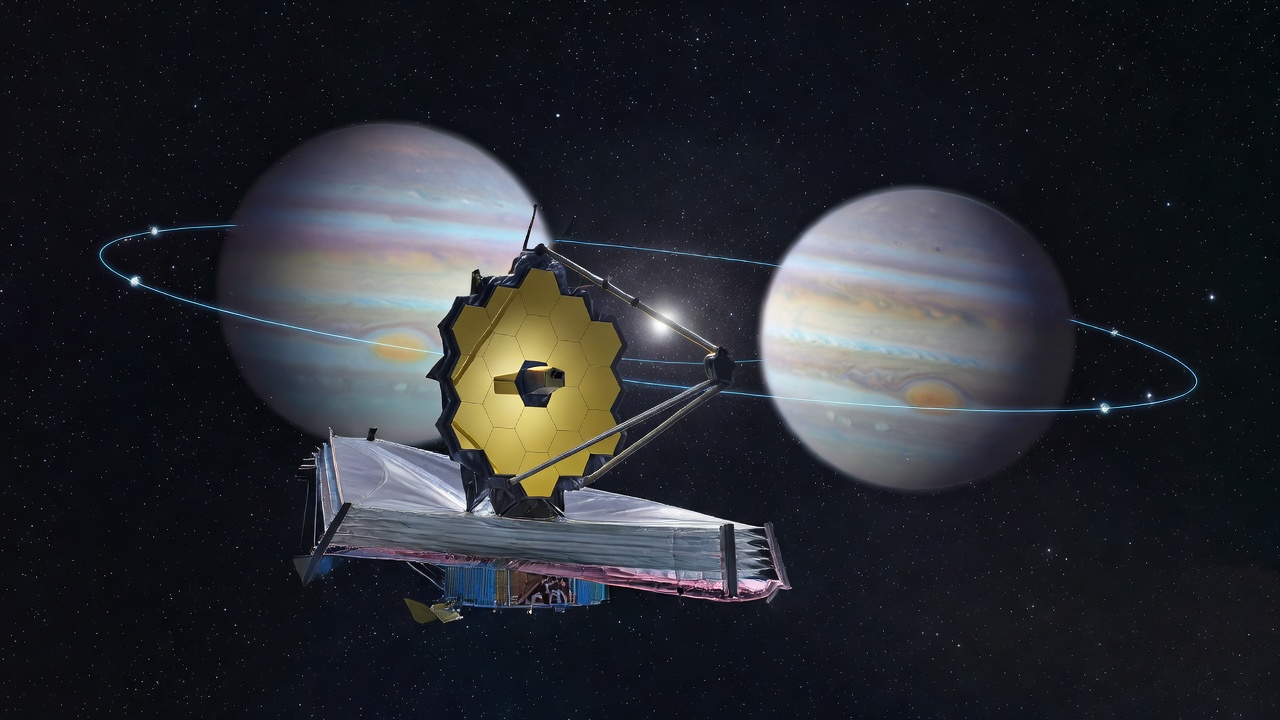
Astronomers have identified two giant planets so diffuse they weigh less than cotton candy. These worlds, each roughly the size of Jupiter, challenge basic ideas about how massive bodies accumulate material in distant star systems. The discovery, announced this week, adds fresh data to the short list of known super-puff exoplanets and offers a rare paired laboratory for testing formation models.
The planets orbit an F7-type dwarf star 1,110 light-years from Earth in the southern constellation Volans. Their densities clock in at 0.038 grams per cubic centimeter for the inner world, TOI-791 b, and 0.047 grams per cubic centimeter for the outer one, TOI-791 c. For scale, Jupiter averages 1.33 grams per cubic centimeter—28 to 35 times greater. Cotton candy itself sits around 0.05 grams per cubic centimeter. Earth, by comparison, measures 5.5 grams per cubic centimeter. These objects are, in short, mostly empty space held together by gravity and a thick envelope of gas.
Extreme Low Density and Rare Resonance
Both planets likely consist primarily of hydrogen and helium. That composition alone does not explain their extreme puffiness. The pair sits in a 5:3 mean-motion resonance. The inner planet completes five orbits while the outer finishes roughly three. Gravitational tugs from this locked configuration produce measurable shifts in transit timing. Those shifts allowed researchers to estimate masses despite the planets’ feeble gravitational pull on their host star.
Lead author George Dransfield of the University of Oxford captured the find’s significance. “Only a handful of these super-puffy planets are known, and it is even rarer to find two in the same system. Their extremely low densities make them fascinating targets for understanding how planetary systems form and evolve,” he said, according to the University of Oxford announcement.
The detection began with NASA’s Transiting Exoplanet Survey Satellite, or TESS. Citizen scientists in the Planet Hunters TESS project flagged the candidates in 2019 and 2023. Confirmation required eight years of follow-up data from ground observatories worldwide. One standout contribution came from the Antarctic Search for Transiting ExoPlanets telescope at Concordia Station. Its location inside the Antarctic Circle let operators capture each planet’s transit—lasting more than 11 hours—in a single uninterrupted window during the long polar night. Those observations rank among the longest continuous planetary transits recorded from the ground.
Prof. Amaury Triaud, also involved in the work, described the system as “a unique laboratory.” He and colleagues plan James Webb Space Telescope observations to probe atmospheric chemistry, specifically carbon-, nitrogen- and oxygen-bearing molecules. Such data could distinguish between competing ideas about how these planets grew. One leading theory holds that they formed farther out in a cold protoplanetary disk, where they gathered massive hydrogen-helium envelopes around modest rocky cores before migrating inward. Alternative explanations involve atmospheric inflation mechanisms or late-stage gas accretion. The resonant pair offers a controlled setting to weigh those scenarios because both worlds experienced the same natal disk conditions yet ended up with slightly different densities.
Only four other star systems are known to host multiple super-puff planets. Fewer than 40 such objects appear among the more than 6,000 confirmed exoplanets. That scarcity underscores why TOI-791 stands out. The new worlds are also the largest yet found with densities below that of cotton candy, pushing the boundary of what astronomers consider possible for gas-giant structure. “These multi-planetary systems are complex, with gravitational interactions between the planets that evolve over very long periods, tens of years or more,” noted Prof. Tristan Guillot of Université Côte d’Azur/Observatoire de la Côte d’Azur. “This discovery highlights the importance of continued international collaboration in astronomy. Bringing together observations from Antarctica, space telescopes and observatories across several continents was essential to revealing the true nature of these extraordinary planets,” he added in the same Phys.org report.
The findings appear in the journal Monthly Notices of the Royal Astronomical Society with the title “ASTEP confirmation of a pair of long-period Jupiter-sized planets with extremely low densities transiting TOI-791.” The paper carries DOI 10.1093/mnras/stag864 and was released online June 25, 2026.
Earlier coverage of the announcement, including details on the shaving-foam comparison and orbital periods of 139 days for b and 232 days for c, ran in outlets such as ABC News and CBS News within the past 48 hours. Those reports drew directly from Associated Press wire copy and the Oxford release. No major new observations have surfaced since publication. Social-media discussion on X has largely echoed the press materials, with users noting the visual absurdity of Jupiter-scale objects that would float in a bathtub if one could find a large enough tub.
Yet the real value lies beyond the headline density numbers. Super-puff planets test the limits of core-accretion theory, the standard model for giant-planet growth. If these objects formed in the conventional way, their cores must have remained small while runaway gas accretion produced bloated atmospheres that failed to contract. Disk instability models or hybrid scenarios might also apply. JWST spectra could reveal atmospheric metallicity and heat-transport efficiency, offering quantitative constraints. The resonance adds another lever: long-term dynamical simulations of the 5:3 lock can backtrack the planets’ migration history within the disk.
Astronomers have cataloged puffy worlds before. Kepler-51, for example, hosts several low-density planets. But those orbit younger, more active stars and show signs of atmospheric escape. The TOI-791 system appears more mature. Its host star is relatively quiet, reducing the chance that stellar irradiation alone inflates the atmospheres. That leaves internal structure or formation pathway as the dominant variables. And because the two planets differ in density despite shared origins, researchers gain a differential experiment. Small differences in core mass, migration timing, or opacity could explain why one is puffier than its neighbor.
Ground-based efforts like ASTEP proved decisive. Traditional observatories struggle with transits longer than a night. The Antarctic instrument sidestepped that limit. Its upgraded mount and stable polar conditions delivered photometric precision high enough to detect the subtle timing variations caused by the resonance. Without those data points, mass estimates would have remained too uncertain for density calculations. The collaboration spanning Oxford, Birmingham, Côte d’Azur, and multiple telescope networks illustrates how distributed teams now extract subtle signals from noisy stellar light curves.
Future work will likely target transmission spectroscopy during transit and emission spectroscopy at secondary eclipse. Both techniques benefit from the planets’ large scale heights—their atmospheres extend far relative to their radii, increasing the signal-to-noise ratio for molecular absorption features. If JWST detects a clear hydrogen-helium atmosphere with low metallicity, that would favor formation beyond the snow line followed by inward migration. High metallicity or evidence of heavy-element enrichment might point instead to erosion of a primordial envelope or collisional stripping.
Either outcome sharpens models used to interpret thousands of other TESS and upcoming PLATO candidates. Super-puffs may represent an early, transient phase of giant-planet evolution that most worlds outgrow as they cool and contract. Or they could mark a distinct population shaped by specific disk conditions. The TOI-791 pair, with its convenient resonance and extreme parameters, tilts the odds toward the latter. Continued monitoring over the next decade will reveal whether the resonance remains stable or eventually breaks, offering a direct view of dynamical evolution in action.
For now the planets remain ethereal beacons 1,110 light-years away. They are probably pale blue or white, their hazy atmospheres scattering starlight in ways no rocky world can match. And they remind researchers that planetary taxonomy still holds surprises. Size alone never told the full story. Density, formation pathway, and dynamical context matter more. With each new low-density giant, the catalog of possible outcomes expands. The cotton-candy planets of TOI-791 have just widened it again.


 WebProNews is an iEntry Publication